Understanding W-2 Forms: Essential Tax Documentation for Employers and Employees
W-2 forms serve as critical federal tax documents that record employee compensation, benefits, and tax withholdings for the prior calendar year. Employers must distribute these forms to workers and the Social Security Administration by January 31st each year.

Every January, businesses with full-time employees must issue W-2 forms summarizing the previous year's wages and payroll tax information. This document ranks among the most widely used federal tax forms in America and remains indispensable for employees filing their annual tax returns.
The W-2 applies exclusively to full-time staff members. Freelancers, independent contractors, and other non-employee workers receive different tax documentation. For guidance on obtaining the official W-2 template, the IRS maintains a dedicated page titled About Form W-2, Wage and Tax Statement.
Managing tax compliance can prove challenging, but modern payroll solutions like Gusto enable businesses to monitor tax data systematically and establish automated workflows. This approach allows organizations to maintain regulatory compliance while directing attention to other operational priorities.
What is a W-2 form used for?
Employees rely on W-2 documentation to complete their federal income tax filings. The form displays total employee compensation during a given calendar year alongside the amounts of federal, state, and local taxes the employer deducted and paid on the worker's behalf.
W-2 forms additionally enumerate applicable fringe benefits, which may encompass health insurance coverage, health savings account contributions, retirement plan contributions, adoption assistance programs, and dependent care assistance benefits.
What is the difference between a W-2 and a W-4?
During the hiring process, new employees complete W-4 forms to specify their tax withholding preferences. This document instructs employers regarding the appropriate tax amount to remove from each paycheck, which then determines the final compensation and deductions for every pay period.
The W-2 operates differently—employers prepare these year-end documents to reflect actual tax amounts withheld from previous paychecks based on the employee's original W-4 submission.
What is the difference between a 1099 and a W-2?
The 1099 family encompasses multiple tax documents designed to report diverse categories of non-employee earnings. Form 1099-NEC, the most prevalent variant, documents compensation paid to independent contractors, freelancers, and gig economy participants. Unlike W-2 recipients, individuals receiving 1099-NECs bear sole responsibility for computing and remitting their own federal, state, and local tax obligations.
While employers do not withhold taxes from 1099 worker payments, they must still furnish these workers with appropriate 1099 documentation showing the prior year's compensation by January 31st, mirroring the W-2 deadline.
Does everyone get a W-2 form?
Full-time employees earning more than $600 during a calendar year qualify for W-2 forms. Workers classified as freelancers, independent contractors, or non-employees receive 1099 forms instead.
What are the benefits of a W-2 employee?
From an employer perspective, W-2 employees offer substantial organizational advantages. These workers dedicate themselves to company objectives during business hours, enabling them to invest greater time and energy into assigned responsibilities, thereby enhancing output quality, operational consistency, and institutional knowledge.
While fostering open dialogue with staff and establishing mutually beneficial arrangements represents sound management practice, employers retain considerable authority over employee work location and scheduling. This control facilitates optimal workforce availability and streamlines communication and coordination.
In exchange for these organizational benefits, W-2 employees receive substantial legal safeguards. These protections typically include overtime compensation, minimum wage guarantees, family and medical leave provisions, worker's compensation coverage, and unemployment insurance eligibility. Employees also gain access to employer-sponsored health, dental, and retirement benefit programs. Organizations must weigh these mandatory advantages against the associated costs of providing comprehensive employee benefits.
When should employees receive their W-2 forms?
Federal regulations mandate W-2 distribution by January 31st annually, meaning employees typically receive their forms near the end of January or early February, depending on delivery method—digital or physical mail. Small business owners managing payroll internally should begin W-2 preparation early in the calendar year to ensure timely employee receipt.
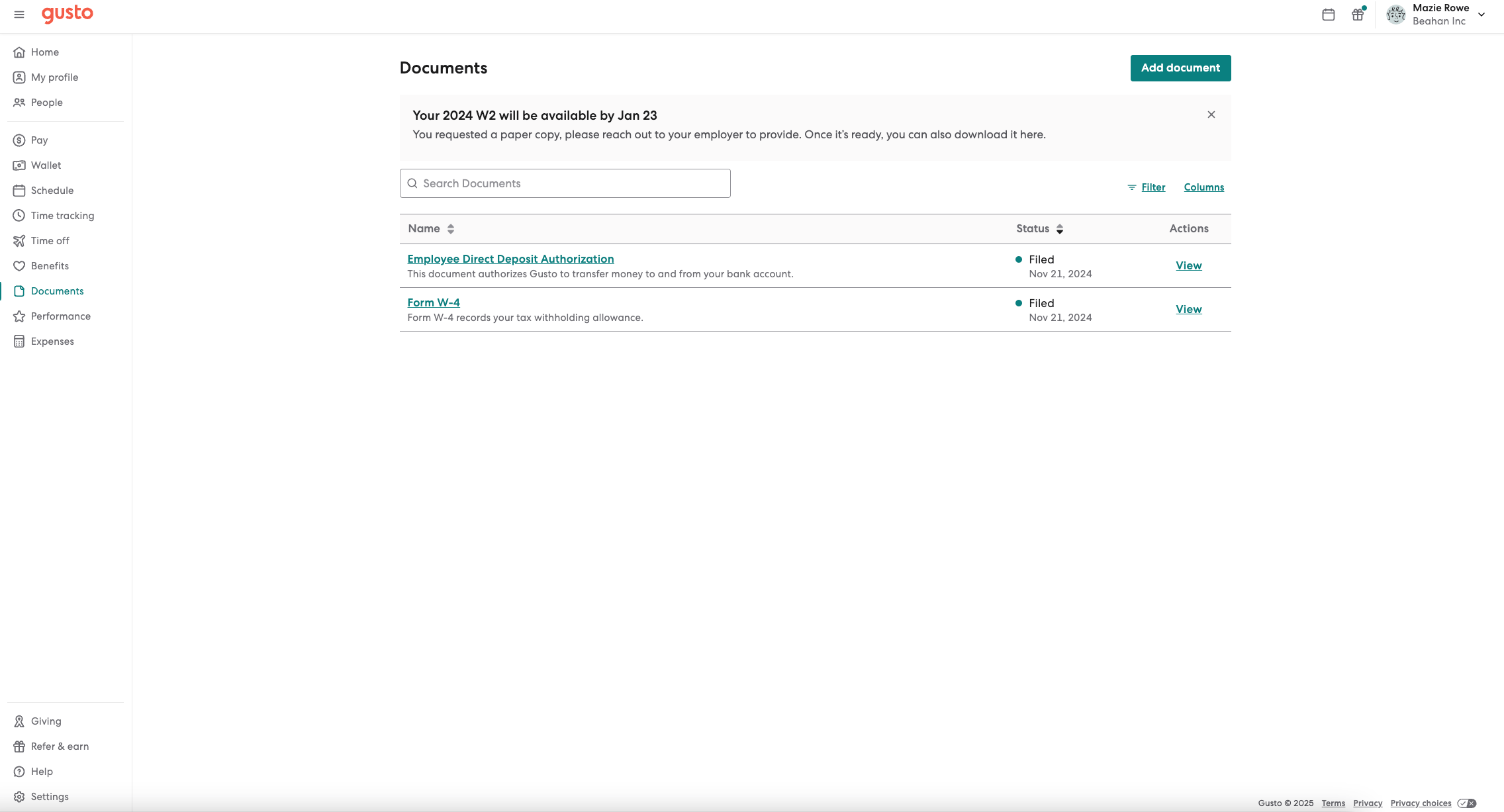
Payroll service providers streamline this process considerably. Most automatically generate and electronically transmit W-2s to employees. Gusto exemplifies this approach by offering an online portal where employees can access their W-2 forms and additional payroll documents whenever needed. Utilizing payroll platforms for W-2 management and delivery conserves time and eliminates the recurring expense of mailing physical copies to staff.
What types of information does a W-2 form contain?
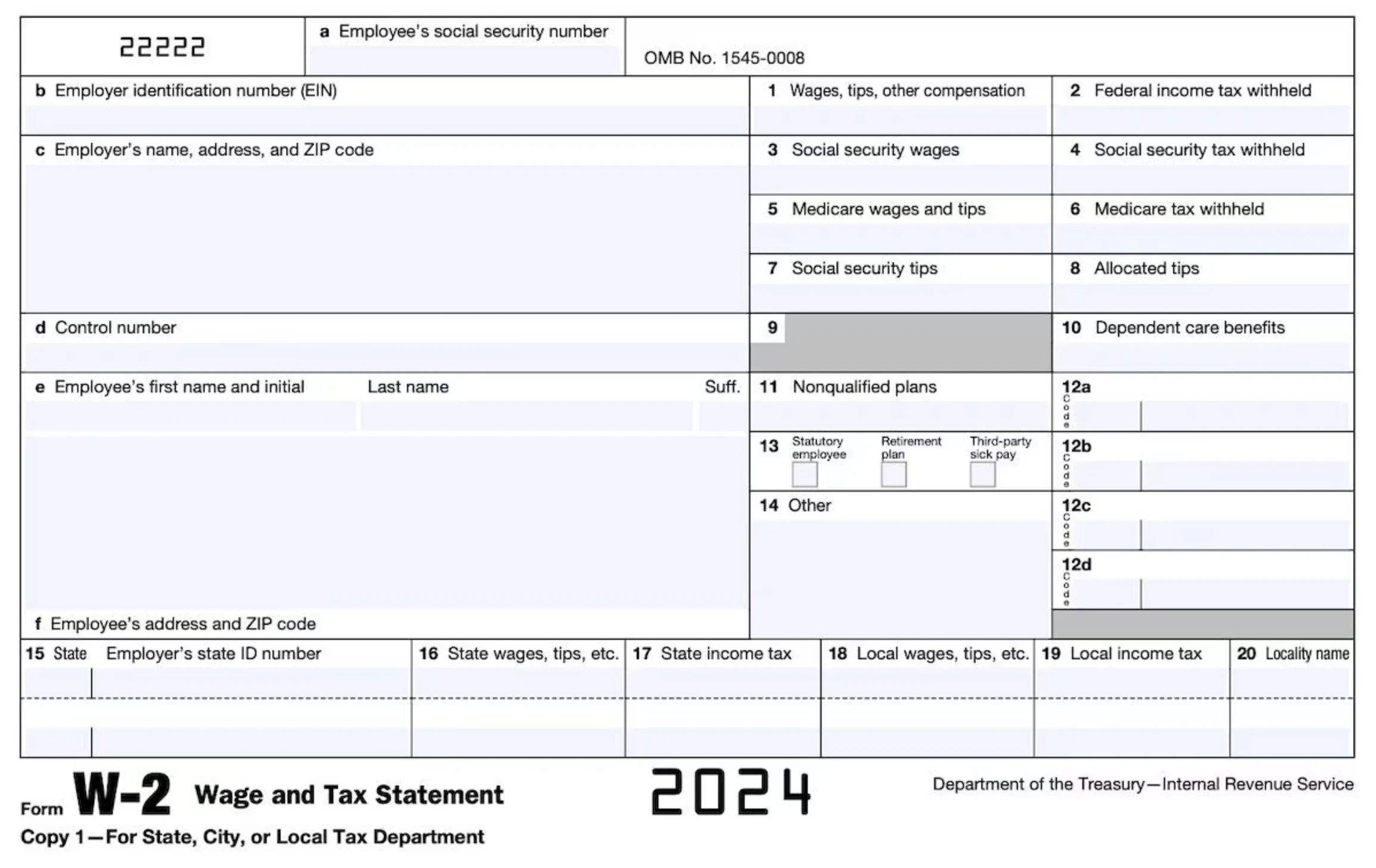
For employers completing W-2s manually, the following breakdown identifies required information and its corresponding form location:
- Box A: Employee's Social Security Number.
- Box B: Employer identification number (EIN).
- Box C: Employer's name, address and zip code.
- Box D: Control number.
- Box E: Employee's first name, middle initial and last name.
- Box F: Employee's address and zip code.
- Box 1: Wages, tips and other compensation that is taxable.
- Box 2: Federal income tax withheld.
- Box 3: Wages that are subject to the Social Security tax.
- Box 4: Social Security tax withheld.
- Box 5: Wages that are subject to the Medicare tax.
- Box 6: Medicare tax withheld.
- Box 7: Social Security tips (how much you reported in tips).
- Box 8: Allocated tips (how much your employer reported paying you in tips).
- Box 9: Used to report advanced income credit payments, which is now defunct, so this box should remain empty.
- Box 10: Dependent care benefits received from employer.
- Box 11: Deferred compensation income from a non-qualified plan.
- Box 12: Other types of compensation or reductions to your taxable income.
- Box 13: Pay that is not subject to income tax withholding.
- Box 14: Other tax information that doesn't fit into any other boxes.
- Box 15: State and employer's state ID number.
- Box 16: State wages, tips, etc.
- Box 17: State income tax.
- Box 18: Local wages, tips, etc.
- Box 19: Local income tax.
- Box 20: Locality name.
How does a W-2 work?
Employers initiate the process by generating W-2 forms, either through manual completion or by leveraging payroll software platforms and services. Once prepared, employers transmit the W-2 to both the employee and the Social Security Administration.
The responsibility then shifts to employees, who utilize W-2 information to prepare their tax returns. The IRS subsequently cross-references employee tax filings against tax payments employers submitted to the agency on behalf of those workers, ensuring consistency and accuracy.
Organizations needing to submit W-2s electronically to the SSA should consult the SSA's W-2 information page for detailed procedures, followed by accessing the Business Services Online portal for submission.
Read more

California Tightens Rules on Robotaxis as Incidents Mount
A new state law sets safety standards and accountability measures for autonomous vehicle operators, requiring local support staff and penalties for blocking emergency responders.

Wawa Elevates Long-Tenured Executive to CIO Role
The convenience store chain has named Bill O'Donnell, a 25-year company veteran, as its new chief information technology officer, putting him in charge of tech strategy, cybersecurity and digital operations.

ServiceNow Debuts Flow, a Conversational Service Desk Built for Speed Over Complexity
ServiceNow is rolling out Flow, a natural language service desk tool that automates employee requests through Slack and Microsoft Teams without requiring a full IT service management overhaul.