Photon Raises $4.5M to Build Agent Infrastructure Over Messaging Apps
The startup, which staged a symbolic funeral for mobile apps, has secured seed funding to expand its platform that lets developers deploy AI agents through iMessage, WhatsApp and other messaging services.
Photon, an AI startup betting that intelligent agents will eventually displace traditional mobile applications, has closed a $4.5 million seed round to accelerate product development. The company, which provides tools for developers to build agents that operate within messaging platforms like iMessage and WhatsApp, marked its funding announcement with an unconventional gesture: a funeral service held in San Francisco on September 17 that doubled as a developer conference.
The event featured panels from Vercel, Stripe, and OpenAI, and included a coffin containing app icons. Co-founder and CEO Daniel Tian described the ceremony as somewhat tongue-in-cheek but reflective of a genuine conviction. "Honestly, it's going to take a while, but I think, directionally, it's inevitable," Tian said of the transition from apps to agents.
Photon's core premise centers on user behavior: rather than downloading new applications, people prefer accessing services through messaging platforms they already use daily. The startup offers developers a toolkit comprising a unified API, an extensible channel framework, a command-line interface (CLI), and an observability suite. These tools enable agents to function across iMessage, WhatsApp, Telegram, SMS, RCS, email, voice, and additional channels.
From Hackathon Project to Platform
The company originated when co-founders Tian and Ryan Zhu, the CTO, were building consumer applications as students. They repeatedly encountered the same obstacle: achieving user discovery for new apps. After developing an iMessage bot that could respond to Tian's friends on his behalf, they released the technology as open source on GitHub. The move attracted thousands of developers, prompting both founders to commit fully to the venture. Tian withdrew from UPenn's M&T program while Zhu left high school to become a visiting student at MIT's Media Lab.

The open source iteration still represents 98% of Photon's usage today. In April, the founders launched a managed platform available through subscription tiers. This hosted version guarantees 99.95% uptime, substantially higher than self-hosted open source deployments. The platform also carries SOC 2 Type II and HIPAA compliance certifications, enabling healthcare-related agent applications.
Growth and Market Traction
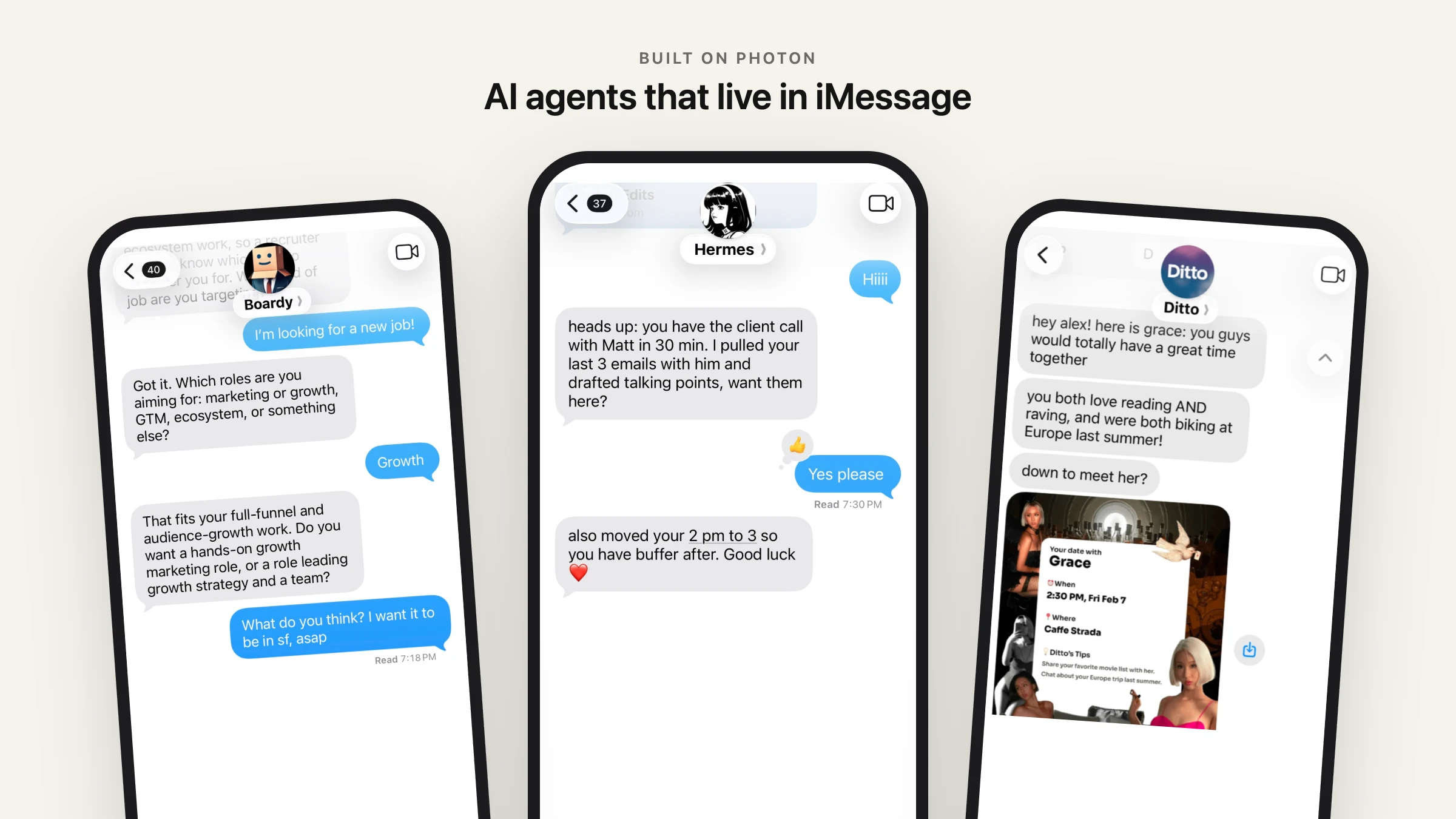
The platform has accumulated more than 40,000 developer registrations and maintains a paying customer base. Users must transition from the free tier to one of three paid subscription levels once usage exceeds 10 users. While specific revenue figures remain undisclosed, Photon reports 10x revenue expansion over four months, churn below 3%, and a 5x increase in messaging volume within the past month.
Current customers span Corgi Insurance, social introductions platform Boardy, Gen Z dating service Ditto, business banking provider Rho, finance assistant Fliptexts, email client Slashy, and various fintech and consumer AI ventures. Technology partners include Vercel, Nous Research (whose Hermes agent uses Photon as its default iMessage layer), Tencent's QClaw and NanoClaw, plus integrations with LangChain, Mastra, Convex, Render, Railway, and Telnyx.
Future Vision: Agent-to-Agent Communication
Tian envisions expansion beyond human-agent interaction toward agent-to-agent connectivity. "I think, in the future, agents will be able to find you the agent that can do the right things — so it's going to be the A-to-A communication layer," he explained. In a travel planning scenario, a user's AI assistant could invoke specialized agents for flight booking or hotel reservations as needed. "It's been pretty powerful to observe the whole A-to-A-to-P [agent-to-agent-to-person] space," Tian added.
The seed round was co-led by Gradient and A* with participation from Vercel, HongShan, Z Fellows, Llama Ventures, Karman, and additional angel investors. Across both hosted and open source versions, Photon's technology reaches millions of end users, according to Tian's estimates.
Read more

Spotify Founder's Health Screening Startup Neko Brings Preventative Medicine to the U.S.
The body-scanning company co-founded by David Ek has arrived in New York with a 300,000-person waitlist and backing from nearly $1 billion in funding.

FieldAI Seeks $700M at $10B Valuation as Robot AI Demand Accelerates
The robotics AI startup is in advanced fundraising talks that would quintuple its valuation from last year, according to sources familiar with the matter.

Tech hiring slows even as employers post record open positions
A surge in IT job listings to three-year highs masks a contraction in actual hiring, with technology sector roles declining and unemployment ticking upward.