The FDE Trap: How Enterprise AI Companies Are Hiding Services Costs in Software Valuations
Enterprise AI vendors are raising massive rounds to deploy armies of engineers into customer offices, masking a services-based business model as software. The industry is betting investors won't ask hard questions about unit economics before the next funding cycle.

A pattern has emerged across enterprise AI fundraising: companies announce breakthrough autonomous platforms, then quietly deploy squads of engineers to customer sites to manually build the workflows their software promised to handle automatically. The funding rounds keep growing, the headcount keeps expanding, and nobody seems to be asking whether the product actually works without human intervention.
The mechanics are straightforward. A vendor sells customers an "AI platform." When the platform fails to deliver autonomously, the company dispatches forward deployed engineers—typically recent computer science graduates—to spend months hand-crafting the specific workflows the marketing materials suggested already existed. The customer receives an invoice labeled "software," which gets booked as annual recurring revenue. The vendor then raises a larger funding round, citing growing ARR, and hires more engineers to repeat the cycle with the next customer.
This structure is not a sustainable business model. It is a staffing operation dressed up with venture capital and a pitch deck.

The business model, decoded
- Sell the customer an "AI platform."
- Discover the platform doesn't actually do the thing on its own.
- Send in the forward deployed engineers: sharp young people with CS degrees who now spend six months hand-building the workflow the website implied already existed.
- Bill the customer for "software."
- Book it as ARR.
- Raise a bigger round because "ARR go up."
- Repeat, forever, with an increasingly large and increasingly expensive engineering org standing between the product and the promise it made.
The industry has stopped pretending this is anything other than what it is. Major players are now fundraising explicitly around deployment capacity. OpenAI committed up to $1.5 billion into a deployment joint venture valued at $10 billion, with additional backing of $4 billion from TPG, Bain Capital, Advent, Brookfield and Goanna. The vehicle, DeployCo, has attracted more than $4 billion in total investment.
Job postings for forward deployed engineers tell the real story. Listings have surged between 800% and 1,000% year over year. Lightcast data reported by Fortune documented an increase exceeding 1,000% from January to August 2026. Financial Times data cited by PYMNTS showed postings rising more than 800% from January to September 2025. Indeed data revealed postings climbing from 643 in April 2025 to 5,330 in April 2026. Total compensation packages are approaching $300,000 in the United States, with Anthropic listing base pay between $280,000 and $320,000 and OpenAI between $185,000 and $300,000 plus equity. Fortune reported certain Anthropic positions reaching $400,000 in total compensation.
Venture investors are calling this "operating leverage." They are wrong. This is a staffing agency that learned to use the word "agentic."
The tell
One question separates genuine product-market fit from what actually exists: "If you pulled the embedded engineer out tomorrow, does the customer still get what they paid for?" If the truthful response is "no, but the ARR is real," then the company has achieved people-market fit, not product-market fit. People-market fit has a harsh ceiling: hiring velocity is finite, and labor costs never fall enough to justify software-level profit margins. Each new customer requires additional headcount, not improved unit economics.
Consider two companies with identical $20 million ARR. One maintains its service with 10 engineers. The other requires 100. Both describe themselves as AI software companies in their investor presentations. The difference emerges in gross margin, customer acquisition cost, and whether those costs decline as the company scales. In one scenario, they do. In the other, they do not.
The bill always comes due
People-market fit feels excellent until someone begins asking uncomfortable questions: What is the fully loaded cost to onboard the next customer? Does that expense decrease as the company grows, or does it simply expand the organization? What happens to gross margin when initial growth slows and headcount can no longer hide behind hypergrowth?
Companies funding their forward deployed engineer armies with fresh nine-figure rounds are betting that these questions remain unasked until after the capital closes and the celebration ends. This is a reasonable wager during a hype cycle. It becomes a dangerous one in a market preparing to scrutinize the details.
Eventually, someone always reads the fine print. A CFO builds a cost-per-deployment model. A CIO compares time-to-value across three vendors instead of accepting a single vendor's demo. An investor performs the unglamorous work of distinguishing software ARR from human-powered ARR on the same financial statement.
The distinction is testable through numbers. Genuine software ARR becomes cheaper to deliver as volume increases. Human-powered ARR does not. OpenAI guaranteed its private-equity backers at the deployment vehicle an annual 17.5% return over five years—a structure fundamentally different from a growth thesis.
The autonomous AI may not exist. But the business model might be autonomous in one respect: it autonomously transfers the cost structure of a services company onto a software valuation, for as long as the funding continues.
Read more
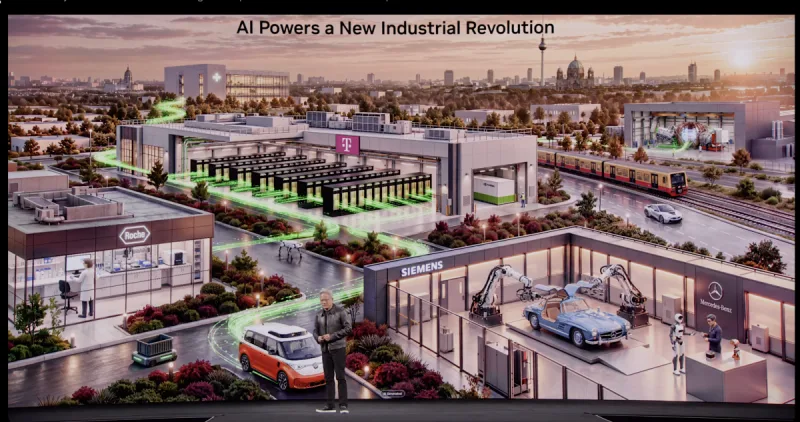
Nvidia shifts from selling chips to selling AI infrastructure as a complete system
At GTC Berlin, Jensen Huang repositioned Nvidia's strategy away from graphics processors toward end-to-end AI deployment, introducing containerized factories, agent security frameworks, and structured data models that address enterprise bottlenecks beyond raw computing power.

Five Technology Shifts Will Push CIOs From Passive Oversight to Active Design
Enterprise leaders must architect AI systems proactively rather than react to rapid technological change, according to Gartner research presented at its IT Symposium/Xpo in Orlando.

Comet Cloud eyes underserved SMBs as GPU inference demand shifts
With AI workloads moving from training to inference, neocloud providers see opportunity in small and midsize businesses that hyperscalers have deprioritized. Comet Cloud is positioning itself to serve that market with dedicated clusters and aggressive pricing.