Nvidia shifts from selling chips to selling AI infrastructure as a complete system
At GTC Berlin, Jensen Huang repositioned Nvidia's strategy away from graphics processors toward end-to-end AI deployment, introducing containerized factories, agent security frameworks, and structured data models that address enterprise bottlenecks beyond raw computing power.
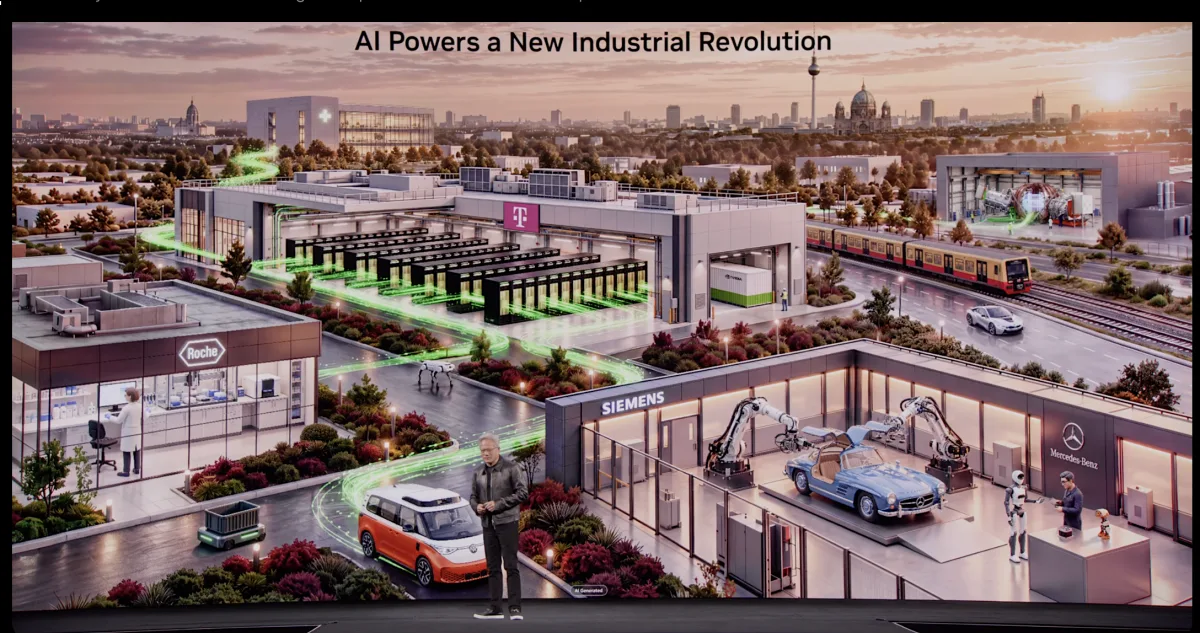
For the past several years, discussions about Nvidia Corp. have revolved primarily around graphics processing units. Industry observers have tracked allocation availability, generational performance improvements, and whether competitors could narrow the technical gap.
At GTC Berlin, Chief Executive Jensen Huang devoted minimal keynote time to silicon itself. Instead, he reframed the challenge: artificial intelligence now faces constraints around deployment velocity, power consumption, security, and leveraging enterprise data. Nvidia plans to address each constraint. "We were early to observe that, in fact, AI is a manufacturing industry," Huang told attendees. "Rather than a tool that's used by us, it is now part of machinery, an infrastructure, factories that are producing intelligence."
Huang's framing connected the announcements from Berlin. Nvidia unveiled DSX POD, a containerized reference design for complete Vera Rubin AI factories assembled by partners; launched the OpenShell Reference Architecture for secure agent deployment; expanded its Agent Toolkit with an Agent Knowledge Foundation and Kumo, a new family of structured-data models; and accelerated telecom partnerships with Nokia and European carriers.
These announcements represent more than individual product releases. Together, they signal Nvidia's transition from supplying the critical component in AI systems to providing the operating model for AI infrastructure itself.
Deployment speed becomes the economic driver
During his keynote, Huang performed a calculation that illuminated the new economics. A one-gigawatt AI factory requires approximately $50 billion in capital and should generate roughly $40 billion in annual revenue. A three-month delay costs about $10 billion in lost revenue. "$10 billion worth of revenue will make anybody anxious," he said.
This framing captures how AI infrastructure economics have shifted. Hardware expense no longer keeps operators awake; idle hardware during installation does. Modern AI deployment resembles construction projects, requiring kilometers of copper and fiber installed by scarce specialized technicians, particularly in Europe.
DSX POD addresses this bottleneck by pre-integrating the factory. Each pod contains seven Vera Rubin NVL72 racks, approximately 20 kilometers of NVLink copper, and 17 kilometers of scale-out networking, all cabled, tested, and ready before shipment. Nvidia claims deployment at a prepared site drops from six months to as little as 14 days.
The strategic positioning matters. DSX POD won't displace gigawatt-scale campuses that benefit from economies of scale. Its target is the hundreds-of-megawatts segment, where operators control sites and power but lack time or regulatory runway for full construction projects. This describes Europe's neoclouds, sovereign AI initiatives, and telecommunications companies. The 14-day timeline assumes site readiness, with deliveries beginning in early 2027. Containerization accelerates integration but doesn't eliminate grid connection delays. DSX POD shifts the critical path; it doesn't eliminate it.
Power efficiency becomes an architectural priority
The DSX platform supporting the pod incorporates engineering work that often escapes public attention. Warm-water closed-loop cooling allows operators in suitable climates to eliminate evaporative cooling towers, which Nvidia estimates conserves 54 million liters of water daily at two gigawatts. DSX MaxLPS directs power to workloads that need it most, delivering equivalent output with up to 30% less power consumption.
DSX Flex warrants closest observation. During the Euro 2020 football match between England and Germany, millions of British households activated kettles at halftime, creating a roughly one-gigawatt grid spike. Currently, when grid operators request data centers to reduce consumption, the process remains largely manual, often involving phone calls. DSX Flex automates this interaction, enabling AI factories to defer or throttle workloads and return capacity to the grid.
This capability matters strategically. Data centers functioning as flexible loads face easier grid connections and greater community acceptance. The sector must transition from treating data centers as pure consumption loads to treating them as grid partners. Hyperscalers are already pursuing this approach; Nvidia's contribution is standardizing it.
Agent security requires infrastructure-level controls
The keynote's second portion shifted from factory infrastructure to the workloads running within it, increasingly agents rather than models. Huang outlined agents as comprising five components: the model, the harness, the sandbox, knowledge, and tools. He emphasized priorities clearly. "The agent is an autonomous system that has access to files, resources and networks, as well as tools, and we need to make sure that the privileges we provide this autonomous system are minimal and that we constantly monitor it," he said.
Much AI safety discussion has focused on model alignment and guardrails, treating a well-trained model as sufficient protection. This assumption fails. No model training can encode the policy requirements of every business and regulated industry. Agents operate probabilistically and will discover unexpected solutions, some touching unintended data or triggering unintended actions. They require deterministic controls enforced outside their decision-making processes.
OpenShell Reference Architecture embodies this principle. Harnesses run on Vera CPUs, models run on Vera Rubin, and BlueField-4 with Nvidia Sentry operates as an isolated monitor between them, capable of stopping an agent within milliseconds. Network professionals recognize this pattern: the industry abandoned host-based security enforcement in favor of network-enforced controls. This approach also enables security teams to author policies specific to their country and industry, particularly relevant for European enterprises.
Ecosystem alignment has been substantial, with CrowdStrike Holdings Inc., Palo Alto Networks Inc., Zscaler Inc., Cisco Systems Inc., and others adding support. A critical question remains whether OpenShell, which is open source and runs on x86 or Arm architectures, can deliver hardware-isolated enforcement without BlueField. Buyers should recognize the distinction between protections available through OpenShell software and the additional hardware enforcement provided by BlueField-4 and Sentry.
Enterprise data transforms agents into operational systems
"What turns these agents into super agents is giving them access to your company's knowledge," Huang said. Enterprises control an estimated 70% of the world's data, yet most remains unprepared for agent consumption. Industry focus has concentrated on documents and PDFs, but significant business value resides in rows and columns within enterprise resource planning, supply chain, and financial systems. Language models lack native capability to reason across such structured data.
Historically, extracting predictions from tables required building custom models for individual questions. Kumo represents a family of predictive models capable of answering multiple "what-if" scenarios against the same dataset. This capability transforms agents from conversational interfaces into operational tools.
This also contradicts the narrative that AI will eliminate software. "Some people said that AI is going to be the end of software, the end of tools companies," Huang said. "It's exactly the opposite." Agents require simulators, solvers, and databases. Companies owning these tools increase their value when packaging them for agent integration.
Telecommunications carriers position themselves as distributed AI infrastructure
Huang articulated an ambitious telecom thesis. "Every single telco in the future, with 100,000 sites representing some 100 gigawatts of distributed telco base stations and data centers, will evolve into a distributed AI network," he said.
European data support this argument. Approximately 20% of Europe's data centers are telco-owned, and more than 1,500 telco facilities could accommodate GPUs. Edge compute initiatives have been pursued before, yet multi-access edge computing failed to deliver meaningful results. The current environment differs fundamentally: real inference workloads exist, and the same platform can run radio networks themselves, as T-Mobile and Nokia demonstrated with their first AI-RAN call on a commercial network.
Physical AI strengthens this case. Robots handle perception locally but occasionally require assistance from on-premises servers, telco edge sites, or cloud resources. This hybrid model suits operators well, provided they develop go-to-market capabilities to commercialize it.
Physical AI has matured beyond experimental status for Nvidia. The company reported physical AI revenue reached nearly $11 billion during the first half of 2026, approximately 30% higher than the entire prior year. Europe, possessing precision manufacturing expertise and a Mittelstand of mid-sized manufacturers, stands to benefit most now that the technology suits companies without dedicated robotics departments.
Telecommunications carriers have encountered opportunities to enhance customer value previously. Cloud, mobile, and internet technologies positioned telcos to transcend commodity status, yet they failed to capitalize. This iteration differs: Nvidia is actively supporting the transition, and Nvidia's upside is substantial if telcos succeed.
Vertical integration meets horizontal openness
Nvidia characterizes its approach as vertically optimized but horizontally open, permitting customers to adopt as much or as little of the stack as desired. Berlin demonstrated how extensively the vertical component now extends, spanning container logistics and grid integration through agent security and structured data models. As Nvidia supplies more of the stack, the openness commitment will face increasing scrutiny, and buyers should enforce accountability.
The strategic message is clear. Nvidia's competitors remain largely focused on chip competition, while Nvidia increasingly competes on time to revenue, supported by an installed base where Volta GPUs from 2019 continue serving customers. For chief information officers and operators evaluating multibillion-dollar AI investments, this durability combined with faster deployment velocity presents a more compelling argument than any performance benchmark.
Read more

Five Technology Shifts Will Push CIOs From Passive Oversight to Active Design
Enterprise leaders must architect AI systems proactively rather than react to rapid technological change, according to Gartner research presented at its IT Symposium/Xpo in Orlando.

Comet Cloud eyes underserved SMBs as GPU inference demand shifts
With AI workloads moving from training to inference, neocloud providers see opportunity in small and midsize businesses that hyperscalers have deprioritized. Comet Cloud is positioning itself to serve that market with dedicated clusters and aggressive pricing.

Era4 builds U.K. AI infrastructure to keep control and cash at home
The British startup is constructing domestically owned data centers to ensure the country retains both operational control of its AI systems and the economic benefits they generate.