Red Hat and Nvidia Deepen Partnership to Protect Autonomous AI Agents in Enterprise Deployments
The two companies announced expanded collaboration at Nvidia's GTC event in Berlin, combining security controls, model governance and hardware support to help enterprises safely deploy autonomous AI agents across hybrid cloud environments.

Red Hat Inc. and Nvidia Corp. have deepened their partnership to address enterprise concerns around securing autonomous artificial intelligence agents, controlling access to AI models and running workloads on Nvidia's forthcoming Vera Rubin data center infrastructure. The expansion, unveiled at Nvidia's GTC conference in Berlin, builds on Red Hat AI Factory with Nvidia by integrating agent runtime controls, model inference software and hardware capabilities across hybrid cloud settings. Red Hat is also working to embed Nvidia's OpenShell Reference Architecture as a native feature within its AI platforms.
Security architecture for autonomous agents
The security framework targets two primary threat vectors: agents operating beyond their intended scope and attackers gaining control of agents through methods including prompt injection or supply chain compromises. Rather than having agents police themselves, the two companies are positioning security controls at the runtime and infrastructure layers, outside the agent itself and sometimes outside the host operating system as well.
An agent shouldn't enforce its own boundaries. Those controls belong outside the agent, in the runtime and the infrastructure beneath it.
John Fanelli, vice president of enterprise software at Nvidia
OpenShell furnishes a sandboxed runtime environment for agents. Below this layer, Nvidia's Sentry security framework operates on the company's BlueField data processing units, leveraging DOCA Argus software to track workload behavior from an isolated hardware security domain.
According to Red Hat's accompanying technical documentation, Argus examines specific host memory structures to track processes, files and network communications without requiring agent software on the host system itself. The integrated security infrastructure can respond to Argus alerts by triggering BlueField policies that isolate affected workloads.
The design extends prior BlueField-3 integration in Red Hat OpenShift 4.22, isolating AI workloads running on server CPUs from networking and security operations running on BlueField's Arm-based processors. When configured to limit host access, this separation strengthens protection of infrastructure controls even if attackers breach the host system.
Red Hat indicates that Sentry can isolate a compromised agent within milliseconds. Offloading monitoring and networking tasks to the data processing unit also decreases CPU load on the host, freeing up processing power for AI workloads.
Model controls
The collaboration also tackles the model infrastructure that agents require for reasoning and decision-making. A joint reference design merges Model-as-a-Service access controls and an AI Gateway with inference engines including vLLM, llm-d, Nvidia Dynamo and Nvidia NIM microservices.
Drawing from Nvidia's Inference Hub reference design, the solution enables self-service model discovery, access policies, rate limiting and subscription tracking. By decoupling access governance from model execution, enterprises can better manage resource quotas, allocate costs and maintain consistent performance in hybrid environments.
The two companies also announced joint backing for Nvidia Nemotron models, including Nemotron 3.5 Super VL, within the vLLM inference and serving engine and Red Hat AI Factory with Nvidia. Red Hat emphasized quantization and speculative decoding methods designed to lower inference latency without compromising model accuracy.
Hardware deployment and OS support
On the hardware front, Red Hat stated that its Enterprise Linux for Nvidia now supports Vera CPUs and is ready for the Vera Rubin platform. Both companies are working toward operating system and platform compatibility ahead of the new hardware's market availability.
A separate operating system blog post noted that RHEL for Nvidia 26.03 adjusts a small number of core packages to support new hardware while preserving standard RHEL userspace and security mechanisms, including Security-Enhanced Linux. Users will have the option to migrate to mainline RHEL without a fresh installation once hardware patches stabilize and merge into the upstream Linux kernel.
Red Hat indicated that the joint use cases, reference designs and agent capabilities are accessible through partners such as Cisco Systems Inc., Dell Technologies Inc. and Lenovo Group Ltd., with ongoing efforts toward native OpenShell integration.
Read more
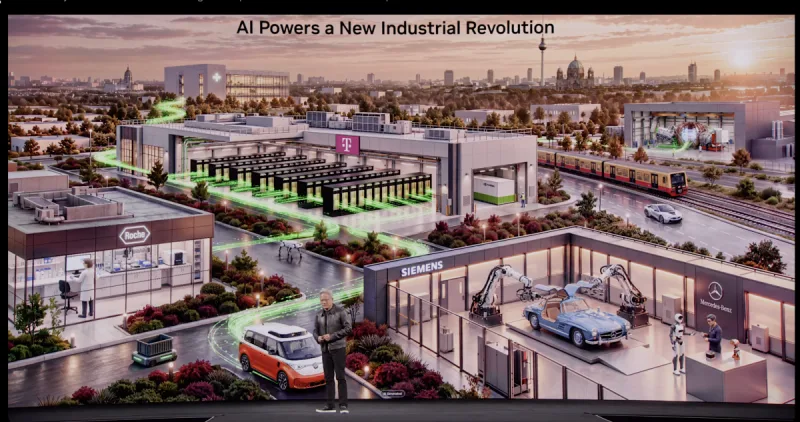
Nvidia shifts from selling chips to selling AI infrastructure as a complete system
At GTC Berlin, Jensen Huang repositioned Nvidia's strategy away from graphics processors toward end-to-end AI deployment, introducing containerized factories, agent security frameworks, and structured data models that address enterprise bottlenecks beyond raw computing power.

Five Technology Shifts Will Push CIOs From Passive Oversight to Active Design
Enterprise leaders must architect AI systems proactively rather than react to rapid technological change, according to Gartner research presented at its IT Symposium/Xpo in Orlando.

Comet Cloud eyes underserved SMBs as GPU inference demand shifts
With AI workloads moving from training to inference, neocloud providers see opportunity in small and midsize businesses that hyperscalers have deprioritized. Comet Cloud is positioning itself to serve that market with dedicated clusters and aggressive pricing.