Physics-Based AI Models Reshape Chip Design Workflows
Vinci4D is deploying pretrained physics foundation models to accelerate semiconductor simulation and analysis, moving beyond traditional finite element methods to handle multiple physical phenomena at once.

Vinci4D Inc. has developed simulation software that applies fundamental physics equations to semiconductor design, departing from conventional approaches like finite element analysis. The platform leverages pretrained physics models to speed up simulations while examining multiple physical effects in parallel.
According to Karthik Aravamudhan, global client director at Vinci4D, the shift matters as the industry moves toward agentic AI. "Vinci is changing how design and analysis is being done from the ground up," Aravamudhan said. "The whole industry is talking about agentic AI and how the workflow automation, the orchestration, happens. That means more simulations, more analysis, a lot more that needs to happen under the hood. Vinci is trying to attack that problem."
Physics foundation models reshape semiconductor design
Physics foundation models are poised to expand their role in chip engineering, Aravamudhan noted. He pointed to a strategic transition from Design Technology Co-Optimization toward System Technology Co-Optimization, treating chip design as part of a broader system rather than an isolated component.
Vinci's approach operates at the physics level itself. "[Vinci] fundamentally tries to solve the problem from the foundational physics level," Aravamudhan explained. "When you're designing, you're trying to understand what the package looks like. While you're designing the package, you're trying to understand what the board looks like. So, you're designing a whole system; you're not just designing one portion of it anymore."
The company trains its models on physics equations rather than proprietary customer data, which limits exposure of sensitive design information during training. The technology also aims to cut simulation time and expense by handling multiple physical phenomena concurrently.
"An average customer today in the whole semiconductor ecosystem tries to solve for a certain physics," Aravamudhan said. "It could be thermal, it can be mechanical and it can by any[thing]. They try to solve one physics at a time because that's the only way it has been known to be possible. That takes a whole long time. What Vinci tries to do with these foundational physics models is try to solve these physics true to what it is and to solve multiple of these at the same time."
Vinci completed a Series B funding round of $250 million at a $1.5 billion valuation, with backing from Advent International, Temasek and Xora as co-leads. The company intends to broaden its market beyond semiconductors into automotive and aerospace sectors.
https://www.youtube.com/embed/IDqIKn1KsBU?feature=oembed
"The funding gives us … the foundation to go after bigger [things]," Aravamudhan said. "From the different physics that we can solve, from having a go-to-market team and a go-to-market approach, it gives us so many different dimensions we can start focusing on. With these big names backing us, it certainly helps a lot and it shows their belief not only in Vinci, but their belief in the technology."
Read more
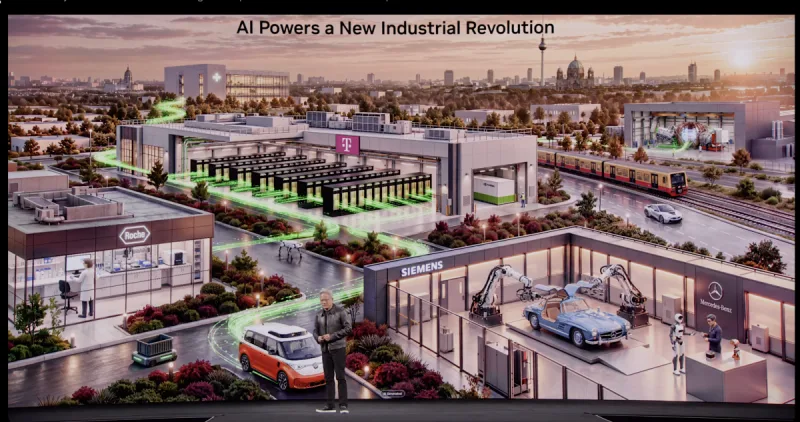
Nvidia shifts from selling chips to selling AI infrastructure as a complete system
At GTC Berlin, Jensen Huang repositioned Nvidia's strategy away from graphics processors toward end-to-end AI deployment, introducing containerized factories, agent security frameworks, and structured data models that address enterprise bottlenecks beyond raw computing power.

Five Technology Shifts Will Push CIOs From Passive Oversight to Active Design
Enterprise leaders must architect AI systems proactively rather than react to rapid technological change, according to Gartner research presented at its IT Symposium/Xpo in Orlando.

Comet Cloud eyes underserved SMBs as GPU inference demand shifts
With AI workloads moving from training to inference, neocloud providers see opportunity in small and midsize businesses that hyperscalers have deprioritized. Comet Cloud is positioning itself to serve that market with dedicated clusters and aggressive pricing.