Motive's Agents Platform Shifts Physical AI From Alerts to Autonomous Action
Motive has launched Agents, an autonomous system that automatically responds to operational issues in fleet management and physical industries without waiting for human intervention. The move signals a broader industry shift toward AI systems that execute decisions rather than merely reporting them.
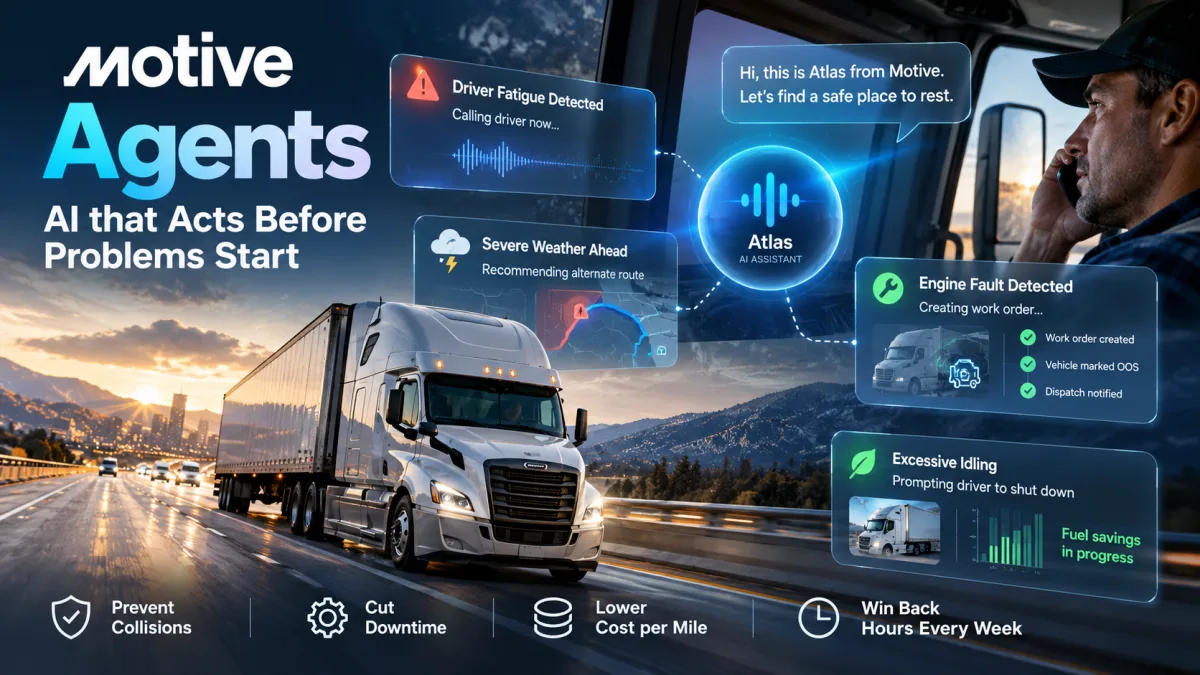
Motive Inc., a San Francisco-based AI platform for physical operations, unveiled Agents this week—a capability designed to automatically handle safety, maintenance and operational issues before they become accidents, expensive equipment failures or operational disruptions. Rather than generating alerts that require human action, the system proactively contacts drivers, creates maintenance orders and coordinates responses across fleet operations.
The technology leverages operational data already flowing through Motive's platform to spot emerging problems and trigger corrective measures. This addresses a fundamental challenge in transportation, logistics and construction: companies accumulate vast amounts of operational data but still depend on manual processes to act on it.
Motive estimates that preventable operational problems cost companies roughly $46 billion annually through vehicle downtime, compliance violations and unnecessary idling. The company's 2026 ROI Report found that 42% of surveyed organizations identify operational inefficiencies and excessive administrative work as their top concern.
Our customers don't need another alert. They need action. The data that prevents collisions and breakdowns already lives in Motive. Agents put it to work the moment it matters, so teams can grow without adding headcount.
Hemant Banavar, chief product officer at Motive
Agents are accessible to Motive customers immediately. The company is showcasing the technology this week at the American Trucking Association's Management Conference & Exhibition in Charlotte, North Carolina. Looking ahead to early 2027, Motive intends to introduce natural-language agent creation, enabling customers to describe workflows in plain English and have the system build the corresponding automation—a step beyond today's rule-based and AI-assisted options.
This announcement extends earlier 2026 releases, including the Atlas AI assistant, AI-powered automation capabilities and expanded edge computing features. Motive has not disclosed independently verified performance metrics for the newly released Agents platform.
The Shift From Insight to Execution
Motive's move reflects a significant evolution in enterprise AI: the transition from systems that surface insights to systems that perform work. For decades, enterprise software prioritized data collection, visibility and dashboards for business management. Cloud computing made data more accessible; generative AI simplified querying and interpretation. Agentic AI now addresses a different challenge: eliminating the gap between recognizing a problem and responding to it.
The deeper value proposition extends beyond automating isolated tasks. It centers on compressing the operational latency between problem detection, decision-making and response execution. This distinction matters significantly for physical operations economics.
Physical businesses have invested heavily in sensors, cameras, telematics and operational software that generate enormous data volumes. Yet converting that information into action still relies heavily on human coordination. When intelligent systems can trigger approved operational responses instead of merely generating alerts, the unit economics shift. Fleet managers can oversee more vehicles; maintenance teams can intervene earlier; organizations can improve asset utilization without proportional increases in administrative overhead.
The genuine opportunity in physical AI may lie not in automating individual workflows but in redesigning operating models around intelligence that continuously translates signals into action.
Architecture Designed for Physical-World Demands
Physical AI operates under fundamentally different constraints than traditional digital AI applications. In digital environments, an incorrect email from a language model creates inconvenience. In physical operations, a safety system failure can have serious consequences. This reality demands real-time processing, dependable models and intelligence integrated directly into physical environments.
Motive has invested in edge AI technologies, including its AI Dashcam Plus and AI Omnicam Plus, which embed computer vision and processing capabilities into and around vehicles. The company partners with Qualcomm, whose chips power these devices. According to Motive's claims, its latest hardware runs three times more computer vision models than competing devices in its category, expanding the range of conditions the system can detect.
Motive's architecture combines edge processing with cloud-connected operational systems and AI-driven workflows. The edge detects events; the platform supplies operational context; Agents initiate approved actions; Atlas enables direct communication with personnel. This integrated stack could become a meaningful competitive advantage as agentic AI expands into industries where reliability, real-time decision-making and safety are paramount.
Measurable Economics in Physical Operations
The real opportunity in AI extends beyond technological innovation to producing measurable economic value. Physical operations offer clearer ROI metrics than many early generative AI applications. Companies can quantify AI's impact through cost per mile, vehicle uptime, accident rates, fuel consumption, maintenance expenses and labor productivity.
Motive has documented concrete results. Phoenix Global, a metals and mining company, reduced safety incidents by 40% while improving operational performance. Ernst Concrete, an 80-year-old construction materials business, deployed Motive's AI cameras and video coaching following costly safety incidents and achieved $6.5 million in savings and a 2,000% return on investment over 13 months. Motive also reports significant reductions in collisions and accident-related costs among its customer base, along with improvements in vehicle uptime and administrative productivity.
Agents could extend these benefits by reducing the time and human intervention required to resolve detected problems.
Redefining Frontline Work
Much AI discussion centers on replacing white-collar positions. Physical AI presents a different narrative: using intelligence to augment workers operating vehicles, machinery and industrial equipment. A driver previously relying on personal experience or supervisor contact can now receive contextual guidance from an AI assistant. A fleet manager previously spending hours reviewing alerts and contacting drivers can increasingly focus on exceptions, higher-value decisions and operational improvements.
This shift changes where human judgment applies. Rather than removing humans from processes, it redirects human expertise toward decisions requiring judgment. Agents will require clear operating policies, reliable escalation mechanisms, transparency and human accountability. The industry faces considerable work ahead in demonstrating how autonomous systems can operate safely and predictably in physical environments.
From Intelligence Systems to Action Systems
Enterprise computing has evolved through distinct phases. Systems of record captured business information. Systems of engagement improved how people interact with that information. Systems of intelligence introduced AI-powered analysis, context and recommendations. Agentic AI now adds an execution layer: instead of showing managers what happened or recommending actions, AI systems initiate the next operational step within defined business policies.
Motive exemplifies this evolution in physical operations. The company's current approach remains relatively constrained: customers define triggers and actions while AI interprets operational conditions and assists in executing workflows. The longer-term roadmap moves toward goal-oriented agents that determine how to achieve business outcomes—a substantially larger architectural transition introducing important questions about governance, explainability, human oversight and accountability.
The strategic opportunity is evident. Competitive advantage in enterprise agentic AI may increasingly stem from combining domain-specific data, real-time context and reliable execution capabilities. Foundation models will continue improving, but they represent only part of the value chain. Systems understanding a business's unique operating environment and executing appropriate actions may ultimately capture more durable value.
For Motive, its integrated hardware, software and AI strategy provides a foundation for pursuing this opportunity. The challenge ahead involves proving that Agents deliver incremental operational improvements while maintaining the reliability required for physical-world applications.
The Larger Opportunity
The significance extends beyond another AI agent entering the market. It signals an emerging operating model where intelligence becomes an active participant in how physical businesses function. For Motive, the opportunity involves converting years of investment in edge computing, computer vision and operational data into a system that not only understands what's happening but coordinates what happens next.
The physical economy could become one of the most compelling testing grounds for agentic AI because outcomes are tangible, economics are measurable and execution consequences are immediate. The next wave of AI value will be measured not by how many agents companies deploy but by how much operational friction they eliminate and how effectively intelligence translates into real-world outcomes.
Read more
Nvidia shifts from selling chips to selling AI infrastructure as a complete system
At GTC Berlin, Jensen Huang repositioned Nvidia's strategy away from graphics processors toward end-to-end AI deployment, introducing containerized factories, agent security frameworks, and structured data models that address enterprise bottlenecks beyond raw computing power.

Five Technology Shifts Will Push CIOs From Passive Oversight to Active Design
Enterprise leaders must architect AI systems proactively rather than react to rapid technological change, according to Gartner research presented at its IT Symposium/Xpo in Orlando.

Comet Cloud eyes underserved SMBs as GPU inference demand shifts
With AI workloads moving from training to inference, neocloud providers see opportunity in small and midsize businesses that hyperscalers have deprioritized. Comet Cloud is positioning itself to serve that market with dedicated clusters and aggressive pricing.