Inception's Mercury 3 Claims Speed Advantage Over OpenAI and Anthropic Models in Benchmark Tests
Inception AI released Mercury 3, a diffusion-based language model that the startup says outperforms OpenAI's GPT-6 Luna and Anthropic's Claude Haiku 5.5 on most benchmarks while running significantly faster.
Inception AI Inc., a startup built around diffusion language models, unveiled Mercury 3 as its latest flagship offering today. According to testing conducted by the company, Mercury 3 surpassed both OpenAI Group PBC's GPT-6 Luna and Anthropic PBC's Claude Haiku 5.5 in eight out of twelve benchmark tests, while delivering performance improvements of four to eight times faster.
The launch directly addresses skepticism surrounding Inception's core technology approach. Co-founder and Chief Executive Stefano Ermon noted that since Mercury 1's debut, the most frequent question has been whether "diffusion can scale." Ermon contends that performance constraints stem from "compute and data, not fundamental algorithmic barriers."
How Mercury 3 Works Differently
The architectural difference between Mercury 3 and its competitors lies in token generation. GPT-6 Luna and Haiku 5.5 generate responses sequentially, producing one token at a time. By contrast, Mercury models generate an entire response initially, then refine all positions simultaneously across multiple iterations. Inception measured Mercury 3 at 1,068 tokens per second on Nvidia Corp. graphics processing units, compared to approximately 240 tokens per second for Haiku 5.5 and roughly 130 for GPT-6 Luna under identical test conditions.
Model Specifications and Capabilities
Inception has withheld specific parameter information for Mercury 3, disclosing only that it exceeds Mercury 1's size by more than 40 times. The model supports a context window of 1 million tokens, a substantial increase from Mercury 2.5's 260,000-token capacity. Ermon indicated that work on Mercury 3's successor has already commenced.
Benchmark Performance
Mercury 3 demonstrated its strongest performance advantage in coding tasks. On SWE-Bench Atlas, the model achieved a score of 51.1 compared to 33.3 for GPT-6 Luna and 32.3 for Haiku 5.5. However, the model underperformed on DeepSWE, a second coding benchmark, scoring 46.3 against Haiku 5.5's 51.6. Mercury 3 also fell short on one long-context evaluation. GPT-6 Luna won two additional tests by margins of less than one point each. Independent verification of these results has not yet been published by external research groups.
Early Adoption and Real-World Performance
Initial customers have begun integrating Mercury 3 into applications where latency directly impacts user experience. Kuan Zou, founder and chief executive of real-time search platform Octen AI, emphasized that on smart glasses "an answer that takes five seconds feels broken." Testing at Octen showed a median generation time of 0.9 seconds. At tutoring platform RevisionDojo, co-founder and Chief Technology Officer Michael Tong reported that hints and corrected answers now arrive in approximately one second.
Pricing and Availability
Mercury 3 carries a base price of 20 cents per million input tokens and 70 cents per million output tokens, with cached input priced 90% lower. A limited-time promotional offer currently reduces both rates by half. For comparison, GPT-6 Luna and Haiku 5.5 are each priced at 10 cents and 50 cents respectively for standard queries. The model is accessible through Inception's proprietary platform as well as through OpenRouter Inc., Baseten Labs Inc., and Vercel Inc. Existing code written for OpenAI's application programming interface requires only minimal modifications to work with Mercury 3.
Company Background and Acquisition Interest
Inception operates as a venture-backed startup founded in 2024 by Ermon alongside fellow computer science professors Aditya Grover and Volodymyr Kuleshov. Microsoft Corp.'s M12 venture arm participated in the company's $50 million funding round, which Menlo Ventures led in November.
According to reporting by Reuters, Microsoft held acquisition discussions with Inception as recently as May, with the startup seeking a valuation exceeding $1 billion. Space Exploration Technologies Corp. reportedly also approached the company regarding a potential acquisition. Neither Microsoft nor SpaceX has announced a completed transaction.
Read more
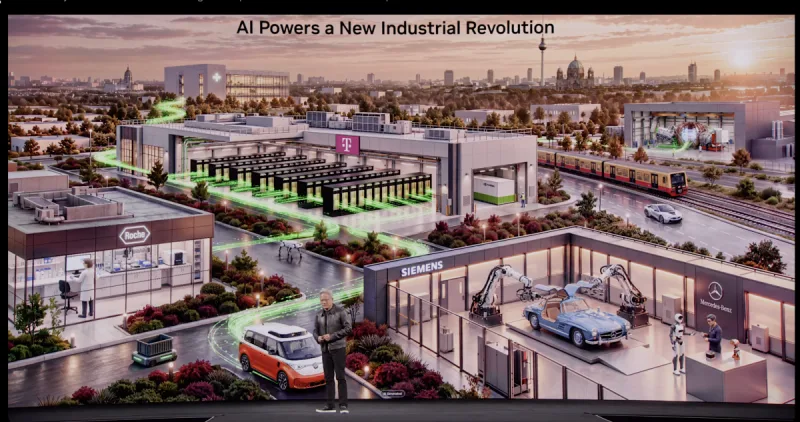
Nvidia shifts from selling chips to selling AI infrastructure as a complete system
At GTC Berlin, Jensen Huang repositioned Nvidia's strategy away from graphics processors toward end-to-end AI deployment, introducing containerized factories, agent security frameworks, and structured data models that address enterprise bottlenecks beyond raw computing power.

Five Technology Shifts Will Push CIOs From Passive Oversight to Active Design
Enterprise leaders must architect AI systems proactively rather than react to rapid technological change, according to Gartner research presented at its IT Symposium/Xpo in Orlando.

Comet Cloud eyes underserved SMBs as GPU inference demand shifts
With AI workloads moving from training to inference, neocloud providers see opportunity in small and midsize businesses that hyperscalers have deprioritized. Comet Cloud is positioning itself to serve that market with dedicated clusters and aggressive pricing.