Google's TorchTPU Challenge: Breaking PyTorch's Nvidia Lock-In
Google has launched TorchTPU, a specialized PyTorch variant designed to run AI workloads on its Tensor Processing Units, directly challenging Nvidia's dominance in AI computing infrastructure.
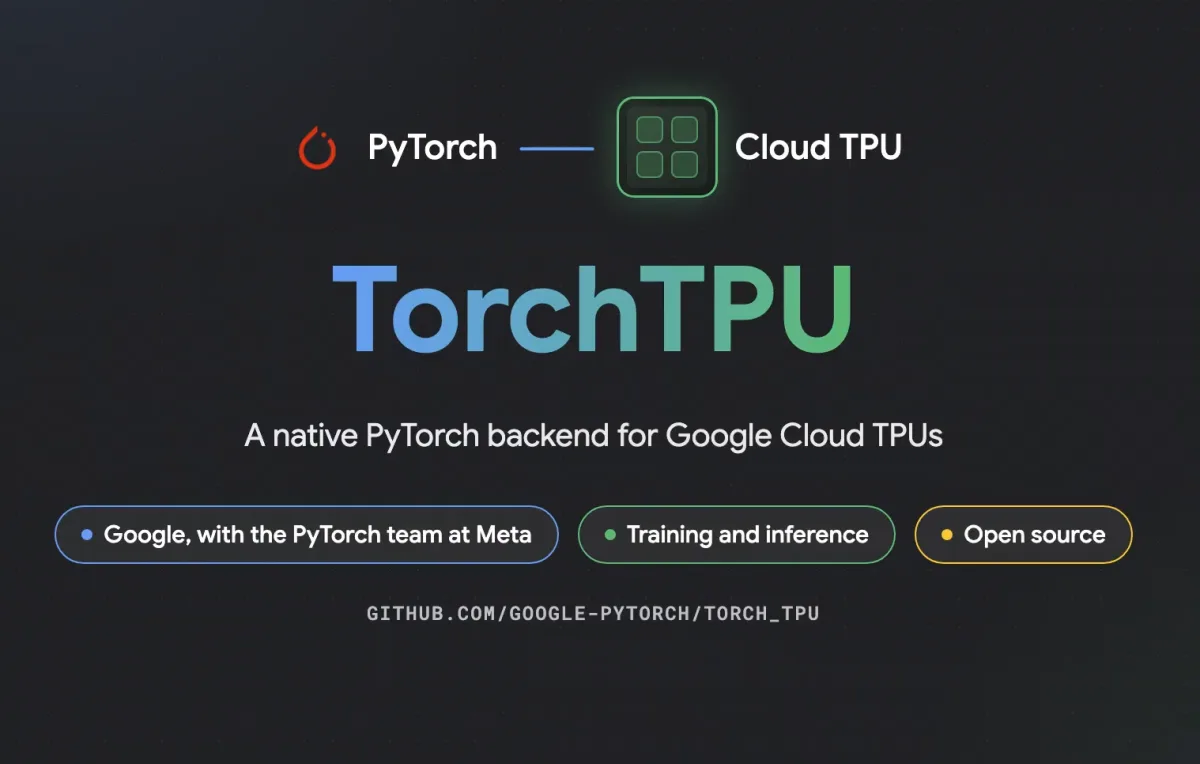
Google is making a deliberate move to weaken Nvidia's commanding position in AI infrastructure by introducing TorchTPU, a custom implementation of the widely-used PyTorch framework tailored for its own Tensor Processing Units. The initiative targets what has become Nvidia's most significant competitive moat: the fact that the overwhelming majority of AI development happens on its GPUs.
PyTorch, the open-source machine learning toolkit created by Meta in 2016, powers development of more than 85% of AI applications globally. When Meta first built the framework, Nvidia's GPUs were already the industry standard for AI research, so the platform was engineered around that hardware from the start. Even after Meta transferred stewardship to the Linux Foundation in 2022, this Nvidia-centric design remained unchanged.
TorchTPU addresses this constraint by providing developers with a pathway to build and deploy models on Google's specialized AI chips. The tool simplifies the process significantly—developers can adapt existing applications to run on TPUs through basic configuration changes rather than rewriting entire codebases. This approach directly undermines the switching costs that have locked developers into Nvidia's ecosystem.
Google is not the only cloud provider attempting to break Nvidia's grip. Amazon Web Services unveiled TorchNeuron earlier this week, which similarly enables AI workloads to run on Amazon's Trainum chips. AWS went further by contributing code to the core PyTorch project itself, aiming to decouple critical functionality from Nvidia's GPUs and make the framework more hardware-agnostic.
https://www.youtube.com/embed/u4n558Ul6w0?feature=oembed
Google's strategy incorporates additional layers beyond TorchTPU. The company coordinated closely with Meta, Hugging Face, and startups Inferact and RadixArk—creators of vLLM and SGLang respectively—to ensure compatibility across developer tools and libraries. This collaboration removes another barrier that has traditionally favored Nvidia-based workflows.
The company also introduced the TPU agent suite, a tool designed to facilitate migration of AI applications to Google Cloud while automatically resolving compatibility issues during the transfer. Additionally, Google updated LiteRT, its existing platform for building AI applications that run on edge devices like smartphones and laptops, to support PyTorch-based models.
While these moves represent a meaningful challenge to Nvidia's entrenched position, converting millions of developers away from GPUs will require sustained effort. Nevertheless, Google's comprehensive approach—combining framework compatibility, migration tools and edge device support—suggests confidence in gradually eroding Nvidia's long-term advantage.
Read more

Nvidia shifts from selling chips to selling AI infrastructure as a complete system
At GTC Berlin, Jensen Huang repositioned Nvidia's strategy away from graphics processors toward end-to-end AI deployment, introducing containerized factories, agent security frameworks, and structured data models that address enterprise bottlenecks beyond raw computing power.

Five Technology Shifts Will Push CIOs From Passive Oversight to Active Design
Enterprise leaders must architect AI systems proactively rather than react to rapid technological change, according to Gartner research presented at its IT Symposium/Xpo in Orlando.

Comet Cloud eyes underserved SMBs as GPU inference demand shifts
With AI workloads moving from training to inference, neocloud providers see opportunity in small and midsize businesses that hyperscalers have deprioritized. Comet Cloud is positioning itself to serve that market with dedicated clusters and aggressive pricing.