Elorian Launches Glimpse, an AI Model That Reasons Through Images Rather Than About Them
The Palo Alto startup, which raised $55 million at a $300 million valuation before shipping anything, has released its first model with a novel approach to visual understanding: the ability to zoom, crop and re-examine images mid-reasoning.

Elorian, a Palo Alto-based artificial intelligence company that secured a $55 million seed investment at a $300 million valuation prior to releasing any product, unveiled its inaugural model on Friday. The model, called Glimpse, debuted as a research preview offering both API access and a chat interface, though the chat component remains available only through a waitlist. At this stage, what exists is primarily benchmark results and a conceptual framework.
The underlying premise challenges a fundamental limitation in contemporary AI systems: despite their proficiency in language and code generation, they lack genuine visual perception. Most multimodal models examine an image a single time, convert it into tokens, and subsequently reason about it using text—essentially describing a photograph from memory. Glimpse operates differently. During the reasoning process, it can zoom into specific areas, extract particular frames from video sequences, or execute code to measure and compare visual elements. Elorian refers to this capability as a "visual scratch space"—akin to how a person might pinch and zoom on a smartphone image to verify what they initially observed.
Andrew Dai, Elorian's chief executive and former researcher at Google DeepMind, encountered a telling moment that crystallized this limitation. He photographed a board game after finishing a session with friends and asked a state-of-the-art model to determine who was winning. The model could not answer. According to Dai, "each have their own visual language, each have their own iconography, symbols," and while adults can readily interpret these elements with minimal text, contemporary models struggle with this intuitive understanding. He posed a broader question: "Humans can look at Ikea diagrams, with no text, and assemble Ikea furniture, right? Why can't AI models?"
The technique itself is not entirely novel—OpenAI incorporated crop-and-zoom functionality into its o-series models during 2025—but Elorian's differentiation lies in constructing the entire model architecture around this capability while maintaining efficiency. The company trained Glimpse using a modest team and only a few hundred GPUs, resulting in a model substantially more compact than the frontier systems against which it was evaluated.
Pricing for Glimpse stands at $0.60 per million input tokens and $3 per million output tokens, positioning it between mid-tier offerings like Sonnet and Sol and lighter-weight alternatives such as Haiku and Luna. Elorian's internal benchmarks indicate that Glimpse surpasses even GPT-6 Astra on scientific chart reasoning and short-form video captioning tasks, with comparable performance across other visual reasoning assessments.
Elorian emerged from stealth half a year ago following a funding round co-led by Striker Venture Partners, Menlo Ventures, and Altimeter Capital, with backing from Nvidia and Jeff Dean, Google's chief scientist.
The company's initial focus targets organizations managing substantial video libraries: robotics manufacturers, research institutions, media organizations, and creative agencies. Looking ahead, Elorian intends to progress from visual understanding to visual action—developing models capable of analyzing a scene and selecting appropriate actions, including direct robot control. Dai indicated that the company's objective for the coming year is to develop "the world's best visual reasoning model," one that achieves top performance across every visual reasoning benchmark.
Read more
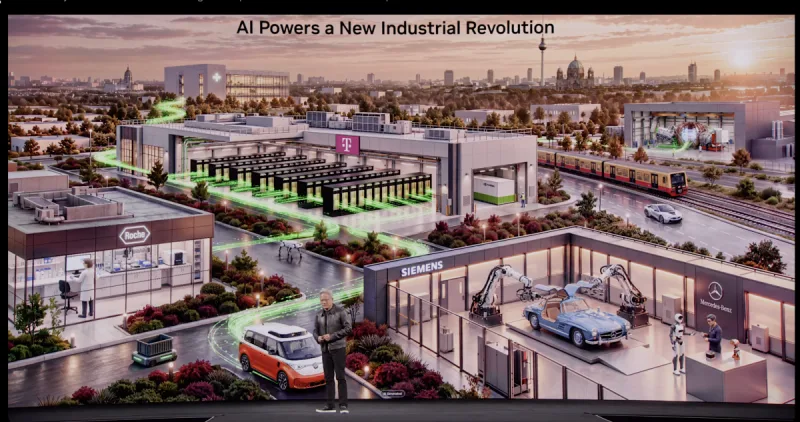
Nvidia shifts from selling chips to selling AI infrastructure as a complete system
At GTC Berlin, Jensen Huang repositioned Nvidia's strategy away from graphics processors toward end-to-end AI deployment, introducing containerized factories, agent security frameworks, and structured data models that address enterprise bottlenecks beyond raw computing power.

Five Technology Shifts Will Push CIOs From Passive Oversight to Active Design
Enterprise leaders must architect AI systems proactively rather than react to rapid technological change, according to Gartner research presented at its IT Symposium/Xpo in Orlando.

Comet Cloud eyes underserved SMBs as GPU inference demand shifts
With AI workloads moving from training to inference, neocloud providers see opportunity in small and midsize businesses that hyperscalers have deprioritized. Comet Cloud is positioning itself to serve that market with dedicated clusters and aggressive pricing.