Quantifying Innovation: How South Korea Became a Global Tech Leader
Mind the Bridge presents a framework for measuring innovation ecosystems, revealing how South Korea has surged to become the world's eighth-largest innovation economy in just a decade through strategic government policy.

Organizations worldwide—from governments to corporations to investors—seek reliable metrics to assess their innovation capacity relative to global competitors. Yet the challenge remains formidable: innovation ecosystems vary dramatically by region, and any standardized measurement risks obscuring the distinctive characteristics that define each market.

Mind the Bridge has spent years developing a comparative framework that maintains analytical rigor while preserving regional nuance. This week, the organization unveiled its latest analysis: a comprehensive assessment of South Korea's innovation economy that illustrates how this methodology works in practice.
Understanding the Ecosystem Pyramid
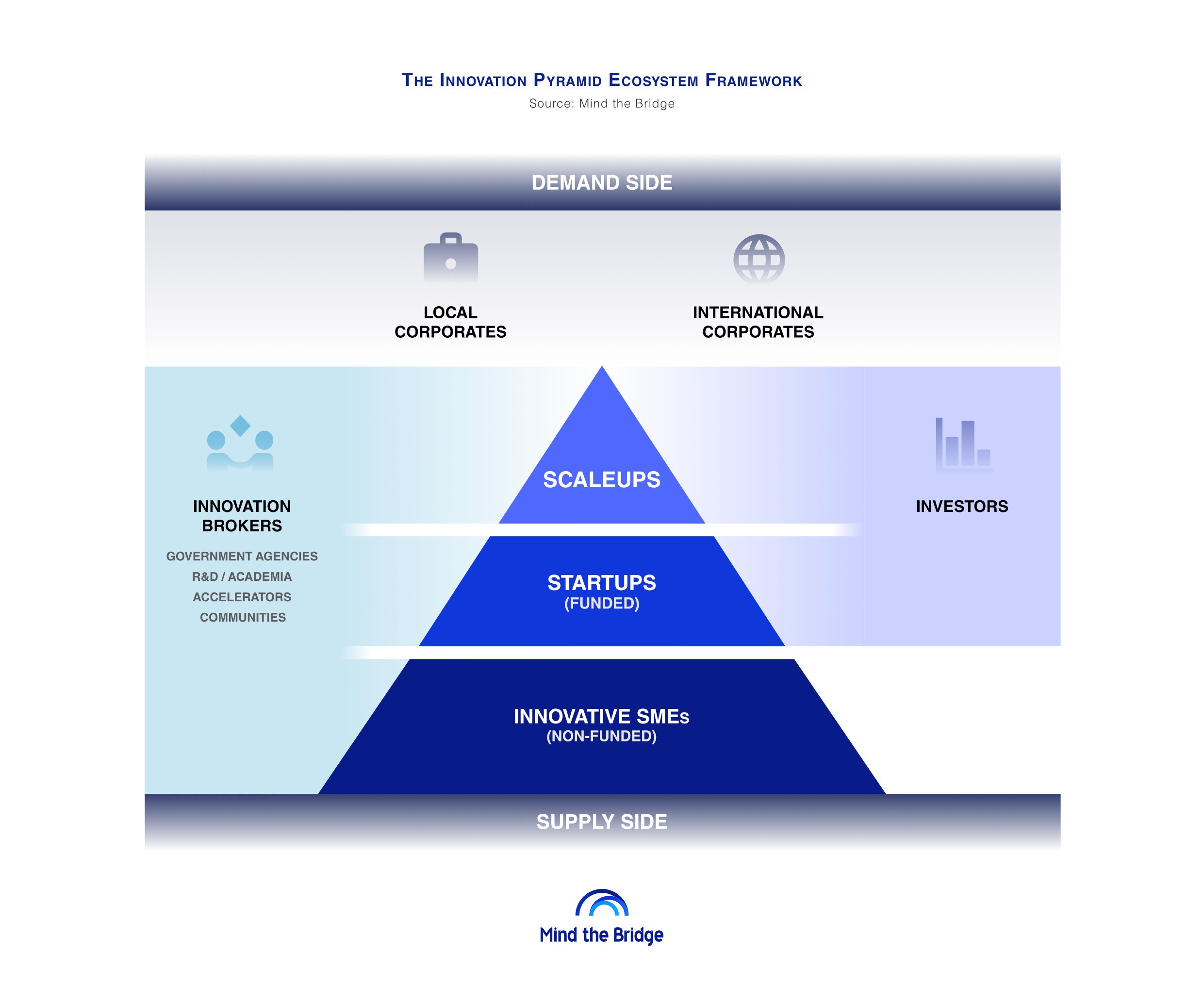
Innovation ecosystems can be visualized as a layered pyramid. The foundation comprises startups—venture-backed technology firms still establishing their business models and proving market viability.
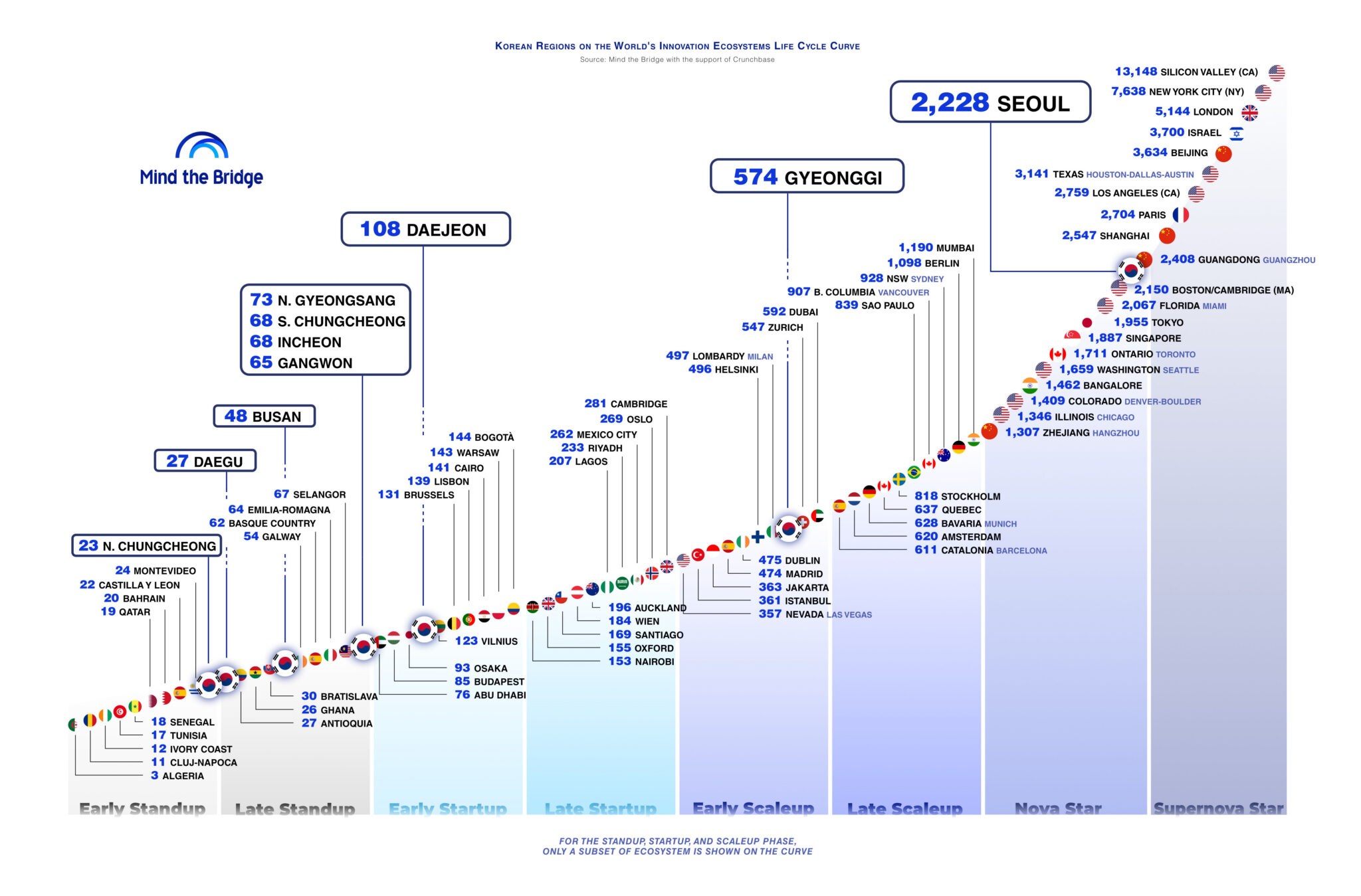
The next tier contains scaleups: companies demonstrating sufficient market traction to secure more than $1 million in venture capital. These firms represent the most tangible, most measurable output of an ecosystem. Their quantity, expansion trajectory, and sector composition serve as reliable indicators of ecosystem maturity when evaluated against the Innovation Ecosystems Life Cycle Curve.
At the pyramid's apex sit the disproportionately influential outliers: scalers and super-scalers that have transcended their domestic markets and achieved genuine international presence. A small number of these enterprises can generate more value for a nation's innovation profile than thousands of early-stage ventures—making separate tracking of these companies essential to credible measurement.
Parallel to this venture-capital-driven pyramid exists another frequently overlooked segment: innovative SMEs. These established, revenue-generating small and mid-sized enterprises compete through technology and innovation rather than venture funding. Many originated as bootstrapped operations; some remain independent while others eventually raise external capital and advance into the startup and scaleup categories. Overlooking this segment means missing substantial portions of the real economy's innovation capacity, particularly in markets like Korea where corporate-driven and government-supported innovation have historically rivaled the venture capital model.
Universities and research institutions form the knowledge foundation underlying all these technology companies, representing the technology supply dimension of an ecosystem.
Supply Meets Demand
Tallying technology companies captures only the supply side. Economic impact emerges when supply encounters demand—primarily through corporations, both domestic and international. These organizations benefit from innovations developed by startups and scaleups while potentially accelerating growth through acceleration initiatives, venture client arrangements, corporate venture capital, and acquisitions. The interaction between technology supply and corporate demand converts innovation into measurable economic value and company expansion, making this measurement critical.
Technology supply additionally intersects with local, regional, and global consumer markets. For companies whose expansion depends on direct market penetration rather than corporate partnerships, consumer demand represents the other essential component of the demand equation.
Capital and public backing fuel ecosystem advancement everywhere. Private capital originates from angels, venture capitalists, and corporate venture arms, equipping companies with resources for development, commercialization, and expansion. Public capital flows through subsidies, grants, and government initiatives, delivered directly or indirectly via innovation agencies and ecosystem facilitators. Stronger connections between these capital sources and pyramid-based companies accelerate progression between layers. Less mature ecosystems require greater public capital infusion to bridge gaps.
Reaching Critical Mass
When an ecosystem achieves sufficient scale, density, and company caliber—typically reaching the Star stage on the Innovation Ecosystems Life Cycle Curve—external players take notice. International investors, multinational enterprises, and foreign government agencies establish local operations, drawn by improved access to talent, technology, deal pipelines, partnerships, and market possibilities.
Counting corporate innovation outposts established by multinational firms and government innovation outposts created by foreign nations, regions, or cities provides a concrete measurement of this external appeal. This metric typically lags actual ecosystem advancement by a couple of years, making it more useful as a confirmation indicator than an early-warning signal, though valuable nonetheless.
South Korea's Innovation Pyramid
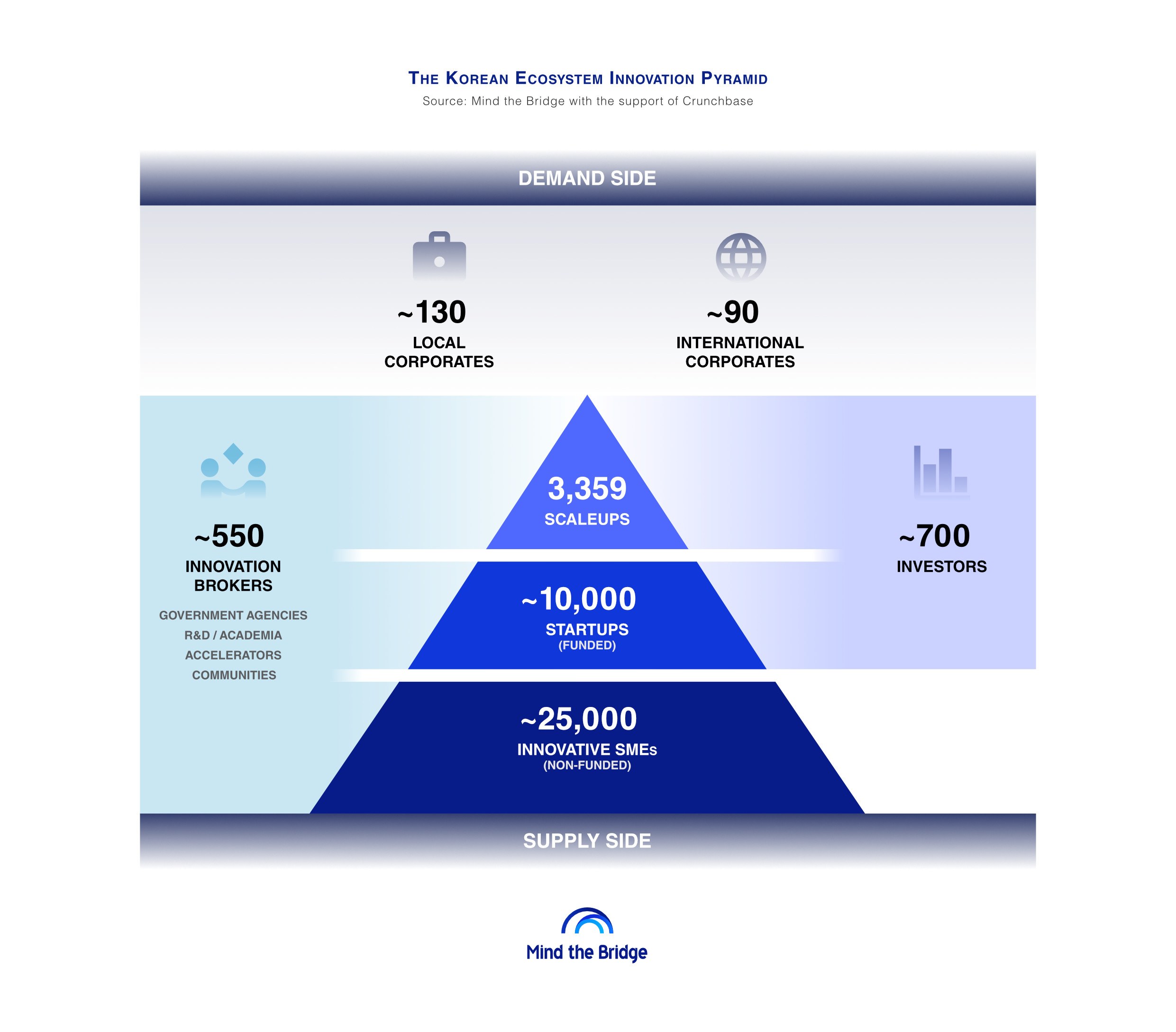
The latest assessment identifies 3,359 scaleups within South Korea's innovation pyramid, positioning the nation as the eighth-largest innovation ecosystem globally, with Seoul ranking as the eleventh most developed ecosystem worldwide.
Supporting this scaleup layer sits a substantially larger foundation of roughly 10,000 startups, alongside an even broader base of approximately 25,000 technology companies (innovative SMEs) without venture capital backing.
The supporting ecosystem encompasses approximately 700 investors and more than 550 innovation brokers—both public and private—operating more than 800 distinct entrepreneurship and innovation support programs.
While scaleup figures derive from analytical calculation, other statistics represent careful assessment of ecosystem components, beginning with government data and consolidating available information sources. Though continuously refined, this data is being open-sourced through the MTB Innovation Ecosystem Platform to strengthen innovation connections.
- Approximately 130 domestic companies maintaining structured open innovation initiatives
- Roughly 90 international companies operating identified innovation outposts in South Korea
These figures undergo continuous assessment and adjustment as the ecosystem transforms and new participants and activities emerge.
Why Measurement Matters
This represents far more than theoretical analysis. Applied methodology—as demonstrated through the Korean analysis—delivers actionable insights: it reveals where an ecosystem sits on the Innovation Ecosystems Life Cycle Curve, identifies bottlenecks, and enables comparison with peer economies pursuing similar transitions from startup nation to scaleup nation. Rigorous methodology transforms numbers from mere scorecards into diagnostic tools.
A Decade of Rapid Growth
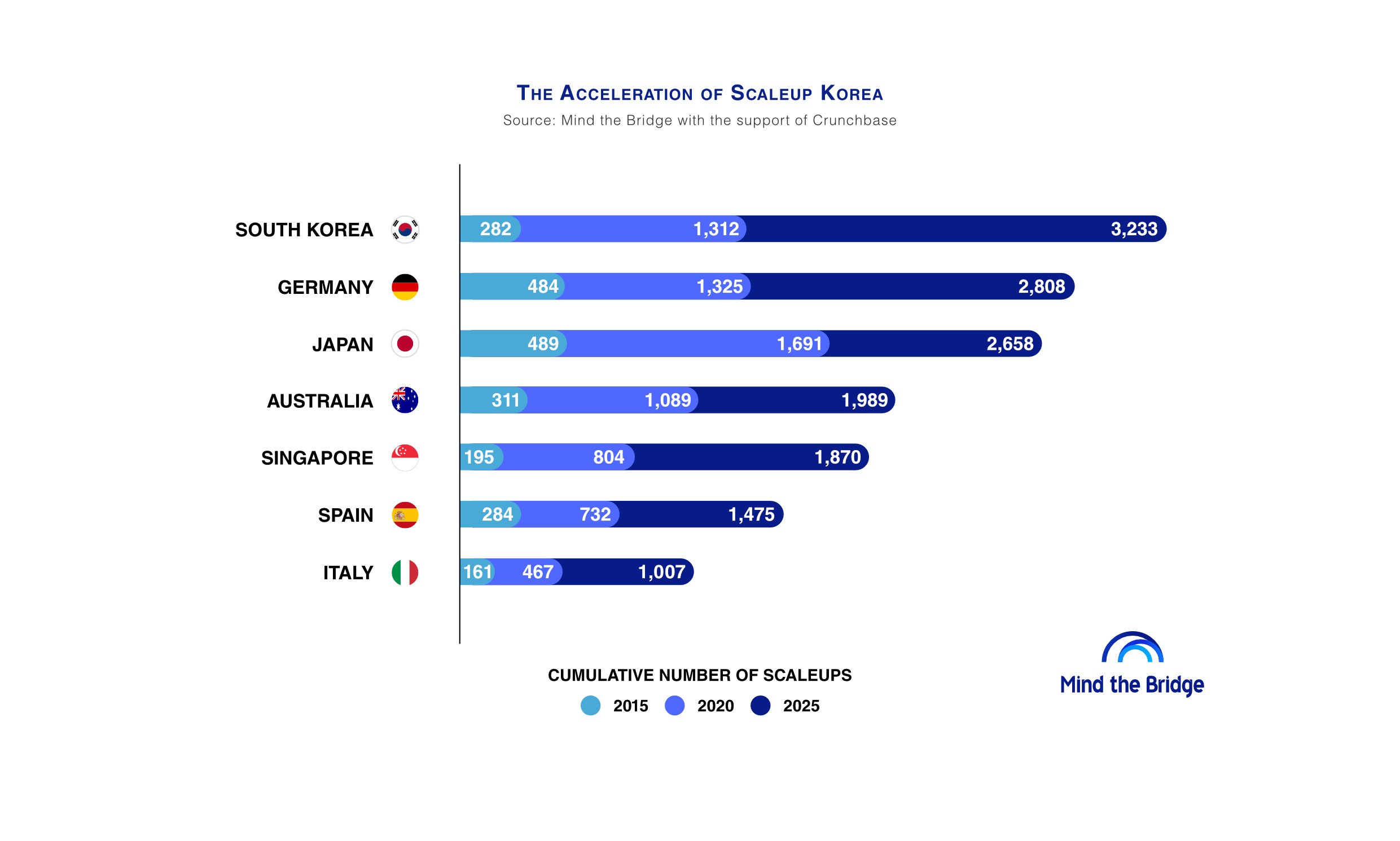
South Korea exemplifies this principle. A decade ago, Korea represented roughly 40% of Japan and Germany's innovation capacity, comparable to Australia and Spain, and marginally ahead of Singapore and Italy. Today, the transformation is unmistakable. With 3,233 scaleups in 2025, Korea has:
- Pulled decisively ahead of Germany and Japan, establishing a widening gap that appears difficult to narrow
- Grown to more than double Spain's size—Korea's most comparable European tech ecosystem in 2015
- Nearly doubled Singapore's scale, the other major Far East technology hub
Deliberate Strategy Drives Results
Korea's extraordinary innovation economy expansion reflects not happenstance but rather more than twenty years of intentional, forward-thinking government strategy.
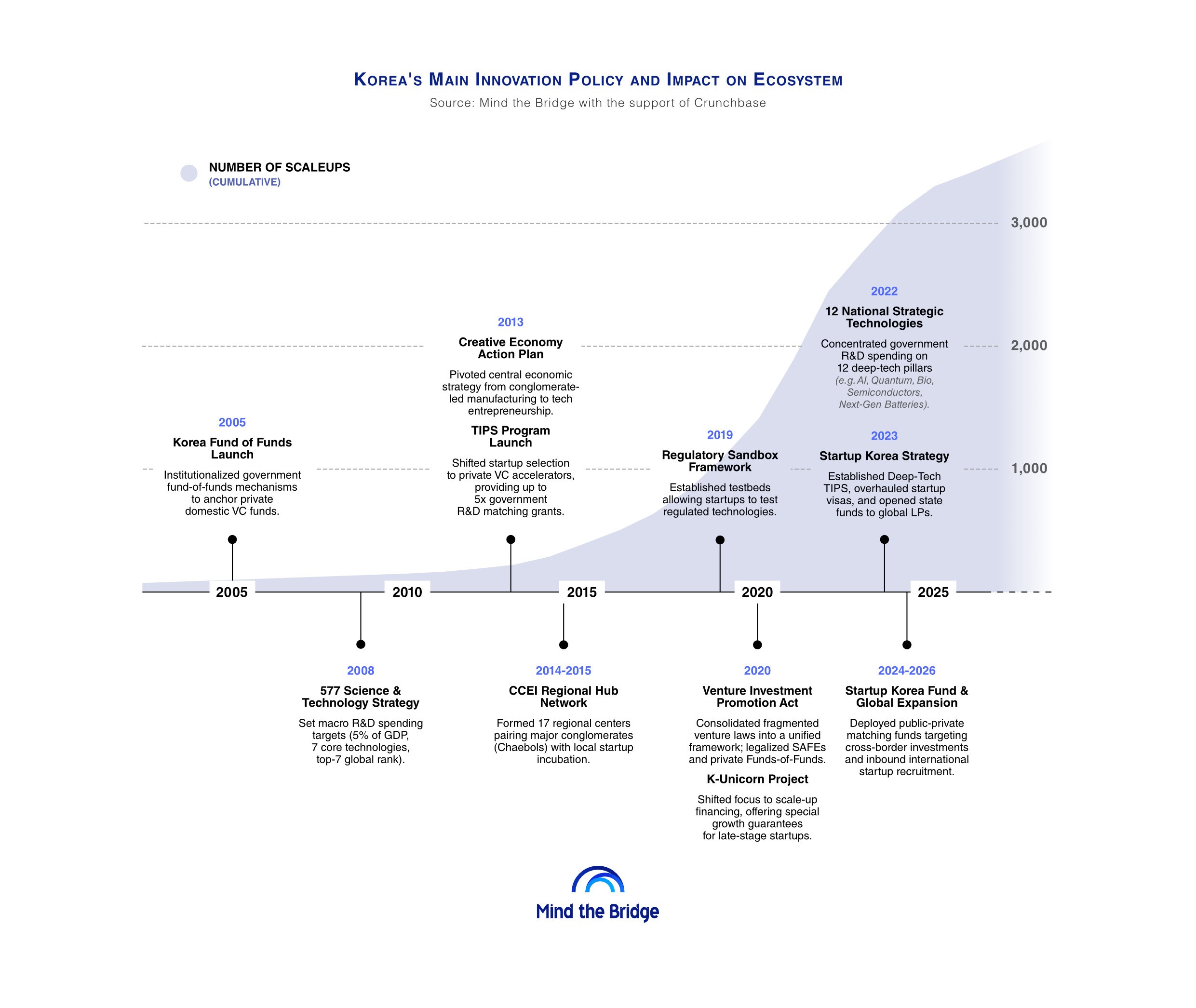
The nation established foundational frameworks for dramatic R&D investment increases—escalating from 2%-3% of GDP to a minimum of 5% by 2008. In 2013, Korea designated technology entrepreneurship as a central economic pillar, launching TIPS (Tech Incubator Program for Startup) to strengthen early-stage development. Subsequent initiatives built on this foundation by supporting scaleup advancement. Between 2014 and 2015 specifically, 17 regional innovation centers (CCEI—Centers for Creative Economy and Innovation) were created, integrating major conglomerates (chaebols) with startup incubation efforts.
Updated regulatory frameworks granted technology companies greater experimentation latitude, unlocked novel financing mechanisms, and incentivized scaleup funding. Beginning in 2022, fresh dedicated strategies and instruments have driven a significant reorientation, concentrating resources and mechanisms on deep technology innovation.
Read more

TechCrunch Disrupt 2026 offers $75 passes for laid-off workers seeking their next opportunity
Those affected by recent tech layoffs can attend TechCrunch Disrupt 2026 at San Francisco's Moscone West for $75, with the discounted Expo+ Pass limited to the first 100 qualifying applicants before the event opens October 13.
How AI Created the GTM Engineer: Clay's Kareem Amin on a Rapidly Emerging Role
A position that barely existed two years ago is now appearing across technology companies. At TechCrunch Disrupt 2026, Clay's founder will explain how AI and automation are reshaping go-to-market work.

Deadline Tonight: Last Chance to Host a Side Event at Founder Summit 2026
Applications to host a Side Event during TechCrunch Founder Summit 2026 in Boston close at midnight PT tonight. The event runs November 1–7 and will draw over 1,000 tech leaders.