Enterprise AI Security Takes Center Stage at October Summit as Trust Becomes the Scaling Factor
As companies move AI systems from experimental pilots into production environments, the ability to defend against cyber threats and maintain data integrity has become critical to success. An upcoming industry summit will examine how organizations are building secure foundations for enterprise AI.
The challenge facing enterprises today is no longer whether artificial intelligence models can deliver strong performance in controlled settings. Instead, organizations must determine whether their underlying systems can handle cyber attacks, preserve data quality and survive real-world disruptions. The gap between how quickly companies are adopting AI and how prepared their security, data governance and identity infrastructure actually are continues to widen, creating significant operational risk.
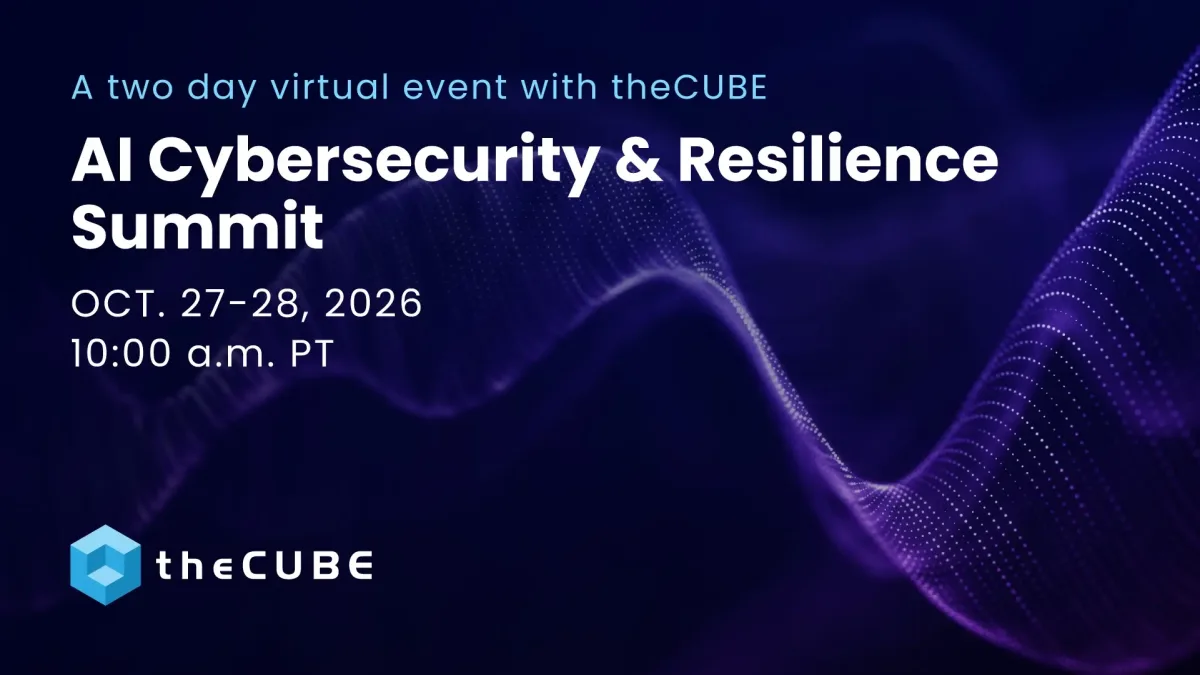
This tension between rapid AI deployment and inadequate security readiness forms the core theme of the AI Cybersecurity and Resilience Summit scheduled for October 27-28. TheCUBE Research principal analysts Christophe Bertrand and Scott Hebner will lead discussions on how enterprises are establishing trustworthy foundations for AI systems running in production. "AI projects don't fail first on capability; they fail first on trust," Hebner explained. "Until enterprises can verify and defend outcomes, autonomy stays trapped in low-stakes use cases. This is what this summit is all about."
Bertrand views cyber resilience as fundamental infrastructure rather than a secondary concern. "There is no trusted AI in the enterprise without a cyber-resilient IT and data foundation," he stated. "And without trusted, compliant and governed data, AI credibility collapses before it ever scales."
SiliconANGLE Media's livestreaming platform theCUBE will provide live coverage during October 27-28, featuring interviews that explore how companies are implementing secure, governed AI systems. The coverage will examine how organizations are putting NIST-aligned frameworks and cyber-resilient architectures into practice, and how chief information officers and chief information security officers are establishing trust as a concrete, measurable standard in production AI environments.
Zero-trust principles extend into AI workloads
Technology leaders across the industry are applying zero-trust security concepts to AI systems. This approach emphasizes ongoing verification, strict controls on who can access what, and isolation of systems from one another—viewing AI as an environment that requires continuous security oversight during operation, not just when first deployed. Rather than replacing their entire infrastructure, many organizations are leveraging Kubernetes-based controls and identity management systems to enforce security policies as AI systems run.
Anjali Telang, senior principal product manager of OpenShift Security and Identity at Red Hat, recently explained the concept to theCUBE: "Zero trust in general means that you trust no one, you always verify, and then you base that verification on an identity, and then you trust the person. With AI, we want to sort of bring in the same trust that we already have built into the system. We want to make sure that the users, the machine, all the trust that we have brought in with the best practices around that, translates to AI workloads, AI agents."
This security approach also encompasses digital sovereignty and confidential computing, where protecting information while it is actively being used becomes as critical as encrypting it when stored or transmitted. Since AI systems process and act on data spread across multiple regions, enterprises are reassessing control of workloads, where encryption protections apply and how compliance rules function across mixed on-premises and cloud environments.
These architectural considerations will likely emerge prominently at the summit, particularly from representatives of data-heavy and regulated sectors such as Experian PLC, Capital One Software (a division of Capital One Financial Corp.), and Thomson Reuters Corp. As AI becomes integrated into credit decisions, financial services and legal processes, the practical meaning of trust shifts from an aspirational goal to an enforceable requirement.
George Kurtz, chief executive officer of CrowdStrike, highlighted the accelerating threat landscape in a recent theCUBE conversation: "When we think about how AI is transforming the world, it's also transforming what the adversaries are doing, and the speed at which they're moving has changed dramatically. It used to be weeks, then days, then hours and minutes. Now it's seconds. The traditional SOC can't keep up."
According to Hebner, the problem extends beyond simply defending network boundaries and into how systems are fundamentally designed: "In the agentic era, trust is the real scaling factor. Without it, every workflow becomes a pilot, every decision becomes a debate, and ROI becomes optional." He further contends that deploying AI at scale demands rethinking the underlying architecture itself, not merely upgrading tools: "The next frontier isn't smarter agents. It's agents whose decisions are audit-ready by design. Trust is the architecture."
Shadow AI and autonomous agents create new governance challenges
A fresh threat is emerging at the identity management layer: Shadow AI. Okta Inc. recently unveiled capabilities designed to help enterprises identify and manage unauthorized AI agents that operate using OAuth credentials and persistent non-human identities. According to Gartner research, 69% of organizations have documented instances of employees deploying prohibited generative AI tools, and the firm forecasts that more than 40% of enterprises will experience security or compliance problems stemming from unsanctioned shadow AI by 2030.
Harish Peri, senior vice president and general manager of AI security at Okta, described the problem: "AI agents don't operate at the network, endpoint or device layer — they live in the application layer and use multiple non-human identities with broad, long-lived privileges. By discovering and mapping every agent and its permissions, Identity Security Posture Management within Okta for AI Agents gives organizations the visibility and governance they need to secure both sanctioned and shadow AI at scale."
As organizations redesign identity systems, security policies and how workloads are isolated from each other, Zscaler's CEO Jay Chaudhry stresses the importance of removing assumptions that any part of the infrastructure can be automatically trusted.
In a recent theCUBE interview, Chaudhry used an analogy to explain the concept: "In the Zscaler Zero Trust Everywhere principle, you get the badge, but then you get escorted to meeting room A, and when the meeting happens, you get escorted out. In this metaphor, the room is like an application, and the building is like a data sync. It's a one-to-one connection — that's what we do."
Beyond identity management, analyzing system logs and detecting unusual behavior patterns are becoming essential for stopping attacks powered by AI, as shown by Cribl Inc.'s recent partnership with DeepTempo. This collaboration demonstrates how machine learning-driven log examination and centralized telemetry collection can identify complex and autonomous attacks with precision while simplifying operational burden. The goal extends beyond preventing breaches to maintaining control over AI systems as they evolve.
For Bertrand, cyber resilience functions as a prerequisite rather than a supporting service: "There's simply no trusted AI in the enterprise without a prerequisite cyber-resilient IT and data infrastructure. Resiliency at the core is what enables autonomy at scale."
The quality of data feeding into AI systems remains foundational. Congruity360 InfoGov Inc. has stressed the value of removing stale and redundant information before it reaches AI models. Mark Ward, chief operating officer of Congruity360, noted: "We're seeing the early adopters leverage our technology in the reduction of infrastructure costs. By eliminating anywhere from 60% to 70% of the data, by eliminating rot, we're able to reduce the amount of AI compute and AI storage required on the backend."
How to follow the summit coverage
TheCUBE will broadcast live from the AI Cybersecurity and Resilience Summit on October 27-28, with interviews available on-demand afterward. Viewers can access coverage through theCUBE's website and YouTube channel, as well as through SiliconANGLE's main site.
SiliconANGLE produces two regular programs featuring enterprise technology analysis. TheCUBE Pod is distributed on Apple Podcasts, Spotify and YouTube, with hosts John Furrier and Dave Vellante discussing major developments in enterprise technology including AI, cloud infrastructure, regulatory matters and workplace trends. Breaking Analysis, a weekly program also available on Apple Podcasts, Spotify and YouTube, features Vellante examining top enterprise technology stories using insights from theCUBE interviews combined with spending data from Enterprise Technology Research.
The summit will include discussions with enterprise information and security leaders addressing the architectural approaches, policies and operational strategies needed to strengthen AI reliability and trustworthiness. Additional details about participating speakers will be announced.
Read more
TechCrunch Disrupt 2026 offers $75 passes for laid-off workers seeking their next opportunity
Those affected by recent tech layoffs can attend TechCrunch Disrupt 2026 at San Francisco's Moscone West for $75, with the discounted Expo+ Pass limited to the first 100 qualifying applicants before the event opens October 13.
How AI Created the GTM Engineer: Clay's Kareem Amin on a Rapidly Emerging Role
A position that barely existed two years ago is now appearing across technology companies. At TechCrunch Disrupt 2026, Clay's founder will explain how AI and automation are reshaping go-to-market work.

Deadline Tonight: Last Chance to Host a Side Event at Founder Summit 2026
Applications to host a Side Event during TechCrunch Founder Summit 2026 in Boston close at midnight PT tonight. The event runs November 1–7 and will draw over 1,000 tech leaders.