Why enterprises are choosing deterministic automation over pure agentic AI
Most AI pilots deliver no measurable returns, and agentic workflows carry hidden costs in tokens, latency and errors. Enterprise architects need a framework to decide when agents add real value.

Orchestration has become unavoidable for technology leaders. A 2024 study by Enterprise Management Associates found that 91% of technology leaders consider AI-enhanced orchestration essential over the next two years, with 80% moving toward enterprise-wide orchestration to manage interconnected digital services.
The pressure stems from AI investments themselves. MIT's 2025 State of AI in Business study revealed that roughly 95% of generative AI pilots showed no measurable financial impact, and Gartner forecasts that more than 40% of agentic AI projects will be abandoned by 2027. Interestingly, MIT also found that while half of generative AI spending targets sales and marketing, the strongest returns emerge from routine back-office work—the less glamorous applications.
Rolling out autonomous AI agents without a unified approach risks deepening the fragmentation already plaguing enterprises. Scaling these systems successfully demands that IT leaders close the distance between conventional automation and agentic AI capabilities.
Deterministic vs. agentic: The architectural choice
Building or redesigning workflows forces architects to pick a direction: stick with deterministic automation or embrace agentic AI applications.
Deterministic automation forms the traditional foundation of operations. Tasks are arranged in strict sequences with defined dependencies, and execution follows an identical path each time.
Agentic AI determines its steps during execution based on an objective. These agents leverage tools, APIs, memory and large language models to evaluate the optimal next move. The key distinction lies in timing: reasoning occurs either at design time or continuously during runtime—with each runtime decision incurring costs.
Proponents of agentic systems argue that models continue improving and that Markdown instruction files can constrain agents to execute routine steps without external calls. Yet an instruction file that executes identically every time functions as a script in disguise.
The actual distinction concerns location. When deterministic logic remains hidden inside an agent, the orchestrator cannot see it, leaving no shared schedule or unified audit trail. These concealed scripts expand observability blind spots. Deterministic steps belong in the orchestration layer where they remain visible.
The operational costs of agentic workflows
Agentic flexibility demands payment in operational terms:
- Cost: LLM tokens represent a continuous expense. Each agent decision consumes tokens, whereas deterministic execution costs nearly nothing per execution.
- Latency: Model calls introduce delays. Workflows with strict Service Level Agreements suffer when each step requires a model call.
- Accuracy: Mistakes accumulate. A ten-step agent chain where each step achieves 95% reliability completes successfully only about 60% of the time.
- Auditability: Deterministic failures produce stack traces. Agent failures typically yield plausible narratives with minimal diagnostic detail.
A framework: Volume and variability
Enterprise architects require a usable decision framework to navigate this landscape. The core strategy: restrict non-determinism to the smallest area where it genuinely delivers value.
IT leaders should assess workloads using two dimensions: Volume (how throughput multiplies per-run costs and failures) and Variability (how unstructured data breaks rigid decision logic).
- High Volume, Low Variability: AI involvement should happen at design time only. Agents perform poorly here because token, latency and error costs repeat with every execution. Deploy fully deterministic automation.
- Low Volume, High Variability: Runtime AI becomes justified, since inputs resist mapping into fixed rules.
- High Volume, High Variability: A hybrid approach works best. Deterministic logic manages scheduling, task dependencies, retries and state. Agents enter only at steps where inputs demand reasoning.
This boundary shifts over time: when an agent consistently reaches the same conclusion, that decision path should move into deterministic automation.
Building an intelligent control plane
Enterprise systems will increasingly blend deterministic jobs and intelligent agentic tasks within unified, end-to-end orchestrated workflows.
Secure management requires an intelligent control plane—a unified governance system linking stakeholders, AI models and business systems. This plane must provide financial transparency, enabling platform teams to track token usage and infrastructure spending by business unit.
Agentic AI represents an architectural transformation, not merely another tool. Putting governance and observability in place across a dispersed automation landscape forms the essential foundation. IT leaders must establish their enterprise orchestration strategy now to regain visibility, strengthen security posture and expand AI capabilities at scale.
Read more

Market Volatility and AI Valuations Collide as Anthropic Pursues Public Listing
Tech stocks tumbled last week amid investor skepticism about AI infrastructure spending, even as Anthropic filed for an IPO. Industry analysts debate whether the sector is experiencing a healthy correction or the early signs of a broader bubble.

42AI Emerges With $62.5M to Deploy Behavioral Prediction Models in Finance
An Israeli startup has unveiled a machine learning system designed to forecast individual decision-making patterns, launching from stealth with substantial funding and early deployments at major brokerages.
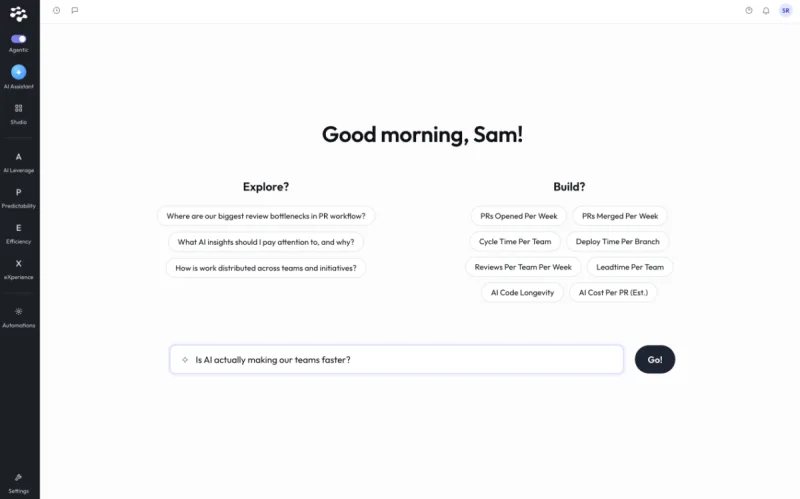
LinearB Launches Agentic Studio to Untangle AI-Driven Code Review Bottlenecks
The development intelligence platform is addressing a critical pain point: AI coding tools have flooded engineering teams with code, but the review and deployment pipeline remains stuck in the past.