Market Volatility and AI Valuations Collide as Anthropic Pursues Public Listing
Tech stocks tumbled last week amid investor skepticism about AI infrastructure spending, even as Anthropic filed for an IPO. Industry analysts debate whether the sector is experiencing a healthy correction or the early signs of a broader bubble.

Turbulence rippled through financial markets on Friday as major technology names took sharp losses, raising fresh questions about whether the artificial intelligence sector has grown overheated. Shares of Intel Corp., Alphabet Inc., Amazon.com Inc., CoreWeave Inc. and Fortinet Inc. all declined, signaling investor wariness toward the massive capital commitments flowing into AI infrastructure. The timing proved notable: Anthropic PBC simultaneously submitted paperwork for an initial public offering to the U.S. Securities and Exchange Commission, positioning itself as a major AI developer seeking public markets despite remaining unprofitable.
Adding to the week's market-moving announcements, Intercontinental Exchange (ICE), the parent of the New York Stock Exchange, revealed plans to collaborate with TradeXYZ on bringing perpetual futures markets powered by the Hyperliquid cryptocurrency trading platform to United States investors.
John Furrier, executive analyst at theCUBE Research, framed the developments as part of a fundamental shift in how markets operate. "The whole idea of exchange is going to change," Furrier said. "It reminds me of cloud computing, how it re-leveled the data center. NYSE is the cathedral of capitalism. Nasdaq started as an over-the-counter bulletin board. Tech was early there and then only listed there. But now the game has changed. It's very interesting to see how the competition between the NYSE and the Nasdaq is going to play out."
On the latest episode of theCUBE Pod, Furrier and Dave Vellante, chief analyst at theCUBE Research, examined what Anthropic's IPO filing and the week's market turbulence reveal about AI sector health. The discussion also touched on Intel's recent struggles and the prospects for companies offering complete infrastructure solutions.
AI bubble releases some air
Alphabet's shares plummeted more than 12% following disappointing results in advertising and search revenue, with observers attributing weakness partly to chatbots diverting user attention from traditional search. Amazon experienced its own difficult session, with stock declining 7% as the company continues substantial spending on AI infrastructure expansion.
Vellante interprets the recent selloff as a constructive development for the sector's long-term prospects. "Think of the tulip bubbles in the 1600s," Vellante said. "Think about the Japanese real estate bubble in the 1980s. And you think about the dot-com. That dot-com was actually different. Dot-com, they were all … overhyped. They drove massive valuations. But the dot-com actually played out. It actually exceeded expectations. And I think there's some things that we can learn from there."
Furrier identified signs of a constructive growth trajectory, beginning with the cloud infrastructure expansion necessary to power AI advancement. He suggested that enterprise AI deployment could simultaneously drive a consolidation among neocloud providers while generating new employment opportunities rather than eliminating them. According to Furrier, last week's market movements do not necessarily foreshadow an imminent collapse.
"Rationale is kicking in, common sense," Furrier said. "You're starting to see the beginning of a transition. Wall Street is trying to figure it out. I think they don't yet get it. But if you look at the language of the experts on the inside and how all the IPOs are being positioned, the value of these IPOs — they want durability. That transition from Silicon Valley tech ecosystem platforms is going to move into the markets. This is a platform game."
Intel suffers setback
Intel experienced the steepest decline of the week, losing nearly 30% of its value following Thursday's earnings announcement. The company's emphasis on central processing units rather than graphics processing units represents a strategic misstep in Vellante's view; the competitive landscape centers on AI platforms rather than the CPU-versus-GPU question. Despite the sharp decline, both analysts expect Intel to recover some ground.
"Lip-Bu Tan and Intel have an opportunity," Furrier said. "You basically lost the hyperscaler market that they once had a foothold in. You still run x86 on some clusters. But they got to look at other footprints. I think he'll turn it around. It's a multiyear journey, as he says. But the fact of the matter is why I don't think it's a bubble, is companies like Alphabet dropping major, major action, $500 billion, in a day."
Intel represents just one piece within a rapidly transforming technology landscape. While the AI expansion invites comparisons to historical market manias, theCUBE's analysis suggests this phenomenon stands apart—a unique challenge that will unfold across decades rather than months.
"This is just a natural adoption phase," Vellante said. "What's different is a lot of things. Like you said, tech is suddenly deflationary. We're trading CapEx for labor, and that hasn't really kicked in yet. We're seeing individual productivity gains but it hasn't shown up at the firm level yet. These things just take time. And, of course, Wall Street's like, show me the money."
Read more

42AI Emerges With $62.5M to Deploy Behavioral Prediction Models in Finance
An Israeli startup has unveiled a machine learning system designed to forecast individual decision-making patterns, launching from stealth with substantial funding and early deployments at major brokerages.

Why enterprises are choosing deterministic automation over pure agentic AI
Most AI pilots deliver no measurable returns, and agentic workflows carry hidden costs in tokens, latency and errors. Enterprise architects need a framework to decide when agents add real value.
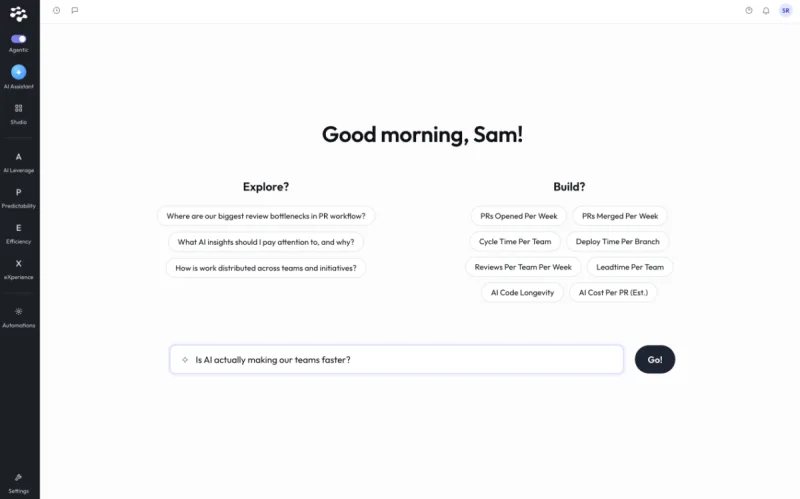
LinearB Launches Agentic Studio to Untangle AI-Driven Code Review Bottlenecks
The development intelligence platform is addressing a critical pain point: AI coding tools have flooded engineering teams with code, but the review and deployment pipeline remains stuck in the past.