OpenAI Launches ChatGPT for Financial Services to Compete on Wall Street
OpenAI has unveiled a specialized version of ChatGPT designed for financial institutions, combining advanced reasoning capabilities with rich financial data to streamline research, modeling, and client deliverables.
OpenAI Group PBC is making a strategic push into the financial sector with a purpose-built ChatGPT variant targeting Wall Street professionals. The new offering, called ChatGPT for Financial Services, integrates sophisticated financial datasets with the reasoning power of GPT-6 Astra to enable financial teams to accelerate research, construct financial models, and produce client-facing materials.
The move reflects a broader industry pattern in which artificial intelligence vendors customize their most advanced models for specific sectors to capture enterprise spending. Nick Turley, OpenAI's Vice President and Head of ChatGPT, indicated in a media briefing that financial services ranks among the company's top vertical priorities, alongside software engineering and cybersecurity.
OpenAI enters a market where competitor Anthropic PBC already has an established presence. Anthropic rolled out Claude for Financial Analysis back in May 2025. Nevertheless, OpenAI is confident that ChatGPT for Financial Services possesses sufficient capability to become the standard tool across the industry. "This is the canonical product we are hoping the industry adopts," Turley stated.
Turley personally contributed substantially to the product's creation, having collaborated with major financial institutions including Morgan Stanley and Evercore Inc. to identify essential features for a financial-focused chatbot. These partnerships also helped ensure the tool meets the exacting reliability standards demanded by the sector. "There's a big difference between what looks good in a demo and what is actually a usable output, [and] you kind of rely on the experts to achieve that," he explained.
Rich data access
Access to ChatGPT for Financial Services requires banks to hold an enterprise subscription and submit an application directly to OpenAI, as the product currently remains restricted to "eligible institutions." The tool shares considerable similarities with ChatGPT Work, though tailored specifically for financial applications, according to Turley.
The user interface mirrors standard ChatGPT but includes additional controls allowing integration of financial data from designated sources. Financial institutions can link proprietary datasets or information from vendors like Bloomberg and FactSet.
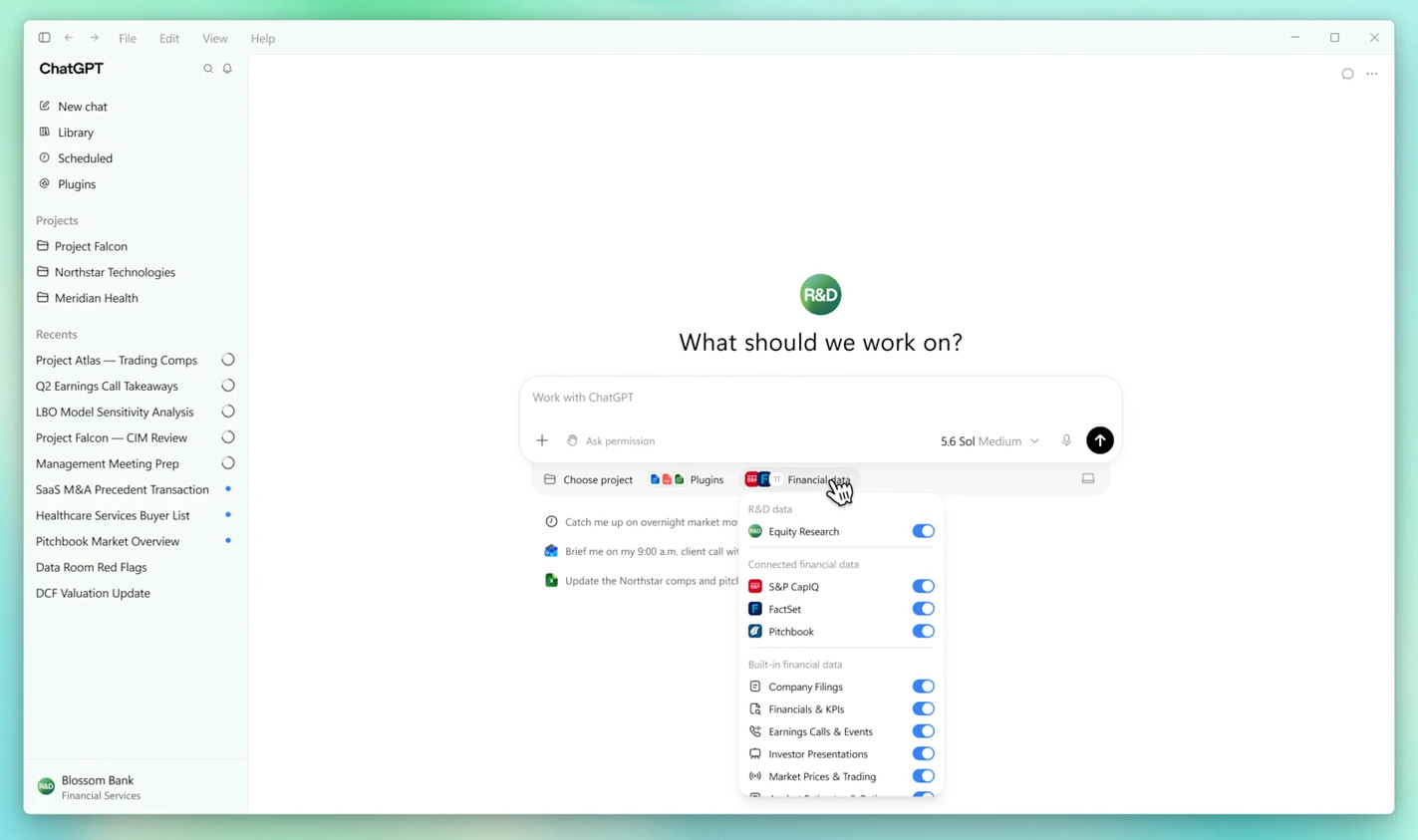
OpenAI also provides pre-loaded datasets sourced from Crunchbase, Pitchbook, Daloopa, and LSEG News. The platform includes approximately 50 Model Context Protocol connectors enabling connections to supplementary data sources and third-party applications. When ChatGPT for Financial Services draws on this information, it furnishes comprehensive citations for its responses, Turley noted.
The interface permits users to specify whether ChatGPT should expend high, medium, or low effort when formulating responses. Greater effort levels consume additional tokens and extend response times but typically yield superior output quality. Beyond answering financial inquiries, the tool can generate PowerPoint presentations, Excel files, and web-based dashboards.
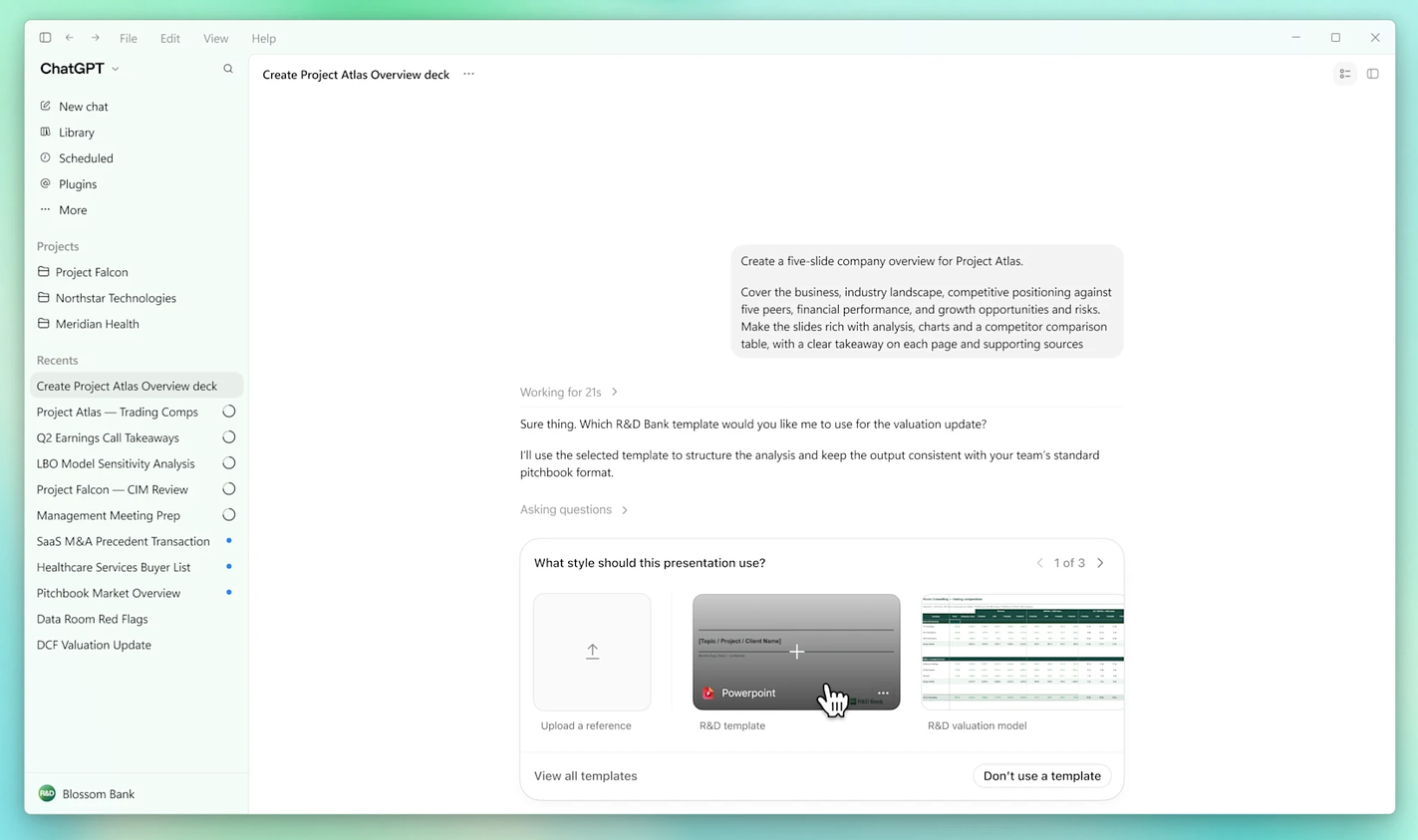
OpenAI's blog post describes the capability to perform comprehensive research across multiple datasets and produce "detailed artifacts" from a single instruction. The company provided an example: "For example, for an acquisition, they can compare the target with its peers, and test how revenue growth affects valuation, and turn the entire analysis into an editable model or pitchbook using their firm's templates."
Turley outlined an ambitious vision for transforming financial analysis workflows. A ChatGPT-generated dashboard could enable analysts to quickly model how various scenarios influence financial projections. Rather than manually adjusting spreadsheet values, users would input parameters and receive updated forecasts instantly. "We're trying to think of new ways of doing the work, rather than just making the existing ways faster," he said.
Challenges ahead
OpenAI is executing a conventional enterprise strategy by targeting industry segments now that its underlying technology has reached maturity, according to Holger Mueller, analyst at Constellation Research. However, demonstrating tangible value to financial institutions will prove essential, particularly through workflow acceleration via automation.
Mueller emphasized that success requires deeper API integration and robust governance mechanisms. "This requires deeper and more advanced integration into APIs and also the necessary oversight and controls, such as implementing role-based access controls, and this is something OpenAI is going to have to learn," Mueller noted. "So far it has done the easy part, but it will need to ensure its tech is safe and provides value if it's to become the key AI backbone for regulated verticals like financial services." Mueller also highlighted that OpenAI's strong consumer brand positioning could work in its favor, as new graduates may expect to use their preferred AI tools in professional settings.
Concerns exist that ChatGPT for Financial Services could reduce hiring of entry-level talent. The financial industry traditionally relies on structured apprenticeships for junior staff development. If a tool can complete research and generate pitchbooks within minutes, institutions might curtail assignments typically delegated to junior bankers for training purposes.
Goldman Sachs partner Chris Churchman, who oversees the bank's major AI initiatives, raised this issue in a recent CNBC interview. He cautioned that automating tasks historically assigned to junior bankers could trigger "cognitive atrophy" among the next generation of banking professionals.
Turley countered with the conventional productivity argument, positioning ChatGPT for Financial Services as a tool that amplifies employee output rather than replacing workers. "Depending on the industry, they're usually working 100-hour weeks," Turley observed regarding analysts and bankers. "I think in the same way that Excel transformed the industry and allowed them to produce better analysis faster, you will see technology like this do the same."
Read more
Identity governance faces new test as AI agents proliferate across enterprises
Autonomous AI agents are forcing organizations to rethink how they manage access and permissions at machine speed. SailPoint's Navigate conference will explore how identity security must evolve to handle this expanding population of non-human actors.

Vertical AI and Purpose-Built Hardware Drive Next Wave of Technology Growth
Specialized AI systems tailored to specific industries are emerging as the primary engine for the next phase of technology expansion, according to insights from the Bank of America Private Tech Trailblazers Conference 2026.

CrowdStrike and CoreWeave Partner to Automate AI Security at Machine Speed
As cyberattackers breach systems in seconds, CrowdStrike and CoreWeave are embedding automated defenses throughout AI infrastructure, turning attacks into training data for faster response.