Nvidia's $600B Capex Claim Doesn't Match What Cloud Giants Actually Say They'll Spend
During its Q2 2026 earnings call, Jensen Huang asserted that the four largest cloud providers would collectively spend $600 billion annually on infrastructure—a figure that far exceeds what those companies have publicly committed to investing.
Nvidia Corp. Chief Executive Officer Jensen Huang made repeated references during the company's second-quarter 2026 earnings call to a $600 billion annual capital expenditure figure for the leading four hyperscalers—Amazon Web Services Inc., Google LLC, Microsoft Corp. and Meta Platforms Inc. According to Huang, this spending level had doubled over the preceding two years and was driving the current wave of artificial intelligence infrastructure expansion. Yet when examining actual earnings disclosures and forward guidance from these same cloud operators, their combined capital spending plans fall noticeably short of the $600 billion threshold, despite accelerating investment tied to AI demand.
Jensen Huang's capex claims
- Huang referenced "$600 billion per year" for the top four hyperscalers multiple times during the call, naming Amazon, Microsoft, Google and Meta as the primary drivers of this massive investment in AI infrastructure.
- He characterized this amount as representing only the leading hyperscaler operators and emphasized it represented a doubling of annual spending relative to two years earlier. (Nvidia later clarified that this figure encompasses total industry data center infrastructure spending rather than exclusively the largest cloud service providers.)
Hyperscaler actual capex statements
The following represents publicly disclosed capital expenditure commitments from each hyperscaler for 2025 (based on calendar or fiscal year as applicable):
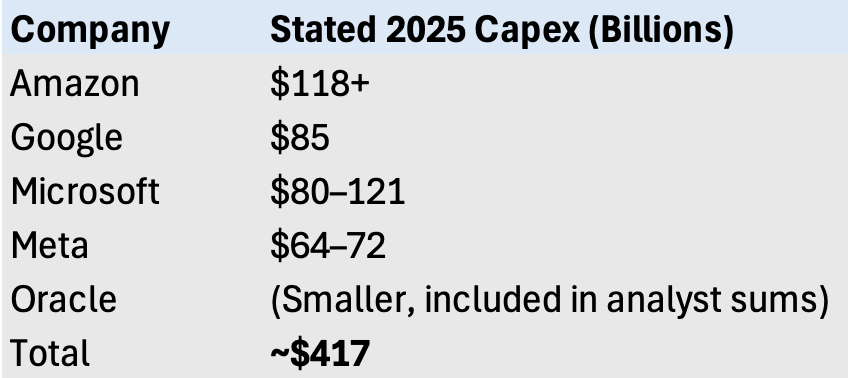
- AWS: The chief financial officer disclosed that quarterly capital expenditures were operating at $31.4 billion, which extrapolates to more than $118 billion annually, with the majority allocated toward AI and cloud infrastructure for AWS.
- Google (Alphabet): The company increased its 2025 capital expenditure guidance to $85 billion, driven by demand for cloud and AI infrastructure.
- Microsoft: The company maintained its target of roughly $80 billion in 2025 capital expenditures, though certain analyses (including from Jefferies) subsequently estimated the figure could reach $121 billion for fiscal 2026.
- Meta: Leadership indicated 2025 capital expenditure guidance spanning $64 billion to $72 billion (with some analyses centering on $70 billion), and signaled expectations for additional growth reaching approximately $30 billion beyond that level for fiscal 2026.
- Combined: Analyst projections (from Jefferies and Investing.com) for the "Big 3 + Meta + Oracle" estimated $417 billion in cloud capital expenditures for 2025, representing a 64% increase from the prior year and approaching triple the 2023 level.
Juxtaposition and theories on the delta
Huang's assertion of $600 billion in annual hyperscaler capital expenditures substantially exceeds both analyst estimates and the hyperscalers' own disclosed figures by approximately $200 billion.
Potential reasons for the discrepancy
- Run rate versus forward guidance: Huang may be extrapolating from quarterly spending patterns and projecting future run rates, whereas companies typically disclose planned or committed expenditures, which could understate actual execution if momentum accelerates.
- Huang knows something we don't know: He could be drawing on internal data derived from hyperscaler forecasts, regarding which he indicated having substantial visibility.
- Global and supplier inclusion: Huang's interpretation might treat U.S. hyperscaler capital expenditures as representative of worldwide infrastructure spending, potentially incorporating undisclosed investments or associated supply chain development (including colocation facilities, power infrastructure and facility enhancements).
- Competitive narrative: Inflating the aggregate capital expenditure figure allows Nvidia to underscore the competitive urgency and magnitude of the AI race—potentially reinforcing its own market position and justifying extraordinary revenue projections.
- Scope ambiguity: Huang's calculation may encompass broader infrastructure capital expenditures, including networking, logistics, facilities and equipment that extend beyond the "cloud/AI/data center" spending reflected in hyperscaler guidance and analyst models.
Analytical delta
- Company regulatory filings, earnings disclosures and analyst research position 2025 capital expenditures for the Big 4 (alongside Oracle) within the $400 billion to $450 billion range. Huang's repeated $600 billion assertion likely represents an optimistic projection that has not yet been substantiated through official hyperscaler statements.
- The gap (spanning roughly $150 billion to $200 billion) highlights ambiguities surrounding how capital expenditure forecasts are tallied, communicated and applied for market analysis. Should Huang's broader estimates incorporate associated supplier investments and non-cloud initiatives, it demonstrates the significance of definitional precision amid widespread AI enthusiasm.
Conclusion
Huang's assertion of $600 billion in hyperscaler capital expenditures during Nvidia's Q2 2026 earnings call lacks substantiation from the hyperscalers' own 2025 guidance and analyst calculations, which position combined spending closer to the $400 billion to $450 billion range. The variance likely stems from both definitional uncertainty (regarding what qualifies as hyperscaler capital expenditure) and forward-looking strategic messaging, as Nvidia positions itself as central to a large-scale AI infrastructure transformation.
Read more

Identity governance faces new test as AI agents proliferate across enterprises
Autonomous AI agents are forcing organizations to rethink how they manage access and permissions at machine speed. SailPoint's Navigate conference will explore how identity security must evolve to handle this expanding population of non-human actors.

Vertical AI and Purpose-Built Hardware Drive Next Wave of Technology Growth
Specialized AI systems tailored to specific industries are emerging as the primary engine for the next phase of technology expansion, according to insights from the Bank of America Private Tech Trailblazers Conference 2026.
CrowdStrike and CoreWeave Partner to Automate AI Security at Machine Speed
As cyberattackers breach systems in seconds, CrowdStrike and CoreWeave are embedding automated defenses throughout AI infrastructure, turning attacks into training data for faster response.