Intel Stock Climbs on Earnings Beat Despite Weak Forward Outlook
Intel's fourth-quarter results exceeded Wall Street expectations, sending shares up more than 3% in after-hours trading, though the chipmaker's guidance for the coming quarter disappointed investors.
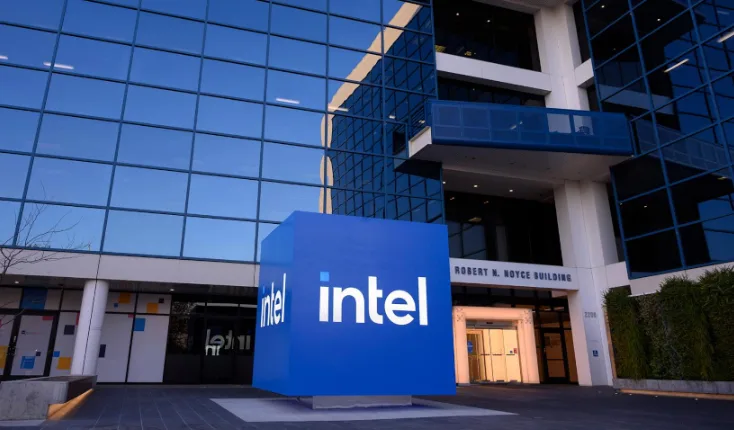
Intel Corp. saw its stock price jump beyond 3% in extended trading following the release of fourth-quarter earnings that surpassed analyst forecasts, even as the company's forward guidance proved less encouraging than hoped.
The chipmaker posted adjusted earnings of 13 cents per share, edging out the Wall Street consensus of 12 cents. Quarterly revenue reached $14.26 billion, representing a 7% increase year-over-year and exceeding the Street's projection of $13.81 billion.
On a net basis, Intel recorded a loss of $126 million for the quarter, a sharp reversal from the $2.67 billion profit it posted in the same quarter the previous year.
This earnings announcement marks the first financial report since Intel's board removed Chief Executive Officer Pat Gelsinger from his position. Gelsinger's tenure was marked by significant challenges, including the company's failure to capitalize on the artificial intelligence boom and erosion of its standing in critical segments like personal computers and data center processors. During his leadership, Intel invested billions in new manufacturing facilities without generating sufficient revenue to justify those expenditures.
Following Gelsinger's exit, Intel elevated finance executive David Zinsner and products chief Michelle Holthaus to serve as interim co-CEOs.
Holthaus characterized the fourth quarter as a "positive step forward" for the company, as it delivered revenue, gross margin and earnings all above guidance. She continued, "Our renewed focus on strengthening and simplifying our product portfolio, combined with continued progress on our process roadmap, is positioning us to better serve the needs of our customers. Dave and I are taking actions to enhance our competitive position and create shareholder value."
The company continues its hunt for a permanent chief executive to replace Gelsinger. Zinsner indicated during an analyst call that the search has not yet yielded any announcements.
AI Strategy Shifts
During the analyst call, Holthaus addressed questions about Intel's artificial intelligence roadmap. She disclosed that the Falcon Shores AI processor will serve only as a test chip for servers and will not move into commercial production based on customer input.
Intel had previously promoted Falcon Shores in 2023 as a potential competitor to Nvidia Corp.'s graphics processing units, which dominate the AI workload market. The announcement came after Intel halted work on its Rialto Bridge GPUs intended for server applications.
Looking ahead, Intel plans to concentrate its AI efforts on Jaguar Shores, a new offering designed to address a wide spectrum of AI data center applications, according to Holthaus.
Manufacturing and Process Technology
Intel anticipates reaching volume production of chips using its most cutting-edge 18A process technology during the second half of this year, when it will introduce its first central processing units built on this technology, internally designated Panther Lake.
Forward Guidance and Segment Performance
For the first quarter, Intel projects breakeven profitability with revenue in the range of $11.7 billion to $12.7 billion. Wall Street analysts had anticipated earnings of nine cents per share on revenue of $12.87 billion.
Zinsner attributed the guidance to "seasonal weakness" compounded by "macro uncertainties" including inventory normalization and competitive pressures. He also cited tariff-related uncertainty as a contributing factor.
Intel's Client Computing group, which produces personal computer processors, generated $8.02 billion in revenue, down 9% from the prior year but exceeding the Street's estimate of $7.84 billion.
"While difficult to quantify, we suspect a portion of Q4 revenue upside was due to customers hedging against potential tariffs," Zinsner stated.
The Data Center and AI segment, which supplies processors for cloud-based servers, posted $3.39 billion in revenue, down 3% year-over-year and matching the Street's projection. The Network and Edge unit contributed $1.62 billion in sales, up 10% from a year prior and surpassing the $1.5 billion consensus estimate.
Mobileye Results
Mobileye Global Inc., the publicly listed Intel subsidiary that manufactures chips for autonomous vehicle systems and advanced driver assistance technologies, reported separate results this morning. The company posted earnings of 13 cents per share against the consensus estimate of 11 cents, with revenue exceeding $490 million compared to the analyst target of $477.8 million.
Mobileye shares rose nearly 2% following its morning announcement but declined slightly during extended trading after the company issued subdued guidance for the fiscal year ahead. The company projects 2025 revenue between $1.69 billion and $1.81 billion, falling short of the Street's estimate of $1.94 billion.
Analyst Perspective
Holger Mueller, an analyst at Constellation Research Inc., told SiliconANGLE that market participants appear encouraged by Intel's performance. "It has made some surprising progress, delivering to expectations for the first time in a while, and that's what investors need to see," Mueller said.
Mueller also observed that the interim co-CEOs appear to be functioning effectively as a team, demonstrating competent management of the company's financial position. They have successfully reduced sales and marketing expenditures to approach breakeven while preserving critical research and development spending necessary for driving innovation.
"The challenge for Intel is that it needs to deliver on its R&D investments, as its overall cost structure still remains untenable in the longer term," Mueller noted. "Investors will be watching very closely for more progress in the first quarter."
Business Portfolio Restructuring
As Intel searches for a permanent chief executive, speculation has mounted regarding potential changes to its business divisions. Many analysts anticipate the company will divest its struggling foundry operation, which continues to generate losses. Last month, Intel announced plans to separate Intel Capital, its venture capital arm, into an independent entity.
Intel is also pursuing the sale of at least a partial stake in Altera, its unit that manufactures field-programmable gate arrays capable of being reconfigured for various computing applications. Intel acquired Altera for $14.5 billion in 2015.
Zinsner provided an update on the Altera process, stating the company is "far along on the process of Altera." He indicated that additional details would be available when Intel reports its next quarterly results in three months. "That will help generate some cash that we can use to deliver," he said.
Following Gelsinger's removal, there was considerable discussion about the possibility of Intel being acquired by a larger competitor, with Qualcomm Inc. and Broadcomm Inc. mentioned as potential acquirers. However, Broadcom CEO Hock Tan stated last month he has "no interest" in buying the company, and Qualcomm's level of interest is believed to have diminished.
Read more

Identity governance faces new test as AI agents proliferate across enterprises
Autonomous AI agents are forcing organizations to rethink how they manage access and permissions at machine speed. SailPoint's Navigate conference will explore how identity security must evolve to handle this expanding population of non-human actors.

Vertical AI and Purpose-Built Hardware Drive Next Wave of Technology Growth
Specialized AI systems tailored to specific industries are emerging as the primary engine for the next phase of technology expansion, according to insights from the Bank of America Private Tech Trailblazers Conference 2026.

CrowdStrike and CoreWeave Partner to Automate AI Security at Machine Speed
As cyberattackers breach systems in seconds, CrowdStrike and CoreWeave are embedding automated defenses throughout AI infrastructure, turning attacks into training data for faster response.