Google Brings AI Weather Forecasting to Energy Markets with WeatherNext 3
Google's latest AI weather model now targets grid operators and renewable energy developers with hourly forecasts of wind speed, cloud cover, and solar radiation—capabilities previously available only from specialized vendors.
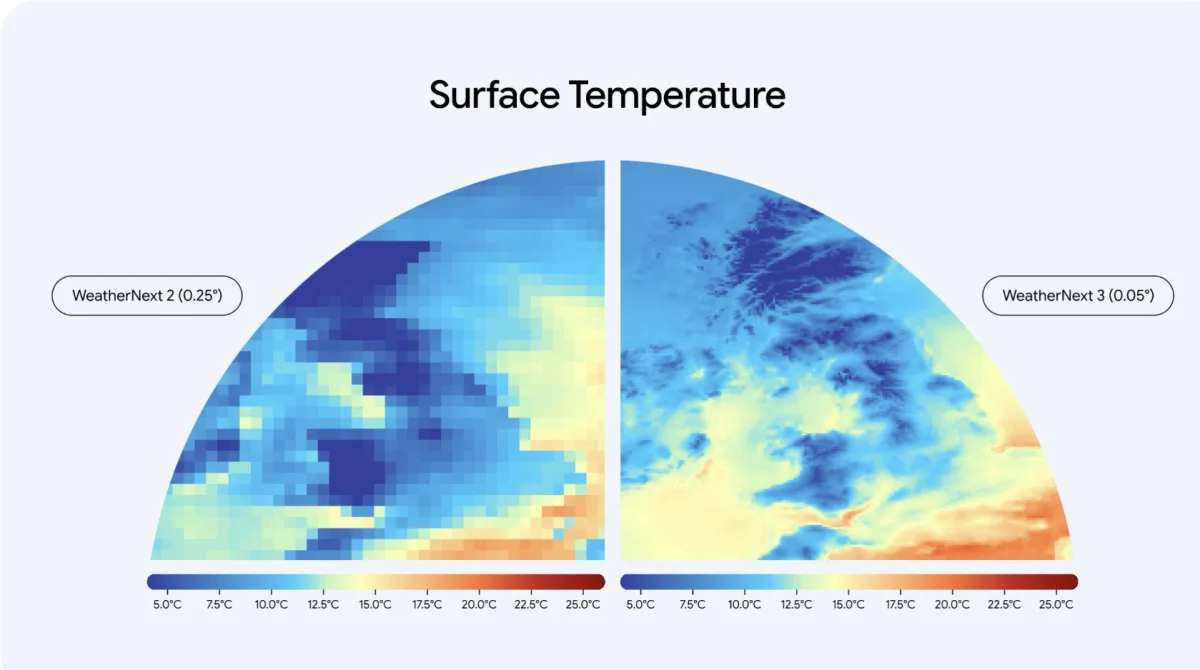
Google DeepMind and Google Research unveiled WeatherNext 3 on September 3, an artificial intelligence weather forecasting system designed to predict wind velocity at the 100-metre altitude where modern wind turbines operate. The model also generates forecasts for cloud coverage and surface solar radiation, refreshing every hour. These capabilities have long been available from specialized vendors serving energy traders, grid operators, and renewable energy companies. With WeatherNext 3, Google is now competing directly in this market.
The new model delivers global forecasts every hour at resolutions up to five kilometres for variables including temperature and moisture. Its predecessor, WeatherNext 2, operated on a 25-kilometre resolution grid and updated every six hours. Google positions the energy-specific variables as tools to help grid operators and developers estimate power generation from wind and solar installations and balance that output against electricity demand.
While consumer-facing deployment has received significant media coverage—WeatherNext 3 now supplies weather information in Google Search, the Gemini app, Google Maps, and the Google Maps Platform Weather API—the commercial opportunity lies in enterprise infrastructure. The same forecast data is accessible through BigQuery and Earth Engine or can be downloaded in bulk from Google Cloud Storage without requiring customers to configure the model themselves.
Why the energy sector is buying AI weather forecasting
Grid operators face mounting forecasting challenges from both directions. On the generation side, renewable sources now represent the majority of new electrical capacity. According to S&P Global Market Intelligence's US Grid Outlook 2026, solar and energy storage will provide the primary sources of new capacity in the coming year, contributing 51.2GW and 25.7GW respectively out of more than 90GW in planned additions.
Unlike conventional power plants, solar and wind installations produce electricity based on weather patterns rather than demand signals. Each additional gigawatt of renewable capacity makes short-term forecasting increasingly critical.
On the consumption side, data centres are driving unprecedented load growth. S&P Global identifies the expansion of data centre infrastructure across North America as a primary factor in recent electricity demand surges, prompting utilities to revise load projections upward. Deloitte's 2026 Power and Utilities Industry Outlook forecasts peak demand increasing by roughly 26% by 2035, with data centre consumption alone potentially reaching 176GW—five times its 2024 level.
Forecasting errors carry direct financial consequences. When operators underestimate incoming wind power, they must procure replacement electricity on short notice, typically from natural gas plants maintained on costly standby. Overestimating renewable generation forces wind and solar facilities to curtail output without compensation because the grid cannot accept the power being produced. Both scenarios impose substantial costs and reflect forecasting inaccuracy.
The market Google is entering
Providing weather forecasts to energy sector customers represents an established commercial segment. Vaisala, Solcast, DNV's WindGEMINI, and IBM's HyperWatch all operate in this space. Jua, a Swiss company, claims its EPT-2 model outperforms Microsoft Aurora and DeepMind's earlier GraphCast on accuracy while updating 24 times daily, compared to what it characterizes as the typical four updates per day among competitors.
Google's competitive advantage stems from its distribution infrastructure. The identical forecast appears as a table in BigQuery, a layer in Earth Engine, an API within Google Maps Platform, and as the default result in Google Search. No specialist weather vendor commands such extensive reach, and the hourly update frequency narrows the gap that competitors have previously exploited through more frequent refreshes.
Incumbent vendors retain one technical argument. Jua's stated position holds that physics-based models like ECMWF's HRES continue to outperform purely data-driven AI approaches during unprecedented extreme weather events, because physics models encode fundamental principles governing atmospheric energy and mass transport, whereas AI models recognize patterns from historical training data.
Jua markets a physics-constrained product, so this assertion aligns with its commercial interests. Nevertheless, it describes the conditions grid operators fear most—storms that exceed anything the model encountered during training.
What is new, and what is being oversold
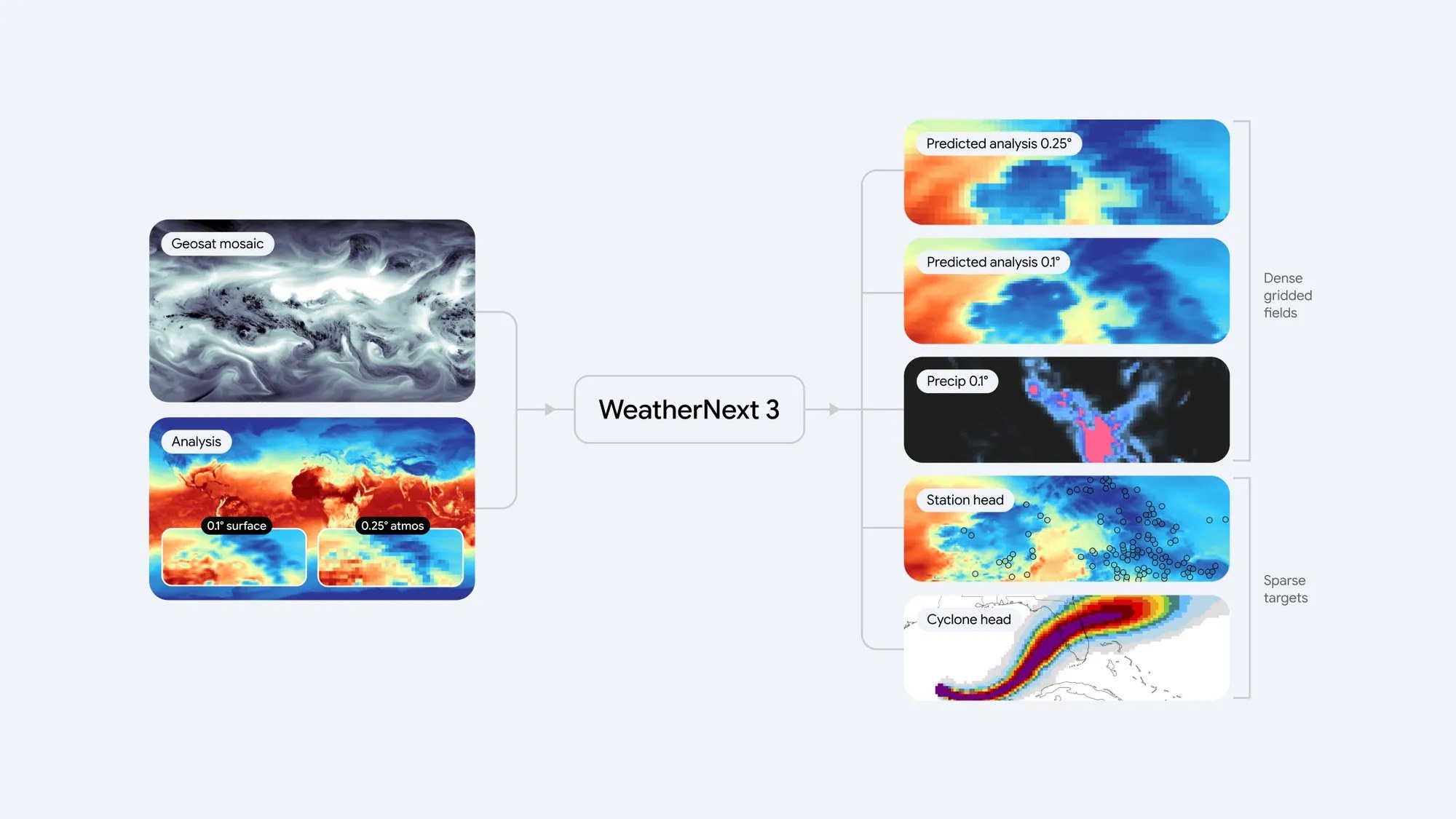
WeatherNext 3's core architectural innovation involves training on actual observations rather than simulated data. Most AI weather models, including WeatherNext 2, learn from output generated by numerical weather prediction systems—supercomputer-based physics simulations that introduce a six-hour data lag. This delay can bias fast-changing variables such as precipitation and surface temperature. WeatherNext 3 processes live geostationary satellite imagery and trains directly on measurements from individual weather stations.
The shift is genuine, though more limited than extensive media coverage has portrayed. Google's system diagram illustrates the model ingesting one-hour satellite mosaics alongside conventional historical analysis. DeepMind senior research scientist Ilan Price told Bloomberg that the improvement derives from avoiding the wait for the next analysis cycle and leveraging the most current available information.
Reports place the remaining data lag at three to four hours, down from approximately seven. Reliance on numerical weather prediction has diminished but persists.
The accuracy claims warrant careful examination. Google reports improvements reaching 60% against NASA's IMERG satellite product, 30% against MRMS radar, and 10% against rain gauge readings at early lead times, using a standard probability forecast scoring method. These represent three distinct comparison points, and the percentages do not combine. The frequently cited assertion of 50% superior precipitation forecasting applies specifically to predictions one day or longer ahead. Each figure includes an "up to" qualifier, indicating best-case rather than typical performance.
Google released no independent third-party validation concurrent with the launch. Instead, it references live evaluations by Brightband, whose leaderboard it cites when claiming WeatherNext 3 represents the most accurate global weather model available. A utility considering switching from a paid specialist vendor will prioritize performance within its own service region and on its own assets over global leaderboard rankings.
Google's own stake in the problem
Google is marketing forecasting solutions into a grid challenge that its own sector substantially contributed to creating. The data centre expansion driving the load growth utilities struggle to manage is spearheaded by hyperscalers, including Google, and Google has committed to multi-gigawatt renewable energy procurement agreements to power its own operations.
Precise forecasting of wind and solar generation directly benefits a company matching substantial clean energy volumes against a load that is simultaneously expanding and fluctuating. This commercial rationale partially explains why energy-specific variables appear in this release.
Google has not disclosed pricing for enterprise access to WeatherNext 3, nor clarified whether BigQuery and Earth Engine data access follows standard Cloud query pricing or requires a separate licence. Utilities contemplating a transition away from a paid specialist vendor will require this information before evaluating any accuracy claims.
Read more

Identity governance faces new test as AI agents proliferate across enterprises
Autonomous AI agents are forcing organizations to rethink how they manage access and permissions at machine speed. SailPoint's Navigate conference will explore how identity security must evolve to handle this expanding population of non-human actors.

Vertical AI and Purpose-Built Hardware Drive Next Wave of Technology Growth
Specialized AI systems tailored to specific industries are emerging as the primary engine for the next phase of technology expansion, according to insights from the Bank of America Private Tech Trailblazers Conference 2026.
CrowdStrike and CoreWeave Partner to Automate AI Security at Machine Speed
As cyberattackers breach systems in seconds, CrowdStrike and CoreWeave are embedding automated defenses throughout AI infrastructure, turning attacks into training data for faster response.