From Logs to Proof: How Enterprise AI Governance Must Evolve for Autonomous Agents
As AI agents move into production and begin delegating tasks across systems, enterprises face a new governance challenge: proving not just what agents did, but what they were authorized to do. The shift demands contextual authorization, cryptographic evidence and sovereign infrastructure.
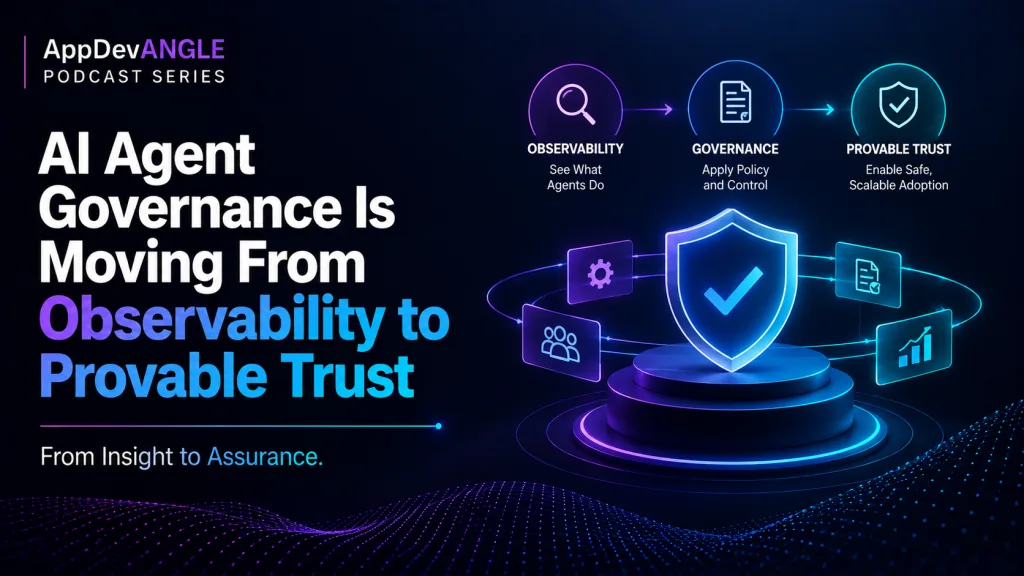
The transition of artificial intelligence agents from experimental prototypes to operational systems is forcing enterprises to confront a fundamental governance problem. Visibility into agent actions is no longer sufficient; organizations must now establish and demonstrate authorization at every step. This becomes critical as autonomous systems receive authority from humans, hand off tasks to other agents, call APIs and invoke tools—each handoff potentially altering what remains authorized.
The urgency intensifies as agentic deployments expand within regulated sectors, where compliance, security and data sovereignty requirements often prohibit reliance on external control platforms. In a recent episode of theCUBE Research's AppDevANGLE podcast, Sudeep Goswami, chief executive officer of Traefik Labs Inc., and Andreas Prins, who leads sovereignty strategy at SUSE Group, discussed how governance frameworks must adapt as autonomous agents make decisions and distribute work across intricate enterprise infrastructures.
From visibility to provable authorization
Enterprise observability has historically centered on examining what occurred after an event took place. Logs, traces and monitoring dashboards reconstruct which components participated and where problems emerged.
Agentic AI introduces a distinct governance challenge. An autonomous system may obtain authority from a person, pass a task to another agent, activate an API or tool, and then transfer portions of that task downstream. Each transition modifies the boundaries of permitted actions.
Identity and credentials alone cannot address this. "Just because an agent has some credentials, is that agent allowed to make this specific action right now, given the surrounding context around it?" Goswami asked. "A simple credential cannot answer that."
The situation parallels physical access management. An employee identification badge permits entry to a building, yet it does not inherently authorize financial approvals or access to all systems within the organization.
Governance must therefore become contextual. Policies should specify what an agent can perform based on its identity, the specific task, the surrounding environment, the chain of delegations and the operational circumstances of the request.
This transformation shifts governance from analyzing events after they occur toward real-time authorization decisions and verifiable proof.
Agent delegation breaks traditional accountability models
Complexity multiplies when agents begin assigning work to other agents.
Conventional enterprise access frameworks were constructed primarily for humans, software applications and fixed service accounts. Agentic systems introduce chains of machine-to-machine exchanges where authority moves through orchestrators, subagents, APIs and tools at machine velocity.
Prins drew a parallel to how continuous integration and continuous delivery systems evolved. Software organizations transitioned from manual production deployments to automated workflows, which required them to embed approvals, security validations, credential handling and deployment rules directly into the process.
"We go through that same thinking again," Prins said. "Let's rethink, and more importantly, let's articulate as code."
This becomes increasingly vital as enterprise agent counts grow. Prins recounted a recent discussion in which one executive learned that an engineering team had built roughly 8,000 agents.
"If you're unaware how many are created, you are also unaware what they're doing and what their function is," he said.
The implication suggests that agent proliferation may quickly exceed the capacity of conventional governance approaches. Enterprises may eventually require mechanisms comparable to software supply chain governance for agents: distinct identity, delegated authority, policy enforcement and documentation of how each system operated.
Policy enforcement must happen in context
Establishing policies represents only part of the solution. Enterprises also require mechanisms to apply those policies at the locations where agents interact with applications and systems.
This elevates the gateway layer to a critical role.
Goswami contended that AI governance systems must track both permitted and blocked actions. Demonstrating that a system successfully prevented an unauthorized action carries equal importance to confirming that an authorized task succeeded.
"You want to be able to showcase proof that your guardrails are working," he said. "Which means it should allow and deny, and you want to have that entire thing in context."
The enforcement layer can also feed information back into governance policies themselves.
When agents repeatedly attempt blocked actions, this pattern may indicate poorly constructed workflows, excessively permissive instructions or shortcomings in the policy design.
The outcome is a governance framework where policy creation, enforcement and documentation function as interconnected elements rather than isolated security operations.
Why audit logs may no longer be enough
Logging has traditionally served as the cornerstone of enterprise auditing, yet autonomous AI introduces a distinct trust concern: the system generating the evidence may also manage that evidence.
Goswami compared this to a vehicle odometer. If the vehicle owner can alter the mileage and serves as the sole source reporting it, there exists no independent method to confirm whether the record has been changed.
The identical problem can affect audit logs produced by applications and vendors.
"They can be tampered with, and there's no third-party way to know when and how it was tampered," Goswami said.
Cryptographic techniques can reinforce this trust framework by making alterations detectable. Rather than depending solely on standard logging, systems can cryptographically preserve decisions, authorization outcomes and agent operations.
Yet cryptographic signing alone does not fully resolve the issue.
Goswami maintained that enterprises additionally require independent verification to establish whether evidence has been altered following its creation.
"You need the logging capability at a cryptographic level, but then you also need a third-party verification mechanism to be able to check against it," he said.
This transforms observability information into something resembling verifiable evidence.
In highly regulated sectors, this distinction may prove consequential. An organization may eventually need to demonstrate not only what an agent performed, but also that its records could not have been modified afterward.
Sovereignty becomes part of the governance architecture
Governance grows more intricate when organizations cannot rely on externally managed control platforms.
Research discussed during the conversation indicated that 47% of respondents function within environments combining connected and disconnected systems, while 11% deploy generative AI specifically in on-premises and air-gapped settings.
This positions sovereign AI beyond a simple regional compliance consideration.
Organizations in defense, healthcare, financial services, government and comparable regulated sectors may require models, governance systems and verification mechanisms to operate entirely within environments under their control.
"The moment you become dependent on a third-party SaaS service that you don't control or it's not in your own soil, then all bets are off," Goswami said.
Prins characterized sovereignty as a risk-based determination encompassing both the model and the infrastructure supporting it.
Organizations can select from closed frontier models, open-weight models and open-source models. Each presents distinct tradeoffs regarding transparency, usability and governance.
The deployment environment introduces another consideration.
Enterprises may access models through a SaaS vendor or operate them within infrastructure they themselves manage. Prins argued that as workload and data sensitivity increase, the justification for customer-managed infrastructure strengthens.
"The more regulated, the more control you should have," he said.
Sovereign AI requires an ecosystem
The discussion underscored why sovereignty is unlikely to emerge from a single platform.
An enterprise AI infrastructure can encompass models, processors and graphics accelerators, Kubernetes systems, gateways, policy engines, observability platforms and evidence layers.
Each element contributes to determining whether an organization can manage and validate its AI environment.
"There is no single vendor that can deliver sovereignty all by themselves," Goswami said.
This elevates the importance of interoperability and collaborative relationships.
Traefik Labs and SUSE address the challenge from distinct stack layers. SUSE delivers foundational infrastructure and open-source components, while Traefik supplies gateway and agent governance systems.
Goswami outlined a sovereign design combining open-weight models, customer-controlled computational resources, gateway-based controls, observability and an evidence or provenance layer capable of validating agent conduct.
The overarching objective is to facilitate agentic system adoption while maintaining security and governance as integral architectural components.
"The objective is to ensure that there is a high degree of secure and scalable adoption of agentic workflows in the enterprise," he said.
The bottom line
AI governance is advancing well beyond dashboards and retrospective audit logs.
As autonomous agents begin calling APIs, delegating assignments and operating across enterprise systems, organizations must understand not only what transpired, but what authorization existed at each juncture.
This creates new architectural demands around contextual authorization, policy enforcement, machine-to-machine identity and verifiable evidence.
Sovereignty introduces an additional dimension. For organizations functioning in regulated, isolated or air-gapped settings, governance systems may need to execute entirely within customer-controlled infrastructure.
The shift moves from observability toward provability.
Enterprises deploying agentic AI will increasingly require architectures capable of addressing four questions: Which agents are active? What authority do they possess? Were they authorized to perform a specific action in the given context? And can the organization independently verify what occurred?
Organizations that address these questions promptly will be better equipped to expand agentic systems while preserving control over the authorization, governance and trust mechanisms supporting them.
Read more
Identity governance faces new test as AI agents proliferate across enterprises
Autonomous AI agents are forcing organizations to rethink how they manage access and permissions at machine speed. SailPoint's Navigate conference will explore how identity security must evolve to handle this expanding population of non-human actors.

Vertical AI and Purpose-Built Hardware Drive Next Wave of Technology Growth
Specialized AI systems tailored to specific industries are emerging as the primary engine for the next phase of technology expansion, according to insights from the Bank of America Private Tech Trailblazers Conference 2026.

CrowdStrike and CoreWeave Partner to Automate AI Security at Machine Speed
As cyberattackers breach systems in seconds, CrowdStrike and CoreWeave are embedding automated defenses throughout AI infrastructure, turning attacks into training data for faster response.