CoreWeave's Broader Stack Play: Why Inference Economics Are Reshaping AI Infrastructure
As inference workloads overtake training in AI deployments, CoreWeave is moving beyond GPU capacity into networking, storage and software to optimize the full system's token production efficiency.
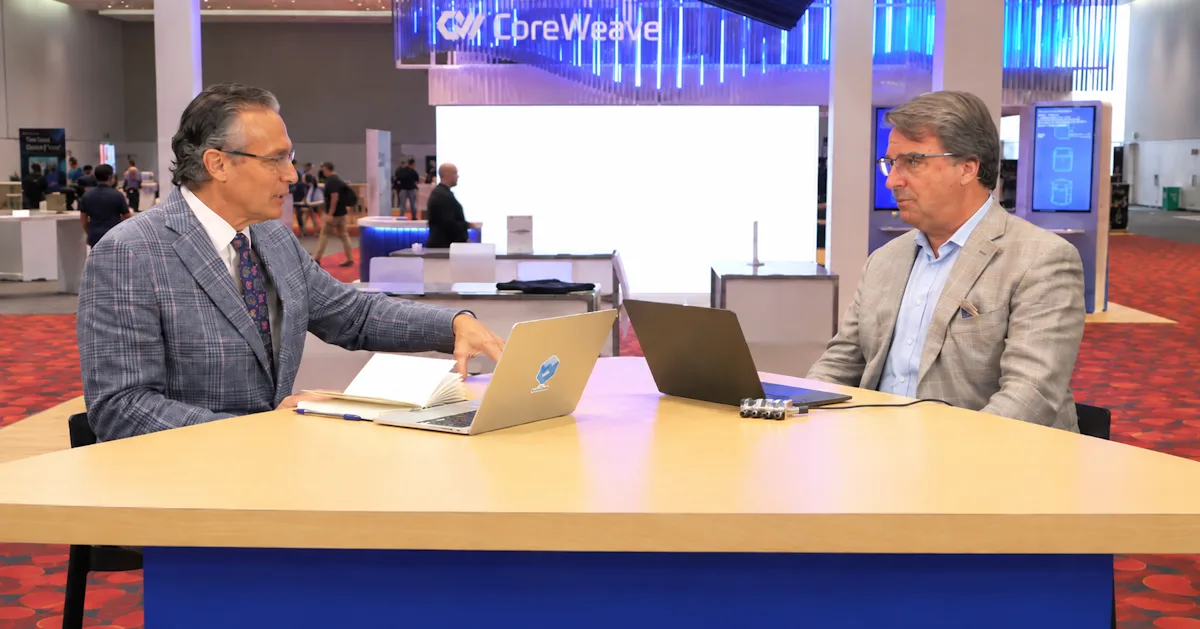
The efficiency of artificial intelligence infrastructure is increasingly measured through token economics. With AI work shifting away from training toward inference, the financial calculus of generating useful intelligence is now driving how organizations choose their infrastructure. CoreWeave is positioning itself for this transition by expanding its offerings across GPU compute, networking, storage and software layers as inference demand accelerates beyond training growth rates. According to Dave Vellante, chief analyst at theCUBE Research, this shift is fundamentally changing how customers evaluate capacity, utilization and the expenses tied to token generation at scale.
Speaking during a keynote analysis at the Fully Connected event broadcast on theCUBE, SiliconANGLE Media's livestreaming platform, Vellante outlined the scale of this transition. "Today they're at 50/50, and they expect to be 10/90 by next year," he said. "Both curves are growing. If you look at CoreWeave's numbers, they're off the charts." Vellante's remarks came during a discussion with Executive Analyst John Furrier about how inference expansion and system-wide optimization are reshaping AI infrastructure economics.
Token economics shift the infrastructure equation
The movement toward inference places greater focus on how effectively a complete AI system converts compute resources into practical output. This favors system designs that optimize across silicon, networking, storage and software components rather than concentrating on a single element. Furrier described this as a shift toward system-level performance optimization. "If that shift happens, these data centers will look a lot different with the game still the same," he explained. "Pump out as many tokens per watt as possible. Get the intelligence shipping. You got the perfect storm on the supplier side with Dell, ecosystems booming and CoreWeave in pole position."
Beyond performance metrics, the commercial landscape is shifting as well. CoreWeave's customer base is increasingly demanding shorter contract terms, spot pricing models and on-demand capacity access, Vellante noted. These flexible arrangements command premium pricing compared to traditional long-term commitments with guaranteed minimums, indicating that operational flexibility itself carries economic value in the AI infrastructure market. "The prices for those types of structures are much, much higher, and people are willing to pay," Vellante said. "It's going to be really interesting to see as that 98% starts to go down toward 50/50, how that's going to sort of affect the market."
CoreWeave builds beyond GPU capacity
While GPU availability may initially attract customers to CoreWeave, the company is deliberately expanding its technology stack to deepen customer relationships. The expanded strategy encompasses networking, storage and a software layer centered on observability, security and continuous improvement, providing CoreWeave with greater control over the complete infrastructure environment supporting AI workloads. Vellante outlined the strategic scope: "What you're seeing CoreWeave do strategically is they're expanding out beyond compute," he said. "They've got networking; they've got storage. They announced [CoreWeave] Forge today … they've got this software layer, which is observability. They've got security in there. They've got this closed-loop system between evaluation, observation, runtime curating … that's sort of how they're saying their software layer is now intact."
This comprehensive systems strategy also strengthens CoreWeave's partnership with Nvidia Corp., whose silicon remains foundational to the business. However, commercial differentiation increasingly hinges on how efficiently the entire infrastructure stack transforms those resources into productive tokens, Furrier emphasized. Hardware supply alone represents only one component of a broader performance equation. "This is becoming increasingly a systems game; it's a systems race," he said. "Silicon matters enormously. What's useful commercially is how quickly the entire system turns into useful tokens. At the end of the day, that's the key."
Read more

Identity governance faces new test as AI agents proliferate across enterprises
Autonomous AI agents are forcing organizations to rethink how they manage access and permissions at machine speed. SailPoint's Navigate conference will explore how identity security must evolve to handle this expanding population of non-human actors.

Vertical AI and Purpose-Built Hardware Drive Next Wave of Technology Growth
Specialized AI systems tailored to specific industries are emerging as the primary engine for the next phase of technology expansion, according to insights from the Bank of America Private Tech Trailblazers Conference 2026.

CrowdStrike and CoreWeave Partner to Automate AI Security at Machine Speed
As cyberattackers breach systems in seconds, CrowdStrike and CoreWeave are embedding automated defenses throughout AI infrastructure, turning attacks into training data for faster response.