Why Cash Flow Positive Wasn't Enough for Miro and Airtable
Bending Spoons acquired Miro and Airtable for $1.355 billion and $1.285 billion respectively, but their strong balance sheets and profitability didn't command premium valuations. The deals reveal what cash reserves actually buy—and what they don't.
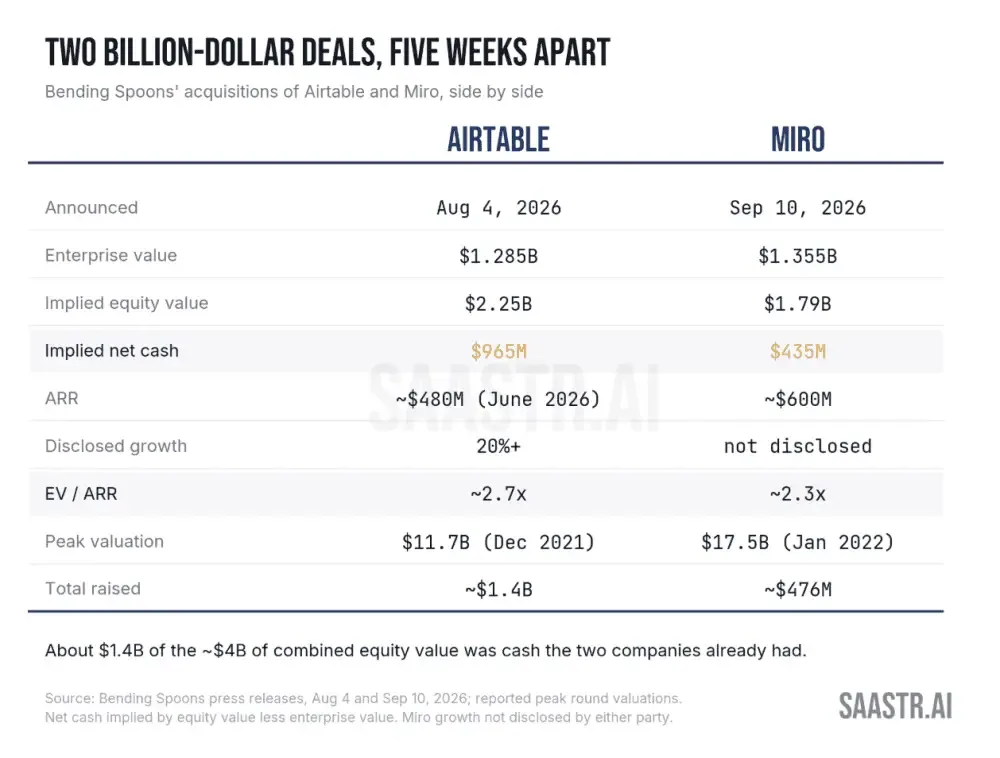
Within five weeks, Milan-based acquirer Bending Spoons announced two major deals: a definitive agreement to acquire Miro at $1.355 billion enterprise value, and the closing of its Airtable acquisition at $1.285 billion. Both companies were well-capitalized, profitable, and among the most recognizable B2B brands of the past decade. Yet their financial strength did little to move the needle on valuation multiples.
The two companies held roughly $1.4 billion in combined cash against approximately $4 billion in combined equity value—meaning a third of what changed hands in these transactions was money the companies already possessed. Both were valued below 3x annual recurring revenue (ARR), a modest multiple that underscores a broader lesson: reaching cash flow positive is a meaningful milestone, but it carries minimal weight at the exit.
Cash on the Balance Sheet Doesn't Command a Multiple
Airtable's equity value reached roughly $2.25 billion against an enterprise value of $1.285 billion, with the $965 million difference representing 43% of the purchase price. Miro's equity value sits at approximately $1.79 billion against $1.355 billion in enterprise value, with $435 million in cash accounting for 24% of the deal. Buyers pay enterprise value and return cash at face value—a 1.0x multiple. By contrast, Airtable's ARR commanded 2.7x and Miro's roughly 2.3x. In a company growing at 60%, ARR might fetch 8x or 10x.
Every dollar sitting in the bank earns the worst multiple on the cap table. It doesn't compound and it doesn't get repriced. Airtable held close to $1 billion and Miro held close to $500 million, yet neither generated returns in these transactions—the cash simply came back to shareholders.
Growth Rate, Not Balance Sheet Strength, Sets the Price
Bending Spoons disclosed that Airtable's ARR was growing over 20% year over year to approximately $480 million as of June 2026. Miro's announcement included its ARR figure of around $600 million, with nearly 90% from business and enterprise customers, a paying user count of nearly 4 million, and more than 750 customers generating over $100K in ARR—but no growth rate.
Third-party estimates place Miro's 2022 revenue at roughly $420 million, suggesting growth in the high single digits annually over the past four years. With 4 million paying users generating $600 million in ARR, the math works out to approximately $150 per paying user per year across a base that is 90% business and enterprise customers, layered atop a long tail of small seats.
Despite their different profiles, the two deals cleared within 40 basis points of each other on valuation multiples. Airtable at 2.7x with 20% growth and $965 million in cash. Miro at 2.3x with $600 million in ARR and $435 million in cash. Public comparables in that growth band trade around 2x. The balance sheet moved the price by roughly nothing; the growth rate set it.
An AI Rebuild Didn't Change the Trajectory
Airtable did not coast into this exit. CEO Howie Liu declared a refounding in June 2025 and shipped against it: Omni as a conversational interface, Field Agents as an execution layer, the DeepSky acquisition in October 2025 that brought in David Azose—who had led engineering for ChatGPT's business products at OpenAI—as CTO, and Superagent in January 2026, the company's first standalone product in thirteen years. Liu returned to writing code himself and described the prior two years as wartime leadership.
This represented a more serious rebuild than most B2B CEOs are attempting right now. By Liu's own January account, the company was generating cash with roughly half its raised capital still in the bank. The rebuild stabilized the business and made it defensible. It did not, however, move the growth trajectory to a number that changes the multiple. Twenty percent growth on $480 million gets priced as a cash-flow asset regardless of what the roadmap promises. The cash bought Liu the time to run that attempt. It could not make the attempt land faster.
Capital Efficiency Didn't Compound Into a Better Outcome
Miro announced profitability when it raised $400 million in its Series C at $17.5 billion in January 2022, and stated it had been profitable and growing 3x before the pandemic. Over fourteen years, the company raised $476 million total and remains profitable today with approximately $435 million in net cash. The company made cuts—119 people in February 2023 and a reported 275 in October 2024—but maintained a disciplined approach to capital.
Airtable took the opposite path, raising roughly $1.4 billion and burning through a significant portion, including two rounds of layoffs totaling 491 people. Despite opposite capital strategies, the two exits landed within about $500 million of each other, with Miro's equity value the lower of the two. Capital efficiency is a good habit, but it wasn't the variable here. Being profitable in 2020 didn't compound into a better answer in 2026.
No Competing Bids Emerged
Two of the most recognized names in collaboration software went to a Milan-based acquirer known for buying Evernote and WeTransfer and running them for earnings. No competing bid from Salesforce, Microsoft, or Atlassian has been reported for either company. No growth private equity process produced a better number.
For a well-capitalized B2B company growing 20% in 2026, that is the buyer set: an operator paying for cash flows rather than a strategic paying a control premium for the roadmap. A fortress balance sheet doesn't summon a second bidder—it lets you decline the first one. Both companies could have declined and didn't, which tells you what they thought another year of waiting was worth.
Miro Shareholders Reinvested Part of the Proceeds
Certain Miro shareholders agreed to reinvest $295 million of what they received into newly issued Bending Spoons stock, representing about 16% of the equity value going straight back across the table. Airtable, five weeks earlier, had no such arrangement—all cash.
Bending Spoons told the SEC in its F-1 filing that it views its cost of equity as relatively high and has been selective about issuing equity. Yet it issued $295 million here. The company's net cash from operating activities was $291 million for all of 2025 and $76 million in Q1 2026. Its July 1 IPO raised $1.68 billion. Airtable and Miro together represent roughly $3.1 billion of equity value. The arithmetic doesn't close on cash alone. The most active buyer in this category has edges on its balance sheet, and a seller at 2.3x ARR still had to take a sixth of the price in the buyer's paper.
What a Strong Balance Sheet Actually Buys
- A process instead of a fire sale. Both deals were unanimously board-approved, all-cash, with real advisors on both sides and normal closing conditions. Compare that to what happens to PE-backed B2B companies that hit a wall with PIK debt on the cap table.
- No bridge round at a 90% discount. Neither company had to return to the market in 2023 or 2024, when the market would have set the worst possible price.
- Exits above capital raised, both times. Airtable raised about $1.4 billion and cleared $2.25 billion, roughly 1.6x on capital in aggregate. Miro raised $476 million and cleared about $1.79 billion, roughly 3.8x. Aggregate multiples hide who got what: at Airtable, late-stage Series C through F investors reportedly got back roughly 1x on their preference while CRV, in early, is estimated to have returned 5-10x. Miro's terms aren't public, though the $400 million that came in at $17.5 billion in January 2022 is by itself 22% of the entire equity value the company just sold for.
- Cash to founders and employees, rather than a rolled-over promise.
- Funding for the rebuild attempt. Airtable spent 2025 and early 2026 shipping instead of fundraising.
All five are worth having. All five are about the downside.
Most Employees Will Lose Their Jobs After Getting a Check
Bending Spoons booked $78.6 million in reorganization-related expenses in 2025, per its own SEC filings, after taking on 1,830 employees from the AOL, Eventbrite, and Vimeo deals. The company expects a few hundred of those 1,830 to still be there at the end of 2026.
- WeTransfer: roughly 75% of staff cut within weeks of the July 2024 close, free plan later capped at 10 transfers a month.
- Evernote: bought for $200 million in 2023, most US and Chile staff cut, operations moved to Europe, price raised from about $100 a year to $249, free tier restricted.
- Vimeo: $1.38 billion deal closed November 2025, mass layoffs by January 2026.
- AOL: more than 100 employees cut after the October 2025 acquisition.
Luca Ferrari says 90% of Bending Spoons' code is now written by AI and that the company has around 1,000 acquisition targets identified. Matteo Danieli says customer retention has been remarkably stable through the changes. The model works and none of it is illegitimate. It's the deal.
For the well over a thousand people at Miro and whoever remains at Airtable, two things are true at once. Vested equity converts to cash at $1.79 billion and $2.25 billion, which for most rank-and-file holders with equity granted before the growth rounds is a real check of some size. And based on every prior Bending Spoons acquisition, most of those jobs go away inside a year.
Cash lets you pick the buyer and the timing. It does not give you a vote on what happens to the product or the team the day after close. The next owner cares less than you do, always, and a big bank account at signing changes nothing about that.
What to Do With $965 Million at 20% Growth
Cash flow positive is the state where nobody else controls your timeline. That's the benefit, and it's a way station rather than a destination. What matters is what you do while standing there. Airtable and Miro both had years of control and a combined $1.4 billion of dry powder, and neither converted the control into a growth rate that changed the price.
Get to default alive early, then stop treating it as a milestone. In this market you'll likely need it. Growth-stage capital is going almost entirely to AI-native companies clearing 100%+, and a 20% grower can't count on a next round at a price it likes.
Deploy the cash into the growth rate. A dollar of cash is worth $1. A dollar of ARR at 20% growth is worth $2.30. A dollar of ARR at 60% growth is worth several times that. If the money can move you from the first band to the second, spending it is the highest-return use available.
Treat a growing cash pile as a decision. Both of these companies would have been better off deploying $500 million into anything that moved the growth rate, including acquisitions, and getting it wrong. The downside of trying was capped at the 1x they were already going to get.
Watch the growth rate, not the bank balance. It's Grow or Die.
Read more

Spotify Founder's Health Screening Startup Neko Brings Preventative Medicine to the U.S.
The body-scanning company co-founded by David Ek has arrived in New York with a 300,000-person waitlist and backing from nearly $1 billion in funding.
FieldAI Seeks $700M at $10B Valuation as Robot AI Demand Accelerates
The robotics AI startup is in advanced fundraising talks that would quintuple its valuation from last year, according to sources familiar with the matter.
Tech hiring slows even as employers post record open positions
A surge in IT job listings to three-year highs masks a contraction in actual hiring, with technology sector roles declining and unemployment ticking upward.