Solo founders are winning—but only if they're exceptional
New data shows solo-founded companies are reaching profitability faster than ever, powered by AI tools that flatten the skill gaps that once made cofounders essential. But the advantage only extends to the most talented operators.
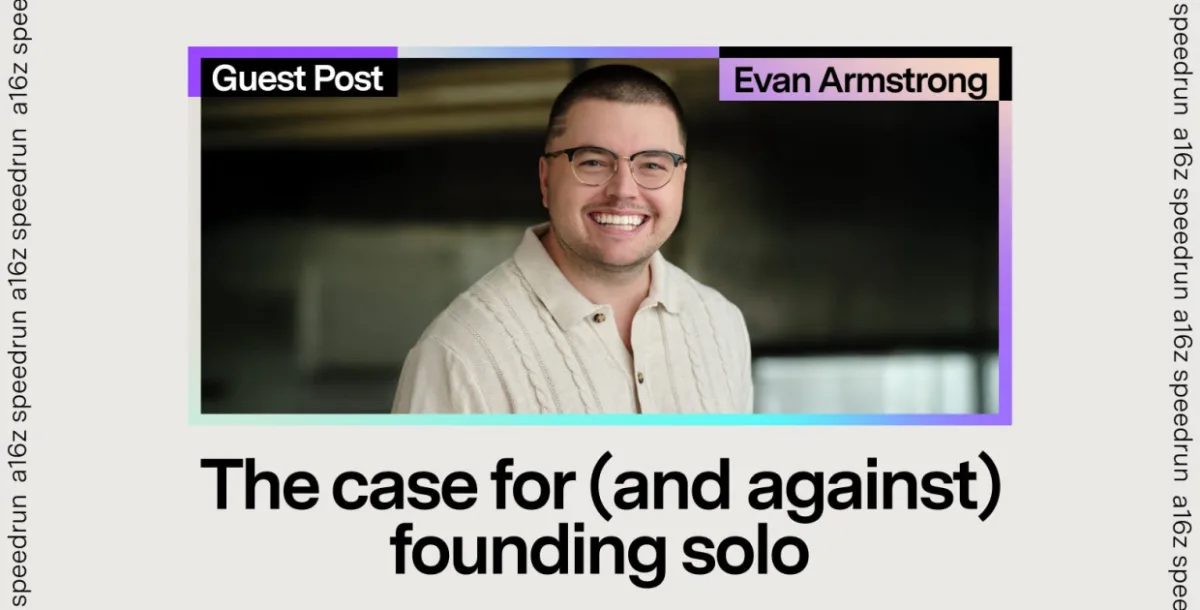
For decades, the startup world has treated cofounders as non-negotiable. The wisdom passed down through investor meetings and founder networks held that building a billion-dollar company required at least two people. Yet this conventional thinking may be cracking under the weight of new evidence.
Evan Armstrong, founder and CEO of The Leverage, a newsletter examining power dynamics in technology, argues that the calculus around solo founding has fundamentally shifted. His reasoning: hiring a cofounder represents the single most expensive decision a founder will make over a decade-long company-building journey, and recent data suggests many founders are succeeding without one.
The numbers tell a striking story. Solo founders accounted for 63% of C corporations established through Stripe Atlas in Q2 2026, marking an all-time high. Venture firms now operate programs exclusively for solo operators. But the real signal lies deeper in the data: these founders are reaching profitability at unprecedented speeds.
Among companies launched on Stripe, roughly 30% more businesses crossed the $1 million revenue threshold within a year in the 2025 cohort compared to 2023, and approximately three times more than in 2019. Stripe's income tracking shows that the share of solo operators hitting the highest income brackets has roughly doubled in two years. This suggests the companies being launched are materially stronger than previous generations.
How AI changes the cofounder equation
Historically, cofounders solved a straightforward problem: no single person possesses every skill required to launch and scale a company. A cofounder filled gaps in areas where the founder was weak. As AI models improve, however, they compress the value of generalist, complementary skills. These tools enable a new operating model—what Armstrong calls "the revenge of the idea guys."
Academic research backs this shift. A Harvard and INSEAD study tracked 515 high-growth startups through a three-month accelerator program. Half received standard entrepreneurship training. The other half received case studies demonstrating how AI-native companies restructure operations around artificial intelligence.
The results were dramatic. According to the researchers:
Treated firms complete 12% more tasks, are 18% more likely to acquire paying customers, and generate 1.9x higher revenue. Revenue and investment gains are largest at the 90th percentile and above, consistent with AI expanding the upper range of what firms achieve rather than modestly improving marginal ventures. Despite faster growth, treated firms do not scale inputs proportionally. Their demand for external capital investment falls by 39.5% relative to the control group, while their demand for labor remains unchanged.
Kim, Hyunjin and Kim, Dahyeon and Koning, Rembrand, Mapping AI into Production: A Field Experiment on Firm Performance (March 30, 2026)
Nearly double the revenue with 40% lower capital requirements represents a fundamental shift in how companies can operate. Yet this advantage is not evenly distributed.
The skill gap widens, not narrows
AI tools function as leverage for the most skilled operators, not as a universal equalizer. Stripe data reveals that in 2022, the top decile of solo founders out-earned the median solo founder by roughly 34 times in their first six months. By 2025, that gap had stretched to 61 times. The advantage compounds for those with the talent to exploit it.
The multifounder advantage persists at scale. By month 24 after founding, top-decile teams with multiple founders generate 53% more revenue than top-decile solo founders. The intuition is straightforward: one exceptional founder armed with AI is powerful, but two exceptional founders are more powerful still.
What investors actually care about
Venture investors have long used cofounders as a signal of founder quality, though the reasoning extends beyond raw capability. Andrew Chen, who works with a16z speedrun, frames it directly: convincing another talented person to join you "is probably step one in validating that it's a serious effort, idea, or team." The cofounder serves as proof of recruiting ability—the true skill that matters.
Emily Bennett, an investor at speedrun, has watched the solo founder wave build and is actively recalibrating her assessment. She observes founders assuming that because AI agents are outcome-focused, they can operate independently. Bennett pushes back on this logic, arguing that the real value of a cofounder is having "someone to push back on your ideas, that foil is what ends up being valuable."
She describes what she calls the "4o syndrome"—a state where founders become utterly convinced by an LLM that they possess exceptional product instincts. Since AI agents are "trained to self-perpetuate your own thinking," founders "actually want a counterpart...who'll tell you when you're being stupid."
The real decision
Going solo is now a defensible default. Exceptional founders no longer need a cofounder to earn investor credibility. However, an elite cofounder who provides emotional and intellectual partnership in ways AI cannot is potentially more valuable than ever. The catch: such people are extraordinarily rare, and few would choose to partner with an unproven founder.
The mistake lies in treating cofounders as a checkbox. Bolting on a cofounder because "you're supposed to" ranks among the costliest errors a founder can make. If a cofounder joins, the bar for quality rises, not falls. Solo success does not mean working in isolation—the best solo founders function as recruiting machines, pulling in early hires and networks with ease.
For the rare right person, the answer to whether a cofounder makes sense is an unambiguous yes. For everyone else, the question remains genuinely open.
Read more

Spotify Founder's Health Screening Startup Neko Brings Preventative Medicine to the U.S.
The body-scanning company co-founded by David Ek has arrived in New York with a 300,000-person waitlist and backing from nearly $1 billion in funding.

FieldAI Seeks $700M at $10B Valuation as Robot AI Demand Accelerates
The robotics AI startup is in advanced fundraising talks that would quintuple its valuation from last year, according to sources familiar with the matter.

Tech hiring slows even as employers post record open positions
A surge in IT job listings to three-year highs masks a contraction in actual hiring, with technology sector roles declining and unemployment ticking upward.