Private Company Boards Show Modest Gains in Gender Diversity, but Progress Stalls
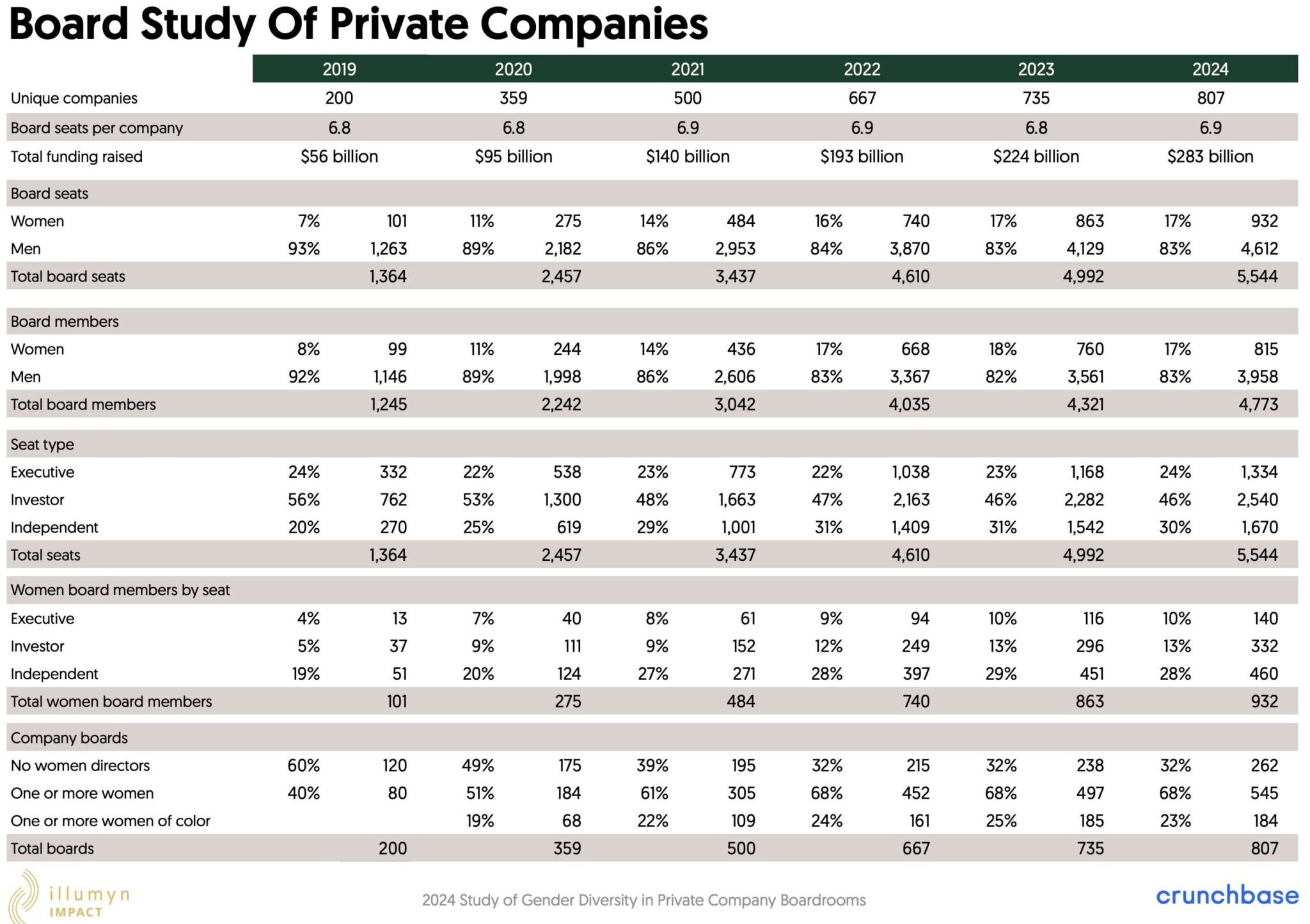
A new study tracking board composition at venture-backed firms reveals women have increased their representation from 7% to 17% since 2019, yet momentum has plateaued in the past year.

illumyn Impact, formerly known as Him For Her, partnered with Crunchbase to produce this research. Gené Teare from Crunchbase participated in the analysis, while Lauren Rivera, a Kellogg School of Management professor, helped develop the original 2019 benchmark framework that underpins the ongoing annual assessments.
Executive Summary
Over the six years since tracking began in 2019, the share of female board members at U.S. private companies has grown substantially—from 7% to 17%—while the prevalence of all-male boards has dropped from 60% to 32%. However, this upward trajectory has stalled. An examination of 807 privately held, venture-backed firms that have raised at least $100 million in cumulative funding shows virtually no improvement from the previous year.
As highlighted in the 2023 report, the slowdown in private company board development stems partly from reduced prioritization amid a challenging capital environment. The combination of fewer initial public offerings and a decline in early-stage venture investments in 2024 has shifted executive attention toward immediate operational matters, leaving board composition lower on the agenda.
Several encouraging signals suggest the potential for renewed progress ahead:
- Newer companies demonstrate greater gender balance on their boards
- The proportion of women serving as investor-directors has grown notably
- Fewer female directors now serve as the sole woman in the boardroom, broadening the network of potential candidates
As venture capital activity rebounds and the IPO pipeline strengthens, the expectation is for another significant shift in female representation on the boards of high-growth private enterprises.
Key Findings
- Female directors occupy 17% of board positions in the studied companies, compared with 7% in 2019
- From 2019 through 2024, women added approximately 0.65 board seats collectively; they now comprise roughly 1.2 of the average 6.9 board members
- Roughly one-third (32%) of companies lack any female board representation, a substantial improvement from 60% in 2019
- One in four company boards (23%) includes at least one woman of color, up from 19% in 2020
- Women represent 28% of independent directors, 13% of investor directors, and 10% of executive directors, compared with 19%, 5%, and 4% respectively in 2019
- 32% of female directors are the only women on their boards, a decline from 44% in 2020
- Companies founded after 2015 are less likely to have entirely male boards (26%) than those founded before 2016 (37%)
- Newer companies are substantially more likely to include a female investor-director (17%) relative to older companies (10%)
Methodology
This year's update follows the same research approach used in prior studies released in December 2019, March 2021, March 2022, March 2023, and March 2024. The current analysis examined 807 of the most heavily capitalized private U.S. companies to assess board makeup as of the fourth quarter of 2024—marking one year since the previous study and four years since the initial benchmark.
Using Crunchbase data, researchers identified 2,829 U.S.-based private firms established since 2003 that had accumulated at least $100 million in funding by June 30, 2024. To guarantee current board information, the study included only companies that publicly list their board members on their websites.
Board member profiles were compiled through company websites, Crunchbase records, and other public sources. The dataset encompassed only formal board directors, excluding board observers and advisers. Each director was categorized by seat type—executive, investor, or independent. Founders and former executives remaining on boards without active operational roles were classified as executive directors based on their prior company involvement. Gender identification relied on professional profiles in Crunchbase and supplementary sources when necessary. Racial and ethnic identity came from self-reported data where available, supplemented by contextual and visual information. Following U.S. Census Bureau standards, people of color encompass Black or African American, American Indian or Alaska Native, Asian, Native Hawaiian or Other Pacific Islander, and Hispanic or Latino populations. Individuals with Middle Eastern or North African backgrounds were not categorized as people of color.
About the Authors
illumyn Impact, the rebranded version of Him For Her, operates as a social impact organization dedicated to transforming the board ecosystem across sectors including healthcare, artificial intelligence, and climate solutions. The organization maintains a curated network of more than 8,000 under-represented executives, with women of color comprising one-third of this talent pool. Through targeted introductions, illumyn Impact connects fresh perspectives to boardroom roles and collaborates with over 100 leading private equity and venture capital firms. As a 501(c)(3) nonprofit, the organization receives support from founding partners including GV, IVP, L Catterton, Mayfield Fund, Silver Lake Partners, SoftBank, Starboard Value, and Tiger Global Impact Ventures, alongside individual supporters such as Brad Feld, Amy Batchelor, Reid Hoffman, Jeff Weiner, and Nasdaq. illumyn, its sister organization, operates a corporate boardroom excellence fellowship program for underrepresented leaders at major corporations.
Crunchbase functions as a predictive intelligence platform that analyzes private market trends through a combination of live company data, artificial intelligence, and activity signals from over 80 million users. The platform enables investors, dealmakers, and analysts to identify and capitalize on emerging opportunities. Additional information is available at crunchbase.ai, with updates shared on LinkedIn and X.
Read more

Spotify Founder's Health Screening Startup Neko Brings Preventative Medicine to the U.S.
The body-scanning company co-founded by David Ek has arrived in New York with a 300,000-person waitlist and backing from nearly $1 billion in funding.

FieldAI Seeks $700M at $10B Valuation as Robot AI Demand Accelerates
The robotics AI startup is in advanced fundraising talks that would quintuple its valuation from last year, according to sources familiar with the matter.

Tech hiring slows even as employers post record open positions
A surge in IT job listings to three-year highs masks a contraction in actual hiring, with technology sector roles declining and unemployment ticking upward.