Jesse Zhang on Finding Your Edge: Why Competitive Markets Signal Real Opportunity
The Decagon CEO discusses how he pivoted from a failed gaming app to building AI customer service agents, and why founders should embrace competition rather than fear it.
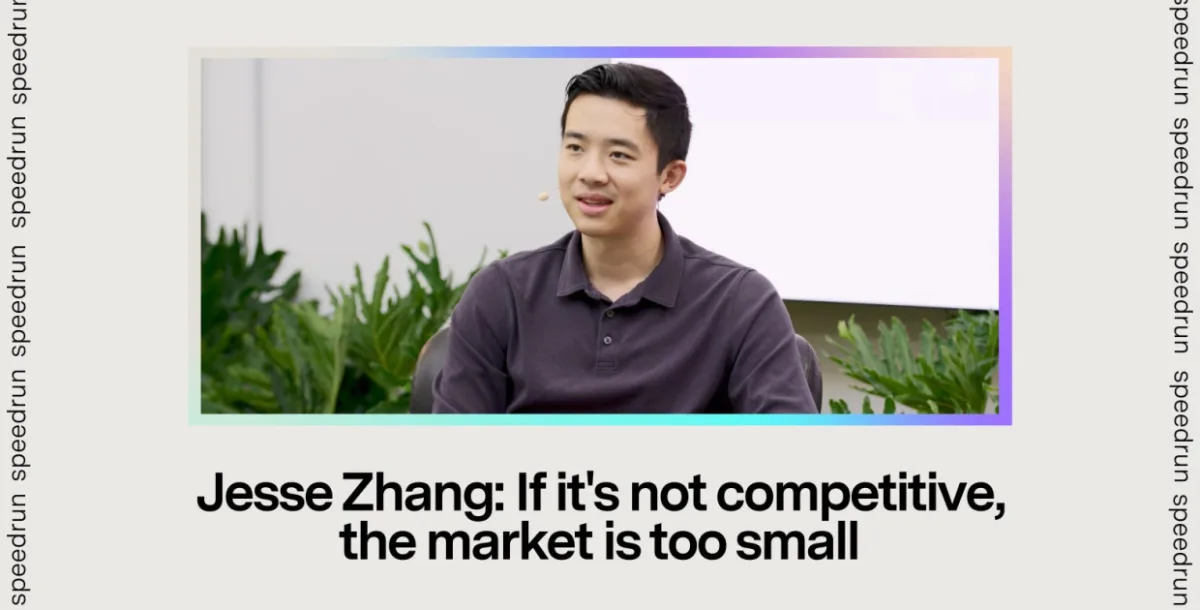
During a recent talk with a16z general partner Jonathan Lai, Jesse Zhang, co-founder and CEO of Decagon, shared insights from his journey building two startups. His first venture, Lowkey—a clip-sharing platform for gamers backed by a16z and Y Combinator—was eventually acquired by Niantic. Now, Zhang is leading Decagon, which develops AI agents handling customer interactions across chat, email, voice, and SMS.
Sam Altman told the assembled speedrun founders that "We're about to see the fastest pace of improvement for the models that we've ever seen." The cohort also includes Mara (SR004), which raised $7M in seed funding to develop drone defense technology, and Atorie (SR004), which secured $9.5M to offer luxury goods to consumers at reduced prices.
Learning from Lowkey's Missteps
When asked about his original hypothesis for Lowkey and what proved accurate or false, Zhang reflected on his approach as a solo founder:
Maybe my big learning was the attitude that I had. I was a solo founder for that one. But the attitude I had was, I think in hindsight, incorrect. It was: 'hey, I'm going to brute-force my way into creating something new. Startups are about creating something new, and we're going to invent something cool here.' Whereas I think it's not really like that. It's more that there's a map of how the world works, and maybe some of it's undiscovered, and your job is to discover it. You're discovering a need, or discovering something that new technology unlocks. And so we didn't really spend enough time actually trying to do that discovery and trying to find what people really cared about, and instead just kind of built stuff that was cool.
Jesse Zhang
The Discovery Process Behind Decagon
Zhang explained how his approach changed when founding Decagon. Rather than building in isolation, he and his co-founders conducted rapid customer conversations to validate ideas:
We would just talk to whoever was willing to talk to us. We would line up maybe a day of calls, and then from that day, we would try to build whatever we wanted to build at night. And we did that for maybe the first three or four weeks. Through that process, we coalesced around the current idea, because we had a lot of ideas going in.
Jesse Zhang
The goal of early sales conversations, Zhang emphasized, is extracting signal rather than collecting feature requests. The right questions focus on what customers struggle with, what they currently spend money on, and what they want to accomplish faster or more efficiently. Once founders understand these pain points, they can propose solutions and gauge willingness to pay.
The goal of the sales process is to actually get as much signal as possible. So you get into: 'if we built this for you, how much would you pay for it? How would you think about the ROI? Where's the budget coming from? Who needs to approve it?' And that line of questioning allows you to filter out ideas that may have seemed good in the past but are actually not good. The purpose of doing discovery is not really to have customers tell you product ideas. It's more to discover: what are the problems they would pay money to solve?
Jesse Zhang
Embracing Competition as a Market Signal
When Lai noted that customer support is a crowded category with well-funded incumbents and well-capitalized competitors, Zhang reframed competition as validation rather than a warning sign:
I think the reality is, if you believe my claim that there's a pretty finite number of good ideas that can become successful at any one time, then every one of those is going to be super competitive. And especially now, there are so many startups out there that everything is going to be competitive anyway. If something's not competitive, then I would argue that the market is probably too small, or something is weird. Even the super hard-tech stuff – everything's competitive. Everyone's just doing everything. So that means you have to embrace that, and just identify what you think your competitive advantage is and try to do more of that.
Jesse Zhang
Rather than avoiding competition, Zhang suggested founders should understand their rivals deeply and build strategy around their specific strengths—whether that's faster product iteration, superior sales execution, stronger networks, or other differentiators.
Productization Over Services
Decagon deliberately chose not to build a large forward-deployed services team, a decision that runs counter to current industry trends. Zhang explained this choice as an extension of his competitive advantage thesis:
I think our answer to the previous question was: hey, we think we can move faster, both on the product side and the go-to-market side, and so we should continue leaning into that. One way to move fast is to productize more and more. And if you can productize something faster, and it's easier to scale than other people, then that can be an advantage.
Jesse Zhang
Zhang acknowledged that forward-deployed work serves a purpose early on—discovering customer needs and bridging gaps between product and requirements. However, he cautioned against letting services become a permanent crutch. He cited Palantir as an example of a company that used forward-deployed engineering to "eat pain and excrete product," ultimately building a scalable offering rather than remaining a services business.
We don't think forward-deployed engineering should be a crutch to bridge that gap. You should either know that you're going to be a product, or you should commit the other way – which could also be a reasonable strategy – and become one of these deploy cos that are pretty popular now. My personal view is that the deploy cos are going to have a hard time scaling, because now there are really big deploy cos out there, like OpenAI and Anthropic. Our view is: hey, we want to have the best product. And that's why we've continuously doubled down on: how do you actually make it so that the effort to deploy is lower and lower?
Jesse Zhang
Selectivity as You Scale
Lai raised the importance of saying no to deals that don't fit the product roadmap. Zhang offered nuance for founders still early in their journey:
Yeah, there's no easy answer to that. I think in the early days, generally, if someone's willing to pay you a large contract, you should probably take that really seriously, because you could build a product around that. But then as you scale, ideally you want to find enough commonality between them so that you can build a product, and be more selective.
Jesse Zhang
The Digital Employee Opportunity
When asked what he would build if not at Decagon, Zhang pointed to the broader opportunity in AI agents that function as digital employees:
I think most of the traction that people are getting in the application layer is where you're actually able to essentially create a digital employee. And I think the mental model around the digital employee is kind of the same as what people are building now in robotics. Why are people going through all this effort to build humanoid robots, when it's really hard? It's because the world is designed for humans, and so you're not going to be as productive if you don't build a humanoid robot.
Jesse Zhang
Zhang sees the largest opportunities in markets where AI agents can interface with enterprise systems and teams the way humans do. Customer interaction represents one major category where AI has already proven capable, but he identified additional high-value areas in revenue-generating and back-office functions.
Read more

Spotify Founder's Health Screening Startup Neko Brings Preventative Medicine to the U.S.
The body-scanning company co-founded by David Ek has arrived in New York with a 300,000-person waitlist and backing from nearly $1 billion in funding.

FieldAI Seeks $700M at $10B Valuation as Robot AI Demand Accelerates
The robotics AI startup is in advanced fundraising talks that would quintuple its valuation from last year, according to sources familiar with the matter.

Tech hiring slows even as employers post record open positions
A surge in IT job listings to three-year highs masks a contraction in actual hiring, with technology sector roles declining and unemployment ticking upward.