Flam Secures $40M Series B to Scale AI-Powered Interactive Content Platform
The San Francisco startup has emerged from stealth with backing from QED Investors and others, claiming over 100 enterprise customers and near-$100M ARR.
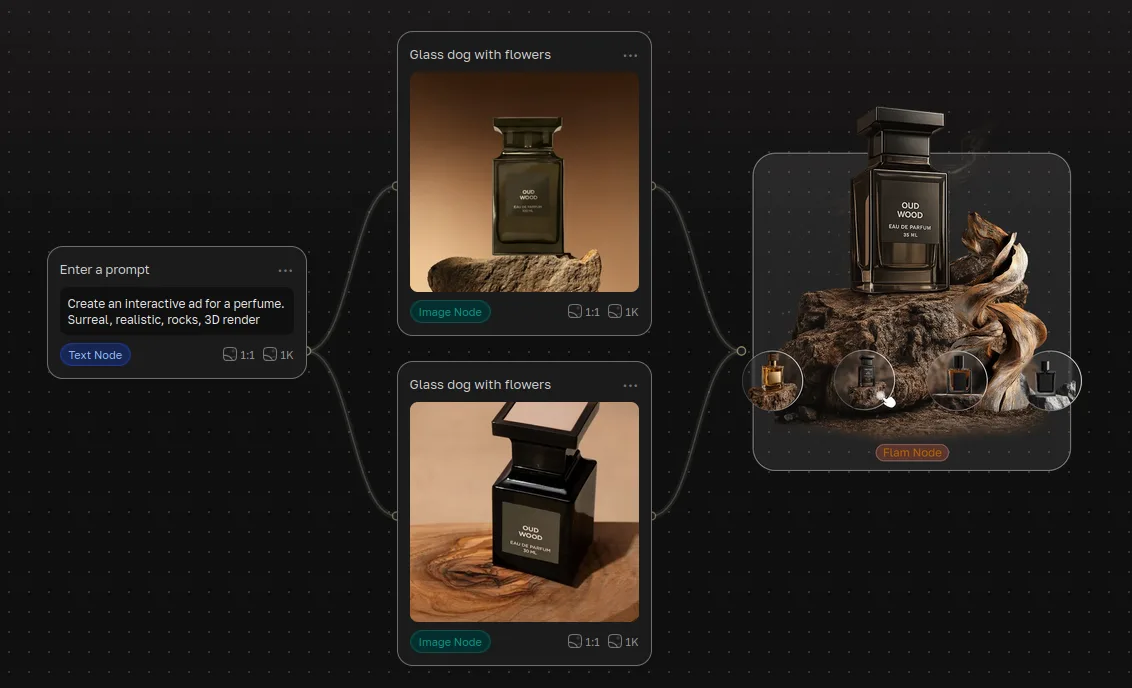
Flam, an interactive content startup, unveiled a $40 million Series B funding round today, marking its public debut after operating quietly to build what it describes as substantial early momentum. QED Investors led the round, with participation from Claypond Capital, Australian Gulf Capital, the SRK Family Office, and angel backers Martin Chavez and Olivier Pomel, CEO of Datadog Inc. Returning investors RTP Global and Dovetail also joined the funding.
The San Francisco-based company has developed a proprietary AI infrastructure layer that powers the creation of interactive videos, real-time 3D experiences and lifelike digital agents. Its platform generates these interactive experiences on demand, enabling creators to produce engaging content instantly for their audiences.
Founder and CEO Shourya Agarwal explained the company's origin story by tracing how digital media has progressed through distinct eras. Content began with text, evolved to images, then to video—yet each medium remained fundamentally one-directional, flowing from creator to viewer. While audiences have consistently sought more interactive experiences, Agarwal noted that creators lacked the tools to deliver them. Flam aims to solve this gap.
The company has assembled an infrastructure stack protected by more than 15 patents, enabling creators to construct programmatic content experiences across digital platforms. Flam refers to these as "flams" and has categorized them into three distinct varieties.
Three Types of Interactive Experiences
- Flicks are AI-generated interactive videos that employ AI compression algorithms to optimize playback and maintain instantaneous, fluid interactions.
- Airboards deliver high-fidelity 3D content experiences that stream directly to devices and camera interfaces. These assets can be created from text and image prompts using Flam's proprietary Fable model.
- Visual Agents function as hyper-realistic avatars capable of engaging users in real-time conversations resembling video calls. An identity-preservation and motion-transfer model called Fantom powers these agents, generatively streaming facial expressions.
The Visual Agents rely on Fantom working alongside Falcon, a 26 billion-parameter mixture-of-experts model capable of 30 millisecond time-to-first-token inference speeds. This architecture enables the agents to respond and act in real time.

Agarwal articulated the company's vision: "We don't just want to see the world; we want to reach out and shape it. Passive media was a limitation of technology, never of desire. We're doubling down on the AI research that makes interactivity feel effortless, and bringing Flam to every enterprise that wants its content to invite people in, rather than talk at them."
Despite its stealth status, Flam has accumulated notable traction. Over the past eighteen months, the company has onboarded more than 100 enterprise customers, including Google LLC. The startup projects it will reach approximately $100 million in annual recurring revenue, with management targeting that milestone for next year.
The capital will fuel continued research and development efforts, broaden the product portfolio with new flams, and strengthen sales capabilities. Flam intends to leverage the funding to establish itself as the foundational infrastructure layer for enterprises seeking to create and distribute interactive content.
Nigel Morris, Managing Partner at QED Investors, reflected on the competitive landscape: "The pattern has always been the same: compelling demos that never scale. What convinced us was the combination of a differentiated AI infrastructure, a platform enterprises can deploy without an engineering lift, and the commercial traction to prove it."
Read more

Spotify Founder's Health Screening Startup Neko Brings Preventative Medicine to the U.S.
The body-scanning company co-founded by David Ek has arrived in New York with a 300,000-person waitlist and backing from nearly $1 billion in funding.

FieldAI Seeks $700M at $10B Valuation as Robot AI Demand Accelerates
The robotics AI startup is in advanced fundraising talks that would quintuple its valuation from last year, according to sources familiar with the matter.

Tech hiring slows even as employers post record open positions
A surge in IT job listings to three-year highs masks a contraction in actual hiring, with technology sector roles declining and unemployment ticking upward.