Baselayer Lands $35M to Build Identity Infrastructure for AI Agents in Commerce
The business identity startup is launching its Agentic Identity Suite to address a critical gap: financial institutions have no way to verify which AI agents are trustworthy or what they're authorized to do.
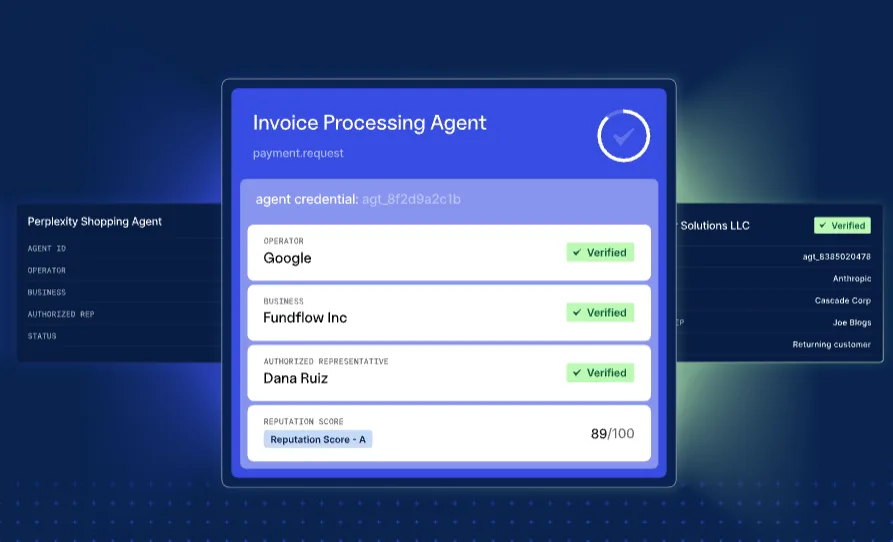
Baselayer, a startup focused on business identity and risk management, has secured $35 million in Series A funding as it pivots toward serving the emerging market of artificial intelligence agents conducting commercial transactions. The company is simultaneously unveiling its Agentic Identity Suite, which it describes as the first interoperable trust and fraud prevention layer built for agent-driven commerce.
The funding addresses what Baselayer sees as an urgent security gap in a rapidly expanding sector. Frontier AI models are now actively handling financial operations for businesses—processing payments, paying invoices and moving money—yet the financial infrastructure supporting these transactions was never designed to authenticate software agents. Stripe reported in June that over 70% of API requests it receives originate from AI agents, while major payment networks including Visa, Mastercard, American Express and Shopify have all rolled out protocols this year to accommodate agent-based commerce.
The fundamental problem remains unsolved: when an AI agent initiates a transaction, financial institutions and merchants cannot determine the agent's identity, which entity it represents, or whether it should be trusted. Baselayer was founded in 2024 by Chief Executive Jonathan Awad, whose background spans risk management, and Chief Technology Officer Timothy Hyde, recognized as a machine learning pioneer. The company previously built business identity verification systems now deployed across more than 2,300 financial institutions, including one in five U.S. banks. Its platform has evaluated over 10 million applications and blocked more than $1 billion in fraudulent transactions.
Awad explained the historical pattern: "Historically that infrastructure gets built only after fraud and abuse make the problem impossible to ignore. Agentic commerce is moving too fast for the industry to repeat that mistake. We already help one in five U.S. financial institutions answer, 'Can I trust this business?' Now we're building the infrastructure they need to answer, 'Can I trust this agent, who does it represent, and what is it allowed to do?'"
How the Agentic Identity Suite Works
The Agentic Identity Suite operates on a "Know Your Agent" framework, enabling financial institutions to cryptographically link an AI agent's transactions back to the platform that deployed it and the business that authorized its actions. This creates a verifiable chain of accountability without depending on passwords that could be compromised.
The platform includes a Model Context Protocol server and Agentic Search capability that anchor AI models to verified business data from authoritative sources like the Inland Revenue and Secretary of State. This approach helps ensure agents base decisions on factual information rather than AI hallucinations. The suite also features Counterparty Verification technology, which allows agents themselves to confirm whether businesses they're transacting with are legitimate, protecting companies from fraudulent counterparties.
Baselayer is pursuing a dual strategy: developing the technical infrastructure for compliant and secure agent commerce while helping establish industry standards. The company is collaborating with the FIDO Alliance Authentication Working Group, the Legal Context Protocol and the x402 Identity Working Group, alongside partners including Google, Cloudflare, Visa and Mastercard.
Investor Perspective
The Series A round was led by M13, with participation from Torch Capital, Picus Ventures, Afore Capital and additional backers. M13 Managing Partner Karl Alomar noted that AI agents have rapidly become significant economic actors despite lacking any underlying identity infrastructure. "This creates an enormous new trust problem, and we believe identity will become one of the foundational infrastructure layers of the agentic economy," Alomar said. "What made Baselayer especially compelling is that Jonathan and Timothy are not starting from a whiteboard. They already have a network spanning more than 2,300 financial institutions, deep risk data and infrastructure in production today."
Read more

Spotify Founder's Health Screening Startup Neko Brings Preventative Medicine to the U.S.
The body-scanning company co-founded by David Ek has arrived in New York with a 300,000-person waitlist and backing from nearly $1 billion in funding.

FieldAI Seeks $700M at $10B Valuation as Robot AI Demand Accelerates
The robotics AI startup is in advanced fundraising talks that would quintuple its valuation from last year, according to sources familiar with the matter.

Tech hiring slows even as employers post record open positions
A surge in IT job listings to three-year highs masks a contraction in actual hiring, with technology sector roles declining and unemployment ticking upward.