NiCE's Cognigy Shift: Why Running AI Agents Matters More Than Building Them
NiCE Ltd. released a redesigned Cognigy platform this week, betting that the real competitive advantage in enterprise AI agents lies not in raw model intelligence but in reliable operations, governance and the ability to blend autonomous reasoning with deterministic control.
Contact centers have emerged as the primary target for enterprise artificial intelligence deployment. When technology and business leaders discuss agentic AI applications, customer experience improvements anchored in contact center operations consistently top the list. Yet the industry has devoted the past two years to a misguided debate: which AI agent possesses superior intelligence. That framing misses the point entirely.
Model performance is advancing at a rapid clip while costs continue falling, making raw computational power and reasoning capability increasingly commoditized. The genuine obstacle enterprises face involves orchestrating multiple AI agents reliably throughout entire customer interactions while maintaining the oversight and command structures that large organizations demand. Without these safeguards, humans and customers alike end up piecing together responses from an expanding roster of agents they interact with simultaneously.
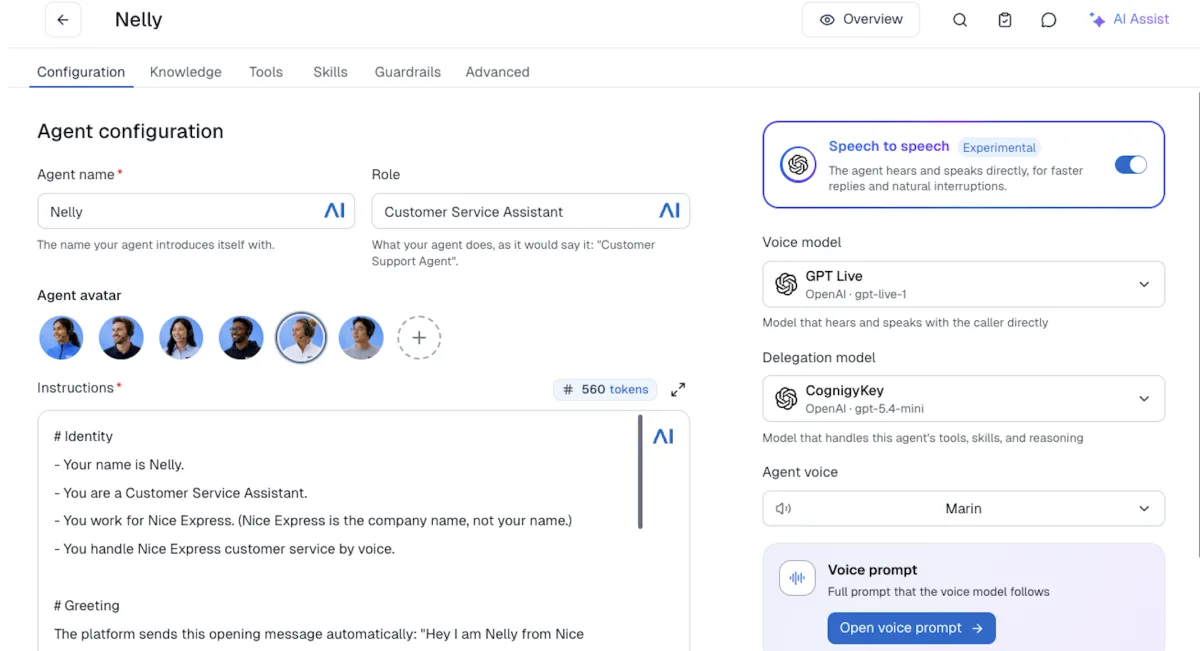
This philosophy underpins the latest iteration of NiCE Cognigy, unveiled by NiCE Ltd. this week. The update introduces a redesigned Agentic Experience Studio, an AI Assist tool that guides agent creation, testing and refinement, modular "skills" that bundle instructions and capabilities, step-by-step execution visibility and integrated voice-to-voice model functionality.
The pricing structure now bundles default speech-to-text, text-to-speech and large language model functionality into per-conversation costs. Customers can opt for premium alternatives from Deepgram, ElevenLabs and Anthropic, which are charged separately based on actual consumption.
Prior to the announcement, an analyst meeting included Nhu Ho, senior product marketing manager at NiCE Cognigy, and Clement Boutier, director of product management overseeing the development team and platform direction. Several critical themes emerged from this release.
Capable is not the same as dependable
Ho presented data illustrating how long AI systems can operate autonomously before requiring human intervention. In 2020, that window measured seconds; by 2024, it extended to minutes; currently it reaches approximately 16 hours. A crucial caveat accompanied this figure: the calculation assumed a 50% success rate. "Capable and dependable do not always mean the same thing," Ho stated. "That is exactly where the platform matters."
For customer experience leaders, this benchmark warrants serious consideration. A 50% success rate represents an academic achievement. In operational contact centers, it translates to customer attrition or regulatory violations. As model technology becomes standardized, competitive advantage migrates to the infrastructure surrounding those models: validation mechanisms, execution tracing, protective constraints and fallback procedures. NiCE does not develop foundational models, and organizations building frontier models do not operate contact centers. Positioning Cognigy as the layer that transforms AI into a dependable system represents sound strategic positioning.
Simplicity is a strategic fix, not a cosmetic one
Cognigy established its market leadership before acquisition by managing intricate production implementations for major enterprises including Lufthansa, Mercedes and DHL. However, that depth of customization introduced operational friction. Boutier explained: "The large number of options when configuring an agent creates friction to get started, which slows things down." The redesigned studio enables developers to launch agents in just a few clicks, with models already configured, while sophisticated capabilities—including direct access to agent system prompts—remain accessible through advanced settings.
This redesign matters strategically because NiCE seeks to create multiplicative value for its existing customer base. Cognigy must penetrate broadly across the CXone user base, extending beyond specialized teams at the largest corporations. Boutier identified three distinct builder categories: smaller organizations deploying straightforward agents, contact center administrators and team leads, and engineers at advanced technical organizations. AI Assist targets the first two segments specifically.
The demonstration showed an agent being constructed, tested, debugged and deployed to WhatsApp in rapid succession. The tradeoff is apparent: reducing entry barriers means more agents built by less experienced practitioners, which elevates the importance of governance capabilities as the genuine centerpiece of this release.
Hybrid is where the market actually lives
Despite widespread enthusiasm for autonomous agents, most enterprises remain hesitant to grant complete journey control to AI systems. Boutier outlined three operational modes: traditional language understanding, hybrid and fully autonomous. Hybrid represents "actually where most of our customers are," he noted, while fully autonomous implementations remain "at the beginning of the adoption curve." This framework allows organizations to transition gradually toward autonomous operation, building confidence incrementally.
The product architecture supports this progression. An agent can function as an orchestration layer, invoking existing workflows as tools. Workflows can also precede agents—for instance, to strip credit card numbers or other sensitive information before any data reaches a language model. Ho characterized the release as "an evolution, not a replacement," with existing production deployments, application programming interfaces and integrations continuing without modification.
This represents a meaningful advantage relative to AI-native competitors whose value proposition effectively demands a complete platform rebuild. Contact centers operate in fast-moving environments, and deterministic workflows are not outdated baggage. They represent how organizations enforce boundaries on what language models should not decide.
Observability is the new battleground
"You can have the best builder experience, but if you don't have any feedback loop on what you're building, you're never going to build a great agent," Boutier said. The new tracing capability displays each interaction turn: which skill activated, which tool executed and with which parameters, and when the agent transferred control to a workflow.
The Simulator now enables multivariate testing across up to 10 variants, deploying an LLM-as-judge to run synthetic customer scenarios against an agent. When Boutier tested the same agent across two models, he discovered one delivered faster performance while consuming fewer tokens. This transforms model selection from subjective preference into data-informed economic calculation.
The front door is about to get crowded
Voice-to-voice functionality may become the first feature customers implement at scale. Boutier noted that purchasers accept cascading speech-to-text and text-to-speech processing, "but what they realize is that voice-to-voice models sound just better." In the demonstration, the agent delegated tool operations to a separate model while maintaining conversation flow, producing substantially more natural dialogue.
Cognigy now operates as both a Model Context Protocol client and server and enables agent-to-agent connections, including a customer scenario linking Cognigy to agents built using Microsoft's platform. NiCE is co-developing the Personal Agent Protocol with Meta and Sierra, which has not yet launched. Boutier described Cognigy as "the front door" of the contact center, where consumer personal agents must authenticate before proceeding. NiCE's collaboration with Sierra, a direct market competitor, on this initiative benefits customers by reducing friction.
The industry treats agent identity as a collective responsibility. However, as Sierra demonstrates, companies can permit personal agents to operate through their websites and application programming interfaces, meaning the front-door position depends on enterprises routing that traffic through Cognigy. This approach allows brands to interact with personal agents in controlled ways.
A wave of organizations have prohibited personal agents, a stance that appears counterproductive. When something benefits consumers, it will occur regardless. Organizations gain more by leading adoption rather than resisting it.
Advice for IT pros
Final thoughts
This release emphasizes where value will accumulate as AI agents mature rather than introducing entirely novel capabilities. Intelligence costs are declining. Dependability, governance and the capacity to combine autonomous reasoning with deterministic safeguards are not.
NiCE holds the market leadership position in contact center as a service, just as Cognigy did in conversational AI. The challenge ahead involves distributing a more accessible Cognigy to thousands of CXone customers while preventing an unmanageable proliferation of independently governed agents. Success here will enable NiCE to preserve industry leadership as personal agents proliferate. When achieved, the Cognigy acquisition will transition from supplementary offering to essential platform component.
Read more

AT&T scales agentic AI to 500 production workflows, plans to triple deployment next year
The telecom giant is moving beyond productivity gains to redesign core business processes with autonomous agents, processing 45 billion AI tokens daily and handling over 1 million transactions monthly.
NATS messaging system moves to center stage as AI agent fleets reshape data center traffic
Machine-to-machine communication is surging as AI workloads and agent systems generate unprecedented volumes of ephemeral connections, forcing a reckoning with messaging infrastructure designed for steadier patterns.

Kubernetes gets new purpose running autonomous AI agents, Google donates open-source tools
Google is repositioning Kubernetes as the platform for enterprise agentic AI workloads, donating foundational open-source projects to the Cloud Native Computing Foundation to help orchestrate autonomous software more efficiently.