AT&T scales agentic AI to 500 production workflows, plans to triple deployment next year
The telecom giant is moving beyond productivity gains to redesign core business processes with autonomous agents, processing 45 billion AI tokens daily and handling over 1 million transactions monthly.

AT&T Corp. has progressed past using artificial intelligence merely to boost how employees work, instead deploying autonomous agents to fundamentally reshape its operational structure. The company currently runs nearly 500 agentic workflows in production and intends to expand that figure threefold during the coming year.
The telecom operator now consumes roughly 45 billion AI tokens each day throughout its organization, according to Luke Corbin, assistant vice president of digital transformation and AI at AT&T Business. The agentic AI platform processes in excess of 1 million transactions per month. A significant portion of these workflows function without human intervention, executing responsibilities that span from customer provisioning through sales prospecting.
During remarks at an Amazon Web Services Inc. gathering in Boston this month, Corbin emphasized that AT&T's strategy centers on reimagining complete business processes rather than merely automating discrete functions. The organization has transitioned swiftly from testing generative AI capabilities to methodically pinpointing business processes suitable for redesign using agentic technologies.
Driving this transformation is Business Agent Foundry, an internal group launched in early 2025 tasked with partnering across business divisions. Rather than gathering scattered automation suggestions from the workforce, the foundry applies industry-standard frameworks to examine business processes and uncover ways to strip away redundant steps, cross-departmental transfers and reliance on outdated systems, Corbin explained.
An early undertaking focused on streamlining how AT&T communicates with its legacy mainframe systems. Previously, modifying customer fiber installation orders meant staff would pull tickets from queues, manually revise data and feed them back into the system.
Agentic automation removed segments of this hands-on work, cutting wait times and quickening service rollout. "It was kind of cool having some of the most advanced technology talking to some of the oldest that we have," Corbin said.
In a separate case, AT&T cut in half the duration needed to activate dedicated internet links in structures where fiber networks were currently present.
A different approach
AT&T's setup diverges from standard models that construct numerous isolated, task-specific agents. Rather, the organization maintains a limited collection of agents that carry out business workflows drawing on centrally controlled business logic.
"We store the business logic in context or in memory," Corbin said.
Retrieval agents locate pertinent information, while planning agents decide which actions, tools and information sources are necessary to accomplish an objective.
Oversight forms a cornerstone of this framework. Individuals within the company may freely construct agents for their own use, yet workflows that could affect customers must receive approval from the foundry and pass through security, privacy and compliance screening.
"We've democratized agents to the point where people can use them for personal productivity, but not to where you would drive business workflows that could touch your customers or materially have an impact on your business," Corbin said.
Each workflow deployed to production initially requires human supervision. Agents can transition to fully autonomous operation only once their accuracy climbs into the mid- to high 90% range and stays within an acceptable risk threshold. Ongoing surveillance tracks how they perform and identifies any degradation.
Measurement focuses on labor reduction, income growth, expense reduction and customer experience. Corbin noted that production-level AI initiatives are yielding returns five times their initial investment within twelve months.
A firm spanning 151 years that has relied on computing technology since its inception "is built on a lot of legacy processes and applications," Corbin said. "The cost of maintaining those applications, training employees to use them and ongoing maintenance is very high. When you can offset some of that with simpler generative workflows, you've got a business case that's built for itself."
Finding and qualifying sales leads represents one area seeing gains. Agents screen potential customers by verifying their locations and confirming fiber service availability before sales staff dedicate effort to pursuing deals.
Harmonizing data
Expanding these capabilities demands more than just AI models. AT&T has needed to consolidate scattered information sources and guarantee steady data movement spanning data centers, cloud platforms and field personnel.
"We've been through a lot of mergers and acquisitions," Corbin said. "You can imagine what our data infrastructure looks like."
Inviting staff to submit recommendations for agent-based solutions has aided in reducing pushback from those concerned about job displacement. The chance to eliminate inefficient operations has also helped.
"There are a tremendous number of people in the organization who have knowledge and passion about the business process that they used to use but that they didn't like," he said.
Corbin indicated AT&T is now reorienting its efforts from refining current operations toward leveraging agents to establish new offerings, penetrate fresh markets and enable additional sales routes.
Looking ahead, Corbin believes that ownership of AI-driven business transformation ought to be dispersed across the enterprise rather than held by a dedicated group such as Business Agent Foundry.
"I feel privileged to have the team that I do, but in the long run, my team shouldn't exist," he said. "What we do should be completely distributed."
Read more
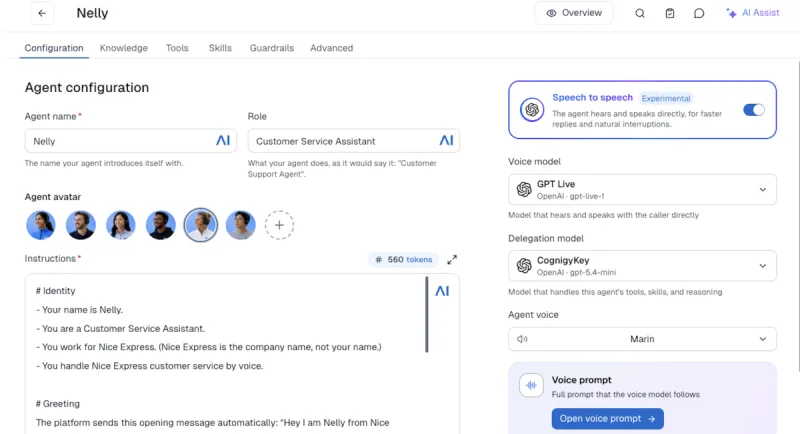
NiCE's Cognigy Shift: Why Running AI Agents Matters More Than Building Them
NiCE Ltd. released a redesigned Cognigy platform this week, betting that the real competitive advantage in enterprise AI agents lies not in raw model intelligence but in reliable operations, governance and the ability to blend autonomous reasoning with deterministic control.

NATS messaging system moves to center stage as AI agent fleets reshape data center traffic
Machine-to-machine communication is surging as AI workloads and agent systems generate unprecedented volumes of ephemeral connections, forcing a reckoning with messaging infrastructure designed for steadier patterns.

Kubernetes gets new purpose running autonomous AI agents, Google donates open-source tools
Google is repositioning Kubernetes as the platform for enterprise agentic AI workloads, donating foundational open-source projects to the Cloud Native Computing Foundation to help orchestrate autonomous software more efficiently.