Cloudera's EVOLVE26 Shifts Focus to Making Hybrid AI Production-Ready
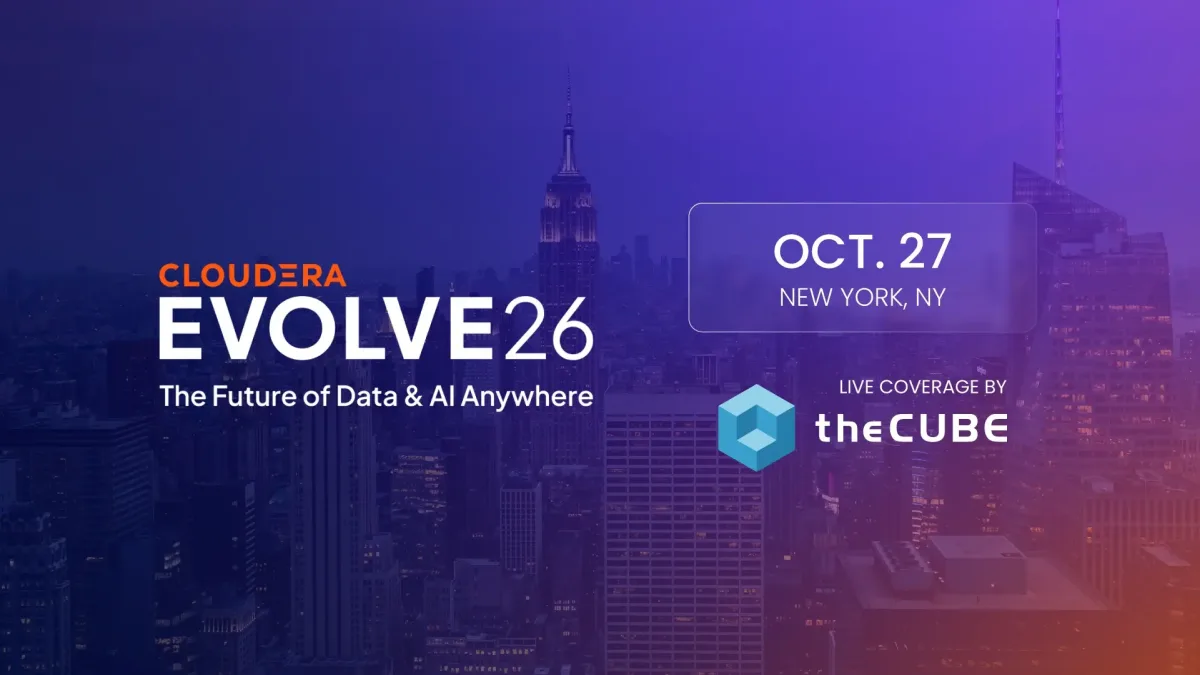
As enterprises move AI agents from pilots into production, Cloudera is demonstrating how its hybrid infrastructure strategy can manage data governance and security across cloud and on-premises systems. TheCUBE will cover the company's latest capabilities at EVOLVE26 on October 27.
Deploying AI agents at enterprise scale involves far more than raw computing resources. Organizations must handle data security, governance and performance across multiple environments—cloud infrastructure, on-premises systems and the edge—especially as agentic workflows transition from experimental phases into live operations.
At EVOLVE25 last year, Cloudera positioned itself as a hybrid infrastructure provider with an "AI anywhere" vision spanning edge, on-premises and cloud environments. This year's EVOLVE26 event in New York will showcase how the company is turning that vision into operational reality. According to Paul Nashawaty, principal analyst for theCUBE Research, "Last year, the narrative was about establishing a hybrid, 'AI anywhere' foundation. This year, expect the conversation to pivot to the operationalization of that vision. The focus has moved from abstract potential to the mechanics of running production-grade AI at scale, proving that enterprise data architectures can handle the rigors of agentic workflows."
TheCUBE will examine Cloudera's translation of hybrid AI strategy into production capabilities, including advances in data governance, agentic workflows and distributed AI deployment. Coverage airs October 27 and features conversations with industry leaders and subject matter experts.
Cloudera advances 'AI Anywhere' capabilities
Cloudera, historically cautious about public cloud adoption, has made hybrid infrastructure central to its AI strategy. In August, the company unveiled Cloudera Anywhere Cloud, a platform enabling organizations to deploy and manage AI applications across public cloud services and on-premises infrastructure. The platform also allows enterprises to apply AI to proprietary data without transferring sensitive information between systems.
Cloudera Anywhere Cloud reflects a strategic maturity toward 'AI everywhere,' moving from just having access to data to having the capability to deploy agents where the data lives. It highlights an architectural shift where the compute moves to the data, rather than the alternative, which is critical for reducing latency and maintaining governance in distributed enterprise settings.
Paul Nashawaty, principal analyst for theCUBE Research
This architectural approach addresses a fundamental challenge enterprises face: AI agents require access to business data, but transferring that data between environments creates security vulnerabilities, regulatory complications and operational expenses. Cloudera Anywhere Cloud gives organizations control over where AI workloads execute while supporting applications on existing infrastructure and enforcing consistent governance across distributed systems.
The strategy reflects Cloudera's effort to streamline hybrid AI deployments as organizations move beyond initial proof-of-concept projects. Rather than forcing enterprises to consolidate data in a single location, the platform supports AI workloads across their existing infrastructure footprint.
Organizations shouldn't have to choose between innovation and control. Cloudera Anywhere Cloud brings the speed and flexibility of the cloud directly to enterprise data, allowing customers to accelerate AI initiatives while maintaining complete ownership of it, with optimized cost of infrastructure and tokens.
Leo Brunnick, Chief Product Officer at Cloudera
The central question for EVOLVE26 concerns whether this approach can reliably support production-scale AI workloads. Beyond agent deployment, enterprises must manage workload efficiency, infrastructure spending and the governance mechanisms needed to oversee autonomous systems operating across multiple environments.
Mistral partnership strengthens data sovereignty options
Data sovereignty represents another pillar of Cloudera's hybrid AI strategy. For organizations operating across multiple countries or within regulated sectors, the ability to leverage proprietary information without routing it through external AI services significantly influences their technology choices.
Cloudera positions its governed data architecture as the foundation for such deployments, enabling organizations to run AI workloads while retaining control of sensitive information. This approach distinguishes Cloudera from infrastructure vendors focused primarily on compute capacity, according to Nashawaty.
Cloudera's competitive edge is its ability to bridge the gap between data-at-rest and data-in-motion. While other cloud infrastructure providers offer raw compute, Cloudera is distinguishing itself by providing an open, governed data layer that remains consistent across hybrid environments. It isn't just about storage; it's about providing the trusted data foundation that AI applications require to be performant and compliant.
Paul Nashawaty, principal analyst for theCUBE Research
In September, Cloudera announced a partnership with Mistral AI SAS, a French AI developer, adding another dimension to this strategy. The collaboration, revealed ahead of EVOLVE26, brings Mistral's models and customization tools closer to enterprise data managed through Cloudera's platform. This gives customers an additional pathway for building specialized AI applications without exposing proprietary information to external systems.
Mistral Forge, which enables enterprises to customize AI models using their own data, represents a particularly significant component. For organizations with strict data residency rules or intellectual property concerns, this capability carries substantial value, according to Steve McDowell, chief analyst at NAND Research.
Mistral Forge is the most compelling part of this announcement. Being able to use enterprise data to create and fine-tune a Mistral model without moving that data is extremely powerful. It brings a known model backed by a known entity, which can appeal to enterprises concerned about the origins of open-weight models, most of which are developed in China. It's a more flexible approach than we see with OpenAI, Anthropic and Google, which all require you to bring your data to them.
Steve McDowell, chief analyst at NAND Research
At EVOLVE26 in New York, Cloudera and Mistral AI will participate in hands-on sessions addressing the practical challenges of moving agentic workflows into production while preserving enterprise data control.
Cloudera faces the broader challenge of proving that its hybrid AI architecture can simplify deployment without requiring organizations to compromise flexibility or control. TheCUBE's coverage will offer additional viewpoints on how these capabilities are being deployed and where enterprises continue to face obstacles when scaling AI operations.
Event coverage details
TheCUBE will provide live coverage of EVOLVE26 on October 27, with exclusive content available on demand following the event. Coverage is accessible through theCUBE's dedicated website and YouTube channel, with additional reporting available on SiliconANGLE.
SiliconANGLE produces "theCUBE Pod," available on Apple Podcasts, Spotify and YouTube, where hosts John Furrier and Dave Vellante discuss major trends in enterprise technology including AI, cloud, cybersecurity and infrastructure. The outlet also produces "Breaking Analysis," a weekly program where Vellante examines significant enterprise technology developments using theCUBE insights combined with spending data from Enterprise Technology Research, available on the same platforms.
Read more

Compliance Becomes Strategic: How Banks Are Mining Employee Communications for Business Intelligence
At the Smarsh EDGE conference, financial institutions revealed how they're transforming regulatory archives of employee messages into competitive advantages through AI-powered analysis—but only if governance is built in from the start.

Hackers Are Weaponizing AI Agents to Automate Intrusions at Scale
CrowdStrike has documented threat actors deploying agentic AI to orchestrate sophisticated cyberattacks with minimal human oversight, with incidents doubling month-over-month in late 2026.
IBM's Governed Context Strategy: Making Real-Time Data Work for Production AI Agents
IBM is positioning governed context—current, relevant business information delivered to AI agents in real time—as essential infrastructure for enterprises deploying autonomous decision-making systems. The approach treats data delivery as an operational requirement, not an afterthought.