Satlyt Demonstrates Distributed Computing Across Orbiting Satellites
The startup has successfully tested software that orchestrates computing tasks across multiple spacecraft in orbit, moving closer to its vision of turning satellites into networked data processing hubs.

Rama Afullo's enthusiasm was immediate when his company achieved a major milestone. Satlyt develops software designed to repurpose existing satellites as interconnected data processing networks—essentially orbital data centers. The startup just moved significantly forward on this ambition.
Following 13 months of development, Satlyt conducted a successful test this month in collaboration with the University of Houston as part of a NASA-funded research initiative. The demonstration proved that the company's software can distribute computational work among orbiting computers based on available bandwidth and processing capacity.
The vision, according to Afullo, involves creating software that links numerous satellites together to coordinate computing assignments. Operators using this system "will only need to define permissions, priorities, and operating limits," Afullo explained to TechCrunch, "while the software will make decisions within those limits." The company's software currently operates on three satellites already in space, with this test representing the initial validation of that broader concept. Although the test received NASA funding, the agency has not yet committed to any specific mission deployment or selected the technology for operational use.
Afullo noted that NASA missions contend with identical obstacles that Satlyt aims to solve: "limited computing resources, intermittent communication, and the need to get useful information back to people."
During the test, researchers constructed a simulated environment containing four computers, four users, and eight services. The software evaluated how to allocate and execute tasks across these machines, factoring in both processing and communication constraints. Just one actual spacecraft computer executed the software—the remaining three existed as simulations—before transmitting findings back to Earth. The test validated that Satlyt's software can formulate execution plans on orbiting hardware, though additional validation is required to understand how multiple physical computers will exchange information in real-world conditions.
Afullo described the outcome as involving trade-offs. One strategy performed optimally but demanded greater computational resources than alternatives.
Satlyt, which ranked among the top five finalists in this year's TechCrunch Disrupt Battle, considers this a significant achievement. "It's a building block toward satellites sharing computing work," Afullo stated.
NASA operates an existing technology framework for transmitting data through space even when communication paths experience latency issues. The agency deployed this system earlier this year and has already validated it on aircraft.
Afullo, a former Google and SpaceX employee, established Satlyt in 2024 with the objective of converting spacecraft into virtual data centers. The company's software enables operators to execute AI and other workloads directly onboard, processing information at the source rather than relying on downlinks—where satellites transmit data earthward—and subsequent ground-based human analysis.
Consider a spacecraft detecting a wildfire on the planet's surface. Such software could accelerate the transmission of critical information significantly. "The goal is to get useful answers to people sooner and make better use of limited communication windows," he said. "This experiment tested one planning component of that broader capability."
Satlyt acknowledges the need for additional testing across diverse workloads, hardware platforms, and network scenarios. The team also discovered a timing issue in their software's delay measurement methodology, Afullo noted—the system recorded arrival time rather than elapsed delay, representing distinct measurements.
This finding does not indicate experimental failure, however. "The software development, onboard execution, and return of outputs succeeded," he said.
Substantial work remains ahead, Afullo cautioned. "We also need usable communication links, permission from participating operators, secure transfers, resource scheduling, and recovery when a connection of computers becomes unavailable." The company intends to expand testing beyond low Earth orbit environments.
"Our next technical steps are broader validation and integration, followed by demonstrations of computing work shared across separate spacecraft," he said. "Longer term, we want developers to build applications for space without having to rebuild the infrastructure for every mission. That's what virtual AI data centers in space mean to us."
Read more

Travel Tech Funding Slumps to Multiyear Lows as AI Fails to Reignite Investor Interest
Despite strong consumer travel demand and an influx of AI-powered startups, venture funding for travel technology companies has cooled dramatically, tracking toward the lowest annual totals since 2018.
SXSW Pitch 2027 deadline: Nov 13, $225 fee, categories and rules
SXSW Pitch 2027 applications close on November 13, 2026, with a $225 non-refundable fee. Finals take place March 16-17, 2027, in Austin.
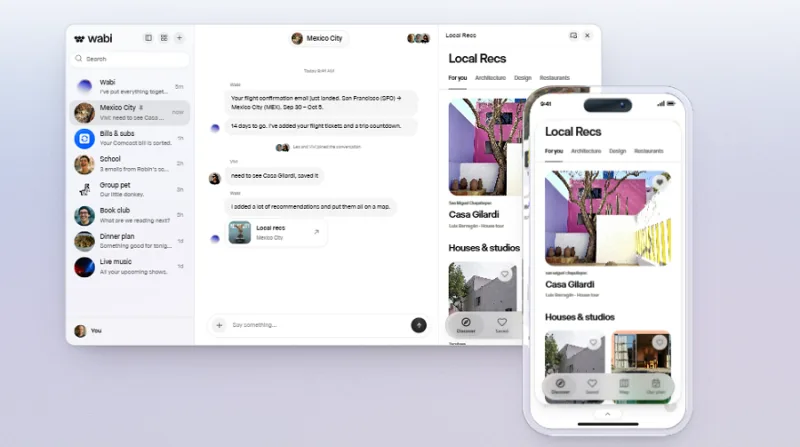
Wabi Lands $55M for AI-Powered Group Chat Platform
The consumer AI assistant startup, founded by Replika's Eugenia Kuyda, has secured funding from IVP and a roster of prominent backers including Marc Benioff and Tobi Lütke.