STRG's Fixed-Rate Cloud Storage Model Targets Developers Tired of Unpredictable Bills
STRG offers S3-compatible object storage at a flat $6.80 per terabyte per month, bundling egress and standard API requests to simplify cloud storage costs. The platform adds AI-assisted configuration and permission-scoped access for development teams.
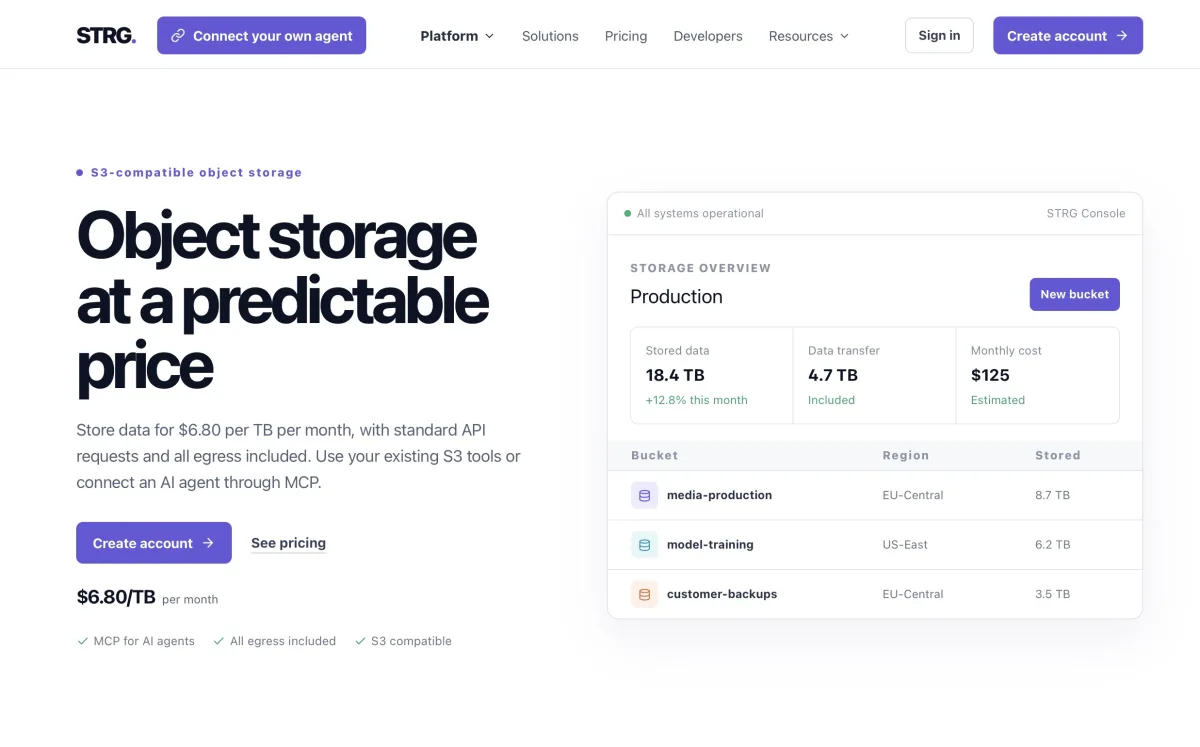
STRG delivers object storage compatible with S3 at a single published rate of $6.80 per terabyte monthly, with egress and standard S3 API requests factored into that price.
The service appeals to development teams seeking predictable costs alongside familiar tooling. A built-in AI assistant and MCP server integration round out the platform's feature set.
Cloud storage pricing often masks complexity behind a low per-gigabyte headline figure. Transfer charges and API fees frequently inflate final invoices, making budgeting difficult. STRG sidesteps this by bundling data egress and standard API calls into one transparent rate.
Transparent pricing with a free tier entry point
STRG charges $6.80 per TB monthly for object storage and includes the first 10 GB at no cost. The pricing structure explicitly excludes retrieval fees and enforces no minimum storage commitments. Teams that frequently move data between storage and applications benefit from having egress included, which simplifies cost forecasting.
Evaluating the service requires modeling an actual workload: storage volume, access frequency, and geographic region. STRG's stated pricing excludes taxes, and large-scale deployments may negotiate separate terms. Prospective customers should verify current pricing details before planning a migration.
S3 compatibility reduces migration friction
STRG integrates with existing S3 workflows through standard tooling. The developer documentation covers AWS CLI connectivity, S3-compatible SDKs, and third-party applications including rclone, Veeam, Restic, and Cyberduck. Teams already invested in these tools can evaluate STRG with minimal setup overhead.
The platform publishes a detailed S3 compatibility matrix, allowing developers to verify support before committing resources. Standard bucket operations, object operations, multipart uploads, and presigned URLs all function as expected.
Some capabilities remain unsupported: SSE-KMS, IAM roles, object tagging, and static website configuration are not currently available. Applications depending on these features should either identify workarounds or conduct testing before migration. This validation step applies equally to any S3-compatible alternative.
AI integration with permission boundaries
STRG embeds AI capabilities into the storage console. An Assistant tool helps teams plan and configure storage deployments. The MCP Server allows compatible AI agents to connect to STRG accounts, with access controlled through customer-selected credentials and permissions.
This design benefits teams already using AI assistants in development or data workflows. Agents operate only within approved permissions, and access revocation remains available. According to STRG's privacy documentation, customer data, prompts, and assistant interactions do not feed into general-purpose AI model training.
These represent STRG's stated commitments. Organizations with specific privacy obligations should independently review the full privacy policy and data-processing agreements.
Encryption, durability, and regional deployment
STRG encrypts stored objects using AES-256 and secures data in motion with TLS. The security documentation also references integrity verification, credential scoping, Object Lock, and optional cross-region replication. The company states a designed annual durability target of 99.999999999%; this represents STRG's design specification rather than a guarantee, and teams should request supporting documentation for their own risk evaluation.
Two geographic regions are available: EU-Central in Amsterdam and US-East in Reston. STRG stores objects in the selected region, though account and operational data may be processed in other locations.
Pilot testing as the next step
STRG's main strength lies in combining predictable pricing, S3 compatibility, and permission-scoped AI features. This combination creates a practical foundation for testing the platform on backups, application data, media storage, or AI workloads—especially when current storage invoices include substantial egress charges.
Production deployments warrant a controlled pilot phase: connect existing tools, validate the S3 operations the application requires, and plan resilience and recovery procedures.
STRG does not provide a standard availability percentage or service-credit guarantee outside of executed customer agreements. Teams with strict uptime requirements should review the SLA and negotiate terms directly with STRG.
STRG presents a solid case for developers seeking S3-compatible storage without pricing complexity. Public documentation enables informed evaluation before migration, and a focused pilot can confirm compatibility with a specific technology stack.
Read more

Microsoft 365 Outage Exposes Risks of Vendor Concentration in Enterprise Infrastructure
A global Microsoft 365 outage that spanned Thursday and Friday revealed how dependent enterprises have become on a single provider's platform, raising questions about resilience and backup strategies across the industry.

How UX Research Keeps Pace With AI-Powered Development
As AI coding agents accelerate software shipping, research must adapt to stay relevant. A new approach called research-in-the-loop embeds evaluation mechanisms directly into product features, letting teams learn from releases in real time.

Beyond the lift-and-shift: Why data management decides VMware exits
Companies fleeing expensive hypervisor licenses discover that migrating virtual machines to Kubernetes is just the beginning. The real challenge lies in managing data across both containers and VMs on a unified platform.