Samsung Patent Hints at Glucose Calibration for Wearables, but Galaxy Watch Glucose Measurement Still Years Away
A newly disclosed Samsung patent reveals one approach to measuring blood sugar on a smartwatch using external calibration data, while the company separately reaffirmed its commitment to noninvasive glucose monitoring research.
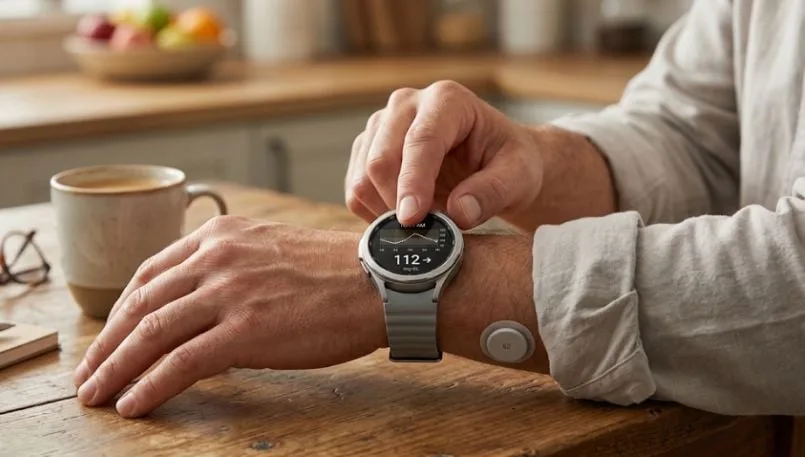
Samsung's latest patent filing provides fresh insight into the company's efforts to develop wearable glucose measurement technology, arriving alongside a public statement confirming that noninvasive continuous glucose monitoring remains a priority for the electronics giant.
The European patent application, published on September 9 and designated EP4803002A1, outlines a wearable system designed to pair biometric sensor data with an external glucose measurement to establish calibration parameters. These calibration parameters would then allow the wearable to infer glucose levels from the biometric signals it collects on its own.
On the same day, Samsung made a public commitment that it continues to pursue noninvasive continuous glucose monitoring. Together, these announcements offer a window into Samsung's glucose research trajectory, though the company has not yet unveiled a Galaxy Watch with the ability to independently measure blood glucose.
How the patent describes wearable glucose calibration
The patent filing describes a wearable electronic device equipped with sensors, memory, a display, communications hardware, and a processor. The glucose-measurement workflow begins with a critical first step: obtaining a blood glucose reading from an external measuring device.
According to the patent, the wearable would identify an appropriate time for the user to take a glucose measurement using that external device. At roughly the same moment, sensors integrated into the wearable would capture a biometric signal from the wearer.
The wearable would then retrieve the externally measured glucose value and merge it with the biometric signal to produce calibration data. This calibration data could subsequently enable the wearable to estimate glucose values based on biometric signals it measures independently.
In essence, the patent describes a system that leverages a known glucose measurement to fine-tune biometric data collected by a wearable, rather than requiring the device to generate an accurate glucose reading without any reference point.
Although the European publication is recent, the patent family's priority date traces back to December 11, 2023. A Korean application was published on June 18, 2025, followed by an international PCT publication on June 19, 2025.
The filing refers to a generic "wearable electronic device" without naming any specific Galaxy Watch model or confirming that Samsung intends to incorporate this technology into a commercial product.
Samsung reaffirms glucose research is ongoing
Samsung's public statements on September 9 provided important context for the patent disclosure.
During a health briefing that day, Jong-min Choi, an executive vice president on Samsung Electronics' Digital Health Team, stated that Samsung is pursuing noninvasive continuous glucose monitoring through multiple channels.
We are pursuing a multifaceted approach that includes global technology exploration, in-house research, and collaboration with external startups (POC)
Jong-min Choi, Samsung Electronics Digital Health Team
Choi also acknowledged the technical hurdles involved, noting that Samsung remains focused on enhancing the reliability of the technology.
Samsung's vision extends beyond a single wearable device. Choi indicated that pairing a Galaxy Ring with a Galaxy Watch together can substantially enhance sensor measurement accuracy. The company envisions a broader ecosystem connecting watches, rings, smartphones, and Galaxy Buds to deliver a more tailored AI-driven healthcare experience.
Additional reporting confirmed that Samsung continues researching noninvasive glucose monitoring as it develops the Galaxy Watch into a comprehensive digital-health platform.
These statements demonstrate that noninvasive continuous glucose monitoring is an active Samsung initiative, not merely a concept buried in older patent documents.
A patent is not a product announcement
Significant distance remains between Samsung's research activities and a Galaxy Watch capable of measuring blood glucose without external assistance.
Samsung has not announced a Galaxy Watch with this capability, provided a timeline for release, or stated that the approach described in EP4803002A1 will appear in any future product.
The September 9 patent publication represents a new chapter in Samsung's longer glucose research journey rather than a shift in what current Galaxy Watches can deliver to users today.
This distinction carries particular weight when discussing glucose measurement technology.
The U.S. Food and Drug Administration has cautioned consumers against smartwatches and smart rings that claim to independently measure or estimate blood glucose without breaking the skin. The agency has stated it has not authorized, cleared, or approved any smartwatch or smart ring designed to independently perform this function.
Current Galaxy Watches already provide health metrics that can sometimes blur the line between what the devices actually measure. Samsung's AGEs Index, for instance, offers data on advanced glycation end products but does not deliver a direct blood glucose reading.
What Galaxy Watch owners should know
For those currently using a Galaxy Watch, nothing changes today.
The September 9 publication does not add independent glucose measurement to an existing watch, confirm the feature for Samsung's next wearable, or reveal when the technology might reach consumers. Anyone who depends on glucose readings for medical decisions should continue relying on appropriately authorized glucose-monitoring technology.
What has shifted is the visibility into Samsung's ongoing efforts. On September 9, a European patent publication offered detailed information about one method Samsung has explored for calibrating wearable glucose measurements. On the same day, a Samsung executive publicly stated that the company remains actively committed to solving noninvasive continuous glucose monitoring.
The next significant developments will be more tangible: clinical validation data, regulatory submissions, or an official Samsung product launch.
Until such announcements arrive, the patent should be understood as a glimpse into Samsung's research pipeline rather than a sneak peek at the upcoming Galaxy Watch. For those anticipating a mainstream smartwatch to achieve independent glucose measurement, Samsung has made its position unmistakable: the company is still pursuing this goal.
Read more
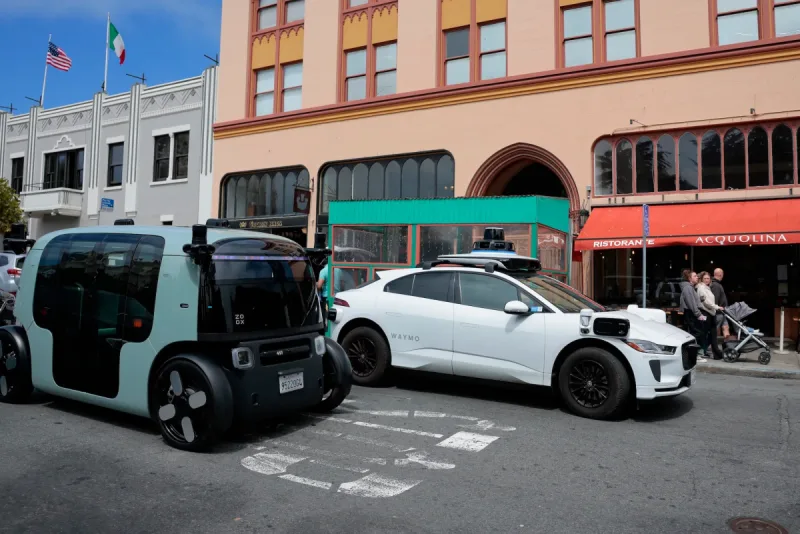
California Tightens Rules on Robotaxis as Incidents Mount
A new state law sets safety standards and accountability measures for autonomous vehicle operators, requiring local support staff and penalties for blocking emergency responders.

Wawa Elevates Long-Tenured Executive to CIO Role
The convenience store chain has named Bill O'Donnell, a 25-year company veteran, as its new chief information technology officer, putting him in charge of tech strategy, cybersecurity and digital operations.

ServiceNow Debuts Flow, a Conversational Service Desk Built for Speed Over Complexity
ServiceNow is rolling out Flow, a natural language service desk tool that automates employee requests through Slack and Microsoft Teams without requiring a full IT service management overhaul.