Maintaining Reliable CRM Data: A Comprehensive Strategy for Revenue Operations
Customer relationship management systems depend on accurate, current information to drive sales decisions and automate workflows. Organizations must establish clear governance, validation rules, and monitoring practices to keep revenue data trustworthy.
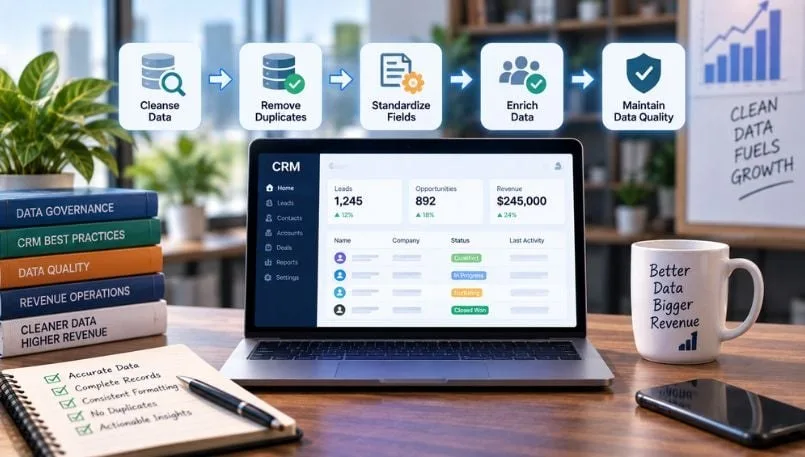
The foundation of effective CRM operations rests on maintaining customer, account, contact, and pipeline information that remains accurate, consistent, complete, and actionable throughout an organization. This encompasses the collection, standardization, validation, enrichment, governance, updating, and monitoring of CRM records.
When CRM information deteriorates, the consequences ripple across multiple business functions. Lead routing becomes unreliable, sales outreach targets wrong contacts, customer segmentation fails, pipeline reporting loses credibility, forecasting becomes inaccurate, and automated workflows execute flawed logic. The stakes grow higher as companies increasingly rely on CRM data to power automated systems and artificial intelligence that can amplify errors across hundreds or thousands of records.
Data enrichment tools like ZoomInfo can strengthen CRM records by supplementing company and contact information with details valuable for prospecting, segmentation, scoring, routing, and reporting. This reduces manual research into missing or outdated account and contact details. However, enrichment represents only one component of comprehensive CRM data management. Organizations still require established standards for validation, deduplication, ownership, governance, and continuous maintenance.
This guide outlines how to evaluate CRM data quality, address common data issues, implement governance frameworks, and sustain accurate customer and revenue information over time.
- Standardize CRM data.
- Validate information as it enters the system.
- Prevent and resolve duplicate records.
- Enrich and update important information.
- Govern and monitor data quality over time.
Understanding CRM Data Management
CRM data management encompasses the policies, processes, and tools organizations deploy to maintain and leverage information stored within their customer relationship management systems.
Several interconnected concepts describe distinct aspects of this broader process:
- The complete set of activities for maintaining and using CRM information
- Whether CRM information is accurate and suitable for its intended purpose
- Rules governing ownership, definitions, permissions, and standards
- Adding or updating information by drawing from external sources
These elements function interdependently. A technically clean database can still create operational problems if different departments apply conflicting field definitions, integrations overwrite accurate data, or responsibility for specific values remains unclear.
Why Data Quality Directly Impacts Revenue Operations
CRM information influences decisions throughout the entire customer and revenue lifecycle.
Sales teams encounter immediate problems when job titles, phone numbers, and employer information become outdated. Representatives pursue incorrect contacts, and missing firmographic details compromise lead scoring, account segmentation, territory assignment, and lead routing effectiveness.
Pipeline analysis and revenue forecasting depend on a separate set of critical fields: opportunity amount, stage, close date, probability, and forecast category. When these values are incomplete or stale, reporting reliability suffers significantly.
Marketing teams face comparable challenges. Weak data undermines segmentation precision, personalization effectiveness, campaign attribution accuracy, and suppression list reliability.
The consequences intensify when automation and AI systems enter the picture. A workflow relying on an incorrect field can propagate the same error across hundreds or thousands of records. An AI system designed to prioritize enterprise accounts may generate flawed recommendations if employee-count or revenue figures are outdated.
The objective of CRM data management extends beyond creating a clean database; it aims to make CRM information sufficiently reliable to support the decisions and workflows that depend on it.
Six Dimensions of CRM Data Quality
Organizations typically assess CRM data quality across six distinct dimensions: accuracy, completeness, consistency, freshness, validity, and uniqueness.
- Accuracy: Does the record reflect reality?
- Completeness: Are the fields required for the workflow populated?
- Consistency: Are values represented the same way across systems and records?
- Freshness: Is the information current enough for its intended use?
- Validity: Does the value follow required rules and formats?
- Uniqueness: Does each person, company, or opportunity have one reliable record?
Acceptable standards vary by field. An invalid email address can immediately halt outreach efforts, whereas an older employee-count estimate might still serve broad segmentation purposes adequately. Data quality standards should therefore reflect how individual fields are actually deployed in operations.
Conducting a CRM Data Quality Audit
A CRM data quality audit identifies current errors, uncovers their underlying causes, and ranks fixes according to their business impact.
An effective audit addresses two fundamental questions: What is wrong with the data, and why does the problem persist?
1. Define what good CRM data looks like
Identify the CRM objects and fields that directly enable workflows, reports, business decisions, or compliance obligations. For each critical field, document its purpose, accepted values, format, source, owner, and expected update frequency. Concentrate on fields that influence actual workflows or decisions rather than treating all CRM fields as equally significant.
2. Measure the current state
Examine important records for missing critical fields, duplicate contacts and accounts, invalid or stale information, unassigned records, email bounces, incomplete opportunity data, and integration or synchronization errors. Use these findings as a baseline for tracking whether data quality improves.
3. Identify root causes
Look beyond the error itself to understand why it keeps occurring. Typical causes include manual entry mistakes, inconsistent imports, weak validation rules, conflicting field mappings, broken integrations, and unclear ownership. For instance, repeatedly merging duplicate accounts will not resolve the underlying problem if imports or forms continue creating new versions of existing records.
4. Prioritize by business impact
Avoid attempting to clean the entire database simultaneously. Prioritize open opportunities, active target accounts, current leads, existing customers, and recently engaged contacts because they most directly affect current revenue and workflows. Dormant and historical records can generally be addressed later when they become relevant again.
10 CRM Data Quality Best Practices
1. Define your CRM data strategy
Before initiating cleanup efforts, determine what information the organization needs and how it should be managed. Document where important fields originate, which system maintains authoritative values, who can modify them, how quickly they become outdated, and what should occur when connected systems conflict. Without these rules, a cleanup may temporarily improve the database without addressing the processes that created the problem.
2. Require fields based on workflows
Avoid mandating fields simply because the CRM supports them. Instead, work backward from the workflow. Lead routing might require country, industry, company size, and product interest. Forecasting may depend on opportunity amount, stage, expected close date, and forecast category. Every required field should serve a clear operational purpose.
3. Standardize values and formats
Free-text fields enable multiple versions of identical information. Whenever feasible, employ controlled picklists, consistent date formats, standardized country and state codes, defined industry categories, revenue bands, and canonical company names. For example, "US," "USA," and "United States" may all represent the same country but function as separate values in filters, reports, and automated workflows.
4. Validate data entry
Preventing incorrect data from entering the CRM reduces cleanup requirements later. Validation rules can verify email and phone formats, required fields, dates, opportunity amounts, company domains, and existing account or contact matches. Where possible, catch errors before a record is created or updated rather than depending on periodic cleanup.
5. Prevent duplicates before merging them
Duplicate contacts, accounts, and opportunities can fragment activity histories, create ownership conflicts, and distort reporting.
Matching rules can leverage identifiers such as email address, company domain, phone number, CRM ID, external ID, and account name.
Exact matching may prove insufficient in some cases. "IBM" and "International Business Machines," for example, may represent the same organization. Account matching may therefore require normalization or fuzzy matching.
6. Automate activity capture
CRM quality often deteriorates when users must manually log every interaction. Where supported, automatically capture emails, meetings, calls, forms, campaign sources, and other customer interactions.
Automation reduces manual entry while making customer histories less dependent on individual user habits.
7. Enrich important company and contact data
Organizations cannot collect every useful field directly from prospects and customers. Enrichment can add or update job title, seniority, industry, company size, revenue, headquarters, parent company, and technology information.
Prioritize enrichment for fields used in account selection, scoring, routing, segmentation, prospecting, or reporting. For B2B teams, ZoomInfo can supplement CRM records where researching every company and contact manually would be impractical. Enrichment should still follow the organization's field ownership and source-of-truth rules. Visit ZoomInfo for more information.
8. Assign ownership and sources of truth
Every important CRM field should have an owner responsible for defining how it is maintained. Organizations should also identify which system is authoritative when the same information exists in multiple places. The CRM might own account assignment, for example, while the billing platform owns subscription status and a marketing platform owns campaign-source information.
Clear source-of-truth rules help prevent connected systems from repeatedly overwriting one another.
9. Establish a CRM hygiene schedule
CRM data starts aging as soon as it is created, but every field does not need to be reviewed at the same frequency.
Validation, synchronization failures, and some enrichment processes can be monitored continuously. New duplicates and unassigned records may warrant weekly checks, while stale segments, unused fields, ownership rules, and integrations can be reviewed monthly or quarterly.
Set the frequency according to how quickly the information changes and how heavily workflows depend on it.
10. Monitor CRM data quality
Track whether CRM quality is improving rather than relying on occasional cleanup projects. A CRM data-quality dashboard can surface rising duplicate rates, falling field completion, increasing email bounces, stale records, and integration failures before they significantly affect operations. Monitoring also helps teams determine whether prevention efforts are working.
Key CRM Data Quality Metrics
The most valuable CRM data quality metrics measure completeness, duplication, freshness, contact validity, ownership, enrichment, synchronization, and pipeline-field reliability.
Focus on metrics connected to important workflows rather than trying to measure every CRM field.
- Whether important records contain required information
- Whether duplicate-prevention rules are working
- How recently important information was verified
- Whether contact information remains usable
- Whether ownership or routing rules are failing
- How much required information has been added or updated
- Whether connected systems are exchanging data reliably
- Whether forecasting inputs are sufficiently complete
Establish an internal baseline first. Improvement against your organization's previous performance is often more useful than comparing CRM data against a generic external benchmark.
CRM Data Governance Checklist
For every business-critical CRM field, document:
- Owner: Who defines and maintains the field?
- Source of truth: Which system owns the authoritative value?
- Allowed values: Which formats or categories are accepted?
- Update method: Is the field updated manually, through an integration, or through enrichment?
- Refresh frequency: How quickly can the information become outdated?
- Permissions: Who can view or edit it?
- Retention: How long should the information remain?
- Dependencies: Which reports, workflows, scoring models, or AI systems rely on it?
Review these dependencies before changing important fields or adding new automation. A field that appears minor may already control routing, reporting, or other downstream processes.
Common CRM Data Management Mistakes
- Treating cleanup as a one-time project. Data starts changing again as soon as new records enter the CRM. Prevention and monitoring need to continue after a cleanup.
- Requiring too many fields. Users may enter placeholders or unreliable information simply to save a record.
- Merging duplicates without preventing new ones. Deduplication fixes existing records but does not address the process creating duplicates.
- Failing to define sources of truth. Integrations can overwrite correct information when multiple systems claim ownership of the same field.
- Adding enrichment without governance. More fields do not necessarily produce better data. Enrichment should support specific business workflows and follow established ownership rules.
- Automating before checking the underlying data. Workflows and AI systems can repeat incorrect decisions at scale if their inputs are unreliable.
Frequently Asked Questions
What is the difference between CRM data management and CRM data cleansing?
CRM data cleansing focuses on correcting inaccurate, incomplete, duplicate, or poorly formatted records. CRM data management is broader and also includes validation, governance, enrichment, ownership, integrations, standards, and ongoing monitoring.
What are the most important CRM data quality best practices?
Start by defining important fields and their owners. Standardize and validate incoming information, prevent duplicates, automate activity capture, enrich missing data where useful, establish sources of truth, and continuously monitor quality.
How often should CRM data be cleaned?
There is no single cleaning schedule for every CRM field. Information supporting active pipeline, routing, outreach, and automation may require continuous or frequent monitoring, while broader database and governance reviews can happen monthly or quarterly.
Who owns CRM data quality?
CRM data quality is typically shared among CRM administrators, RevOps, sales operations, marketing operations, IT or data teams, and business users. Individual business-critical fields should still have named owners responsible for their definitions and maintenance rules.
Read more

California Tightens Rules on Robotaxis as Incidents Mount
A new state law sets safety standards and accountability measures for autonomous vehicle operators, requiring local support staff and penalties for blocking emergency responders.

Wawa Elevates Long-Tenured Executive to CIO Role
The convenience store chain has named Bill O'Donnell, a 25-year company veteran, as its new chief information technology officer, putting him in charge of tech strategy, cybersecurity and digital operations.

ServiceNow Debuts Flow, a Conversational Service Desk Built for Speed Over Complexity
ServiceNow is rolling out Flow, a natural language service desk tool that automates employee requests through Slack and Microsoft Teams without requiring a full IT service management overhaul.