iPhone Duo Meets Galaxy Z Fold8: Two Foldable Philosophies at the Same Price
Apple's debut foldable arrives at $1,999, just $100 above Samsung's eighth-generation Galaxy Z Fold8, offering buyers starkly different approaches to the same form factor.
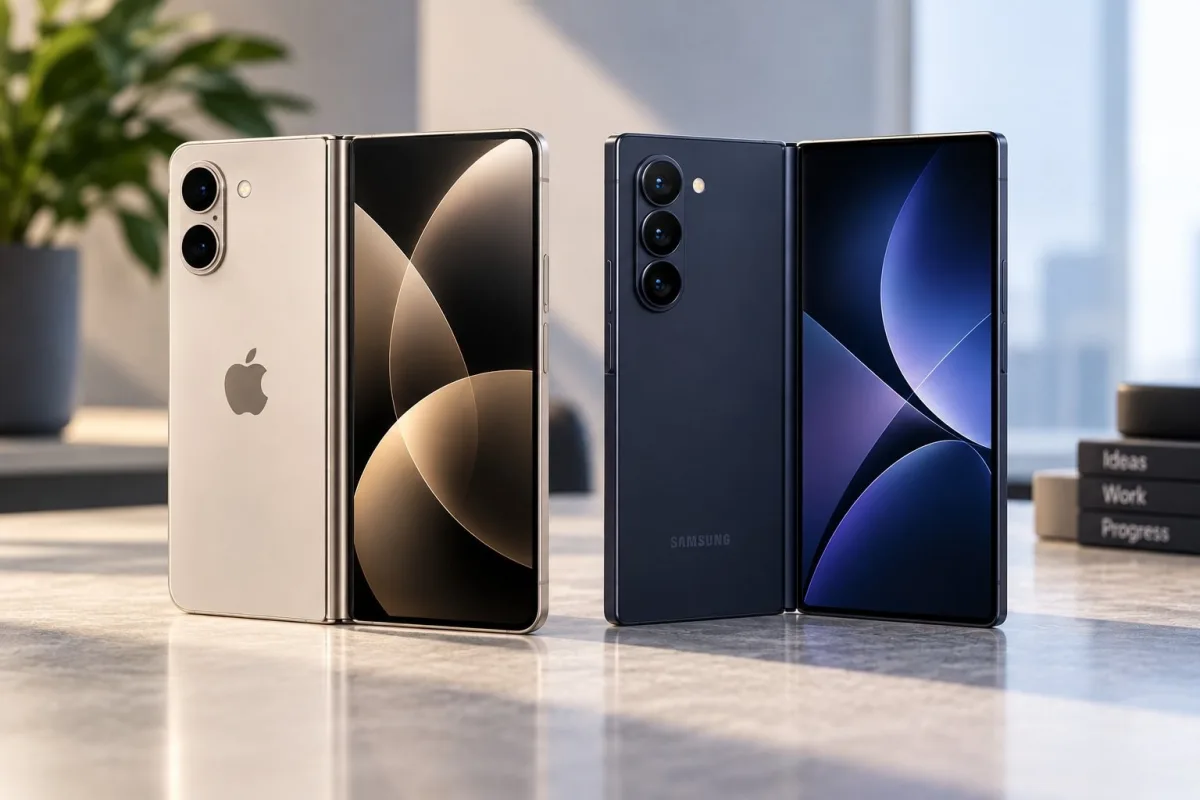
Samsung has refined its foldable design through eight iterations, and now Apple is entering the arena with the iPhone Duo. The two devices sit within roughly $100 of each other—Duo at $1,999 and Galaxy Z Fold8 at $1,899.99—yet they represent fundamentally different visions of what a foldable phone should prioritize.
Those already invested in Apple's ecosystem will find Duo more compelling, particularly for its IP68 durability rating and storage capacity reaching 2TB. The Fold8 counters with significant advantages: substantially lighter weight, a slimmer profile when closed, more sophisticated multitasking capabilities, Samsung DeX functionality, and a lower entry price.
Methodology
This analysis draws on official specifications from both manufacturers regarding pricing, dimensions, display technology, camera systems, durability standards, battery performance, and software features, supplemented by verified TechRepublic reporting for additional context.
Since Apple and Samsung employ different battery-testing protocols and the Duo will not reach retail shelves until October 23, 2026, manufacturer claims about runtime and unverified performance metrics are not treated as direct comparisons. The assessment prioritizes practical distinctions relevant to different user categories rather than tallying specification points.
Design and displays
The most striking physical distinction concerns what users must carry. Both devices unfold to 7.6-inch screens with similarly compact front displays, yet the iPhone Duo weighs 254 grams against Samsung's 201-gram Galaxy Z Fold8. When folded, Samsung's device measures just 9.7 millimeters thick and 4.5 millimeters when open, compared to Apple's 11.3 millimeters and 5.2 millimeters respectively.
Apple's specifications describe 5.4-inch and 7.6-inch OLED screens with ProMotion refresh rates up to 120Hz. Samsung's Fold8 features a 5.5-inch cover display and 7.6-inch main Dynamic AMOLED 2X panel, also capable of 120Hz refresh.
Storage capacity tells a different story. Both launch with 256GB, but Fold8 maxes out at 1TB while Duo extends to 2TB, offering Apple users significantly more space for substantial photo collections, video libraries, games, or professional files.
Samsung decisively wins on portability. Apple claims the storage advantage.
Performance and cameras
The Duo runs on Apple's A20 Pro processor, while Fold8 uses Qualcomm's Snapdragon 8 Elite Gen 5 for Galaxy. Apple emphasizes the A20 Pro's capabilities in performance, gaming, artificial intelligence, and multitasking, whereas Samsung combines Qualcomm's chipset with One UI 9 and Galaxy AI features.
Rear camera configurations show surprising parallels. Duo features a 48-megapixel main sensor paired with a 48-megapixel ultrawide, while Fold8 employs a 50-megapixel wide camera and 50-megapixel ultrawide—a streamlined setup compared to the Fold8 Ultra variant.
Neither device includes a dedicated telephoto lens. Apple claims its Duo main camera delivers 2x optical-quality zoom, and Samsung similarly lists 2x optical-quality zoom from the Fold8's primary sensor.
Apple introduces foldable-specific photography tools, including rear-camera selfies utilizing the outer display as a viewfinder and Duo Preview for real-time subject framing. Users requiring substantial long-range optical magnification should consider alternatives beyond these standard models.
Productivity and software
Samsung's most significant edge stems from eight years of foldable software refinement.
The Fold8 includes Multi Window functionality, an always-visible Taskbar, App Continuity, and Samsung DeX for desktop-like output on external monitors. Users can simultaneously run two or three applications in Split View, enabling greater flexibility when multiple programs require constant visibility.
Duo's Split View displays two applications side by side with adjustable layouts, dual windows of a single app, drag-and-drop capability, and stored app pair configurations. This represents a major advancement for iPhone, yet Samsung maintains the more mature multitasking ecosystem.
Stylus compatibility favors Apple, though not immediately. Apple has pledged Apple Pencil support for the USB-C variant later in 2026, meaning this feature will arrive after Duo's launch. Samsung indicates the Galaxy Z Fold8 will not support the S Pen.
Ecosystem alignment may supersede individual feature comparisons. Duo integrates seamlessly with Macs, Apple Watches, AirPods, iCloud, and Apple's broader service portfolio. Fold8 suits buyers committed to Android, Galaxy products, Google services, or Samsung's DeX workflow.
The Duo operates exclusively on eSIM technology worldwide, whereas Fold8 accommodates both nano-SIM and eSIM options, offering Samsung greater flexibility for international travelers still dependent on physical SIM cards.
Battery and durability
Apple claims up to 24 hours of operation when both Duo displays receive equal use, plus up to 31 hours of video playback on the inner display or 44 hours on the outer display. Samsung specifies a 4,800mAh battery and up to 26 hours of video playback for Fold8.
Since these manufacturer figures rely on different testing approaches, they do not establish a clear battery victor.
Durability presents a more definitive distinction. Duo carries an IP68 rating, while Fold8 holds an IP48 rating, granting Apple superior published protection against dust and water ingress.
Both manufacturers reinforce their folding displays with titanium construction. Apple employs a titanium plate beneath the inner display, while Samsung incorporates a dual-layer titanium configuration within the Fold8's shock-absorbing layer.
Apple has worked to minimize display crease visibility, though the long-term resilience of hinges and displays will only become apparent after Duo has accumulated substantial real-world usage.
Which foldable should you buy?
The Galaxy Z Fold8 presents the more straightforward choice for buyers seeking a mature foldable experience today. It undercuts Duo by roughly $100, weighs 53 grams less, folds to a thinner profile, delivers more comprehensive multitasking, includes Samsung DeX, and permits physical SIM usage for international travelers.
Choose Galaxy Z Fold8 if: Your priorities center on reduced weight, established multitasking capabilities, desktop-style productivity features, carrier flexibility, and a lower starting price.
The iPhone Duo makes stronger sense when the foldable appeal originates from Apple's ecosystem rather than the folding mechanism itself. It delivers the recognizable iOS experience on Apple's inaugural folding device, provides a more robust IP68 durability rating, and offers double Samsung's maximum storage tier.
Choose iPhone Duo if: You maintain commitment to Apple's ecosystem, desire up to 2TB of storage, prioritize the stronger published ingress-protection standard, or prefer maintaining your foldable within your existing iPhone, Mac, Apple Watch, and AirPods environment.
Best for productivity: Galaxy Z Fold8. Samsung's Multi Window, Taskbar, App Continuity, and DeX capabilities establish a more sophisticated large-screen workflow.
Best for portability: Galaxy Z Fold8. The 201-gram weight and 9.7-millimeter folded thickness present advantages the 254-gram Duo struggles to match.
Best for storage and Apple users: iPhone Duo. The 2TB option and Apple ecosystem integration represent its most distinctive strengths.
Apple need not surpass Samsung across every foldable specification for Duo to justify its existence. Its primary audience comprises individuals who desired a folding phone while remaining within Apple's walled garden.
Samsung's position differs. Fold8 arrives with fewer first-generation limitations, carries a marginally lower cost, weighs substantially less, and incorporates software developed specifically around foldable multitasking for multiple generations.
At approximately $2,000, the decision becomes straightforward: Duo brings folding technology into Apple's ecosystem, while Fold8 remains the superior option for buyers who want the folding hardware itself to deliver more capability.
Apple's 2026 product lineup positions the iPhone Duo alongside the iPhone 18 Pro, AirPods 5, and updated Apple Watch models.
Read more

California Tightens Rules on Robotaxis as Incidents Mount
A new state law sets safety standards and accountability measures for autonomous vehicle operators, requiring local support staff and penalties for blocking emergency responders.

Wawa Elevates Long-Tenured Executive to CIO Role
The convenience store chain has named Bill O'Donnell, a 25-year company veteran, as its new chief information technology officer, putting him in charge of tech strategy, cybersecurity and digital operations.

ServiceNow Debuts Flow, a Conversational Service Desk Built for Speed Over Complexity
ServiceNow is rolling out Flow, a natural language service desk tool that automates employee requests through Slack and Microsoft Teams without requiring a full IT service management overhaul.