Extreme Networks' Agent ONE Coworker Shifts Network Operations From Reactive Dashboards to Proactive AI Assistance
Extreme Networks has launched Agent ONE Coworker, an AI-powered tool that moves network troubleshooting from time-consuming dashboard navigation to automated problem detection and resolution guidance.
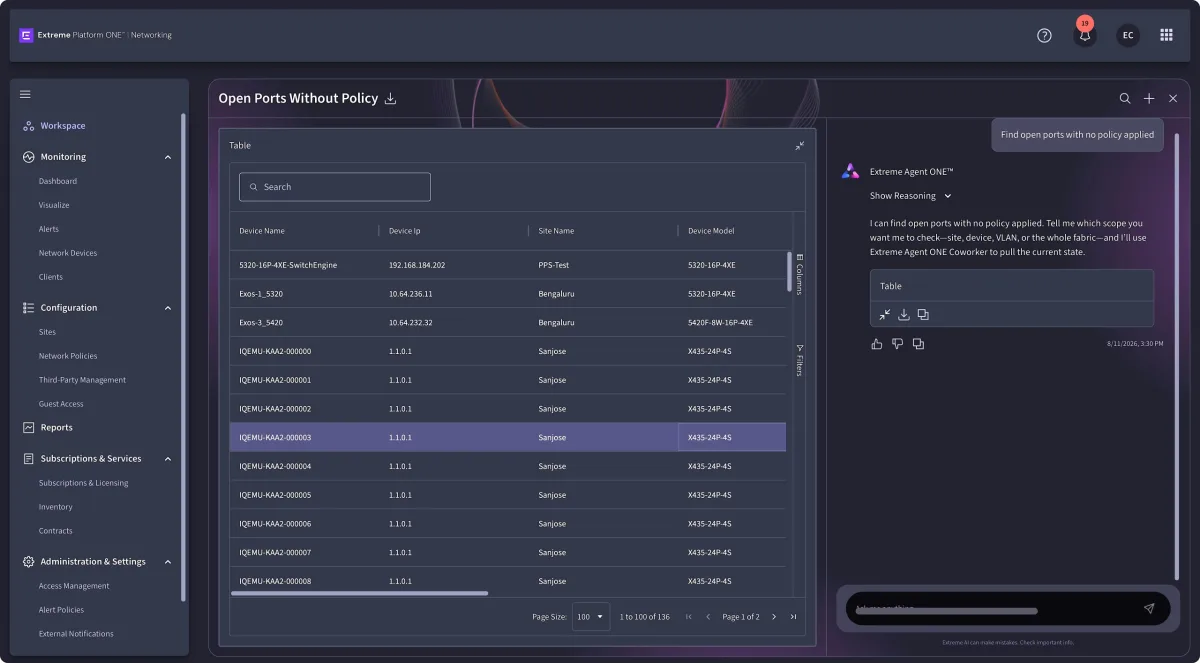
For decades, network administration has followed a predictable pattern: an alert appears, engineers open multiple dashboards, pull logs, check client history, contact the wireless team, and spend an hour gathering enough information to begin addressing the issue. Despite a decade of dashboard improvements, operations teams actually needed fewer tools, not better ones. The first wave of AI in networking promised to change this workflow but largely fell short of expectations.
At Extreme Networks' chief information officer event in Seattle, Nabil Bukhari, the company's chief technology officer and president of AI, offered candid insights into why early AI networking solutions underperformed. "The first generation of AI from multiple vendors in networking, or adjacent markets like security, was essentially a chatbot built on a lot of unconsolidated data," Bukhari explained. "They demoed really well. Everybody showed amazing demos. But when you push them into actual production and people started using them, there were multiple areas where they just did not work."
Extreme has accumulated 18 months of production data since launching its Platform ONE with first-generation generative AI capabilities. This experience informed the development of Agent ONE Coworker, which became generally available Wednesday to all Platform ONE customers worldwide as part of their existing subscription. Beta customers report that the tool reduces resolution time from hours to minutes and cuts new-engineer onboarding time by approximately half.
Three failure modes, three fixes
Bukhari identified three specific problems that plagued first-generation AI solutions, each addressed through distinct design choices in this release.
The first challenge involves data quality and normalization. "Unless you absolutely fix your data and have a custom-built context layer, it's never going to be good enough for a network admin to actually use it," Bukhari said. Within Extreme's own systems, fabric, switching, Wi-Fi and software-defined wide-area networking all use a field called client ID, yet each carries a different meaning. Feeding unnormalized data into a language model leaves the system unable to interpret what it's examining.
Extreme's solution combines a purpose-built context layer with a knowledge graph that maps relationships across users, devices, applications, services and network conditions. This approach addresses a fundamental principle: in networking, context serves as the competitive advantage. While any vendor can connect a model to a chat interface to explain spanning tree protocol, few can determine why a third-floor conference room experienced degraded performance at 2 p.m. on Tuesday.
The second failure mode concerns user behavior. Extreme conducted focus groups with network administrators using open chatbots and observed minimal engagement. "They just kind of go, 'Ah, well, I don't know,' and then they ask you how many devices I have — which is a completely useless question, because it's right there on the dashboard," Bukhari noted. When actual incidents occurred, engineers reverted to established practices and overlooked the AI tool entirely.
The third issue centers on transparency. General-purpose models prioritize helpfulness, often generating responses rather than acknowledging limitations. Extreme implemented what it calls an awareness scale, enabling Agent ONE to quickly assess whether it can assist, plainly state when it cannot, and explain alternative options—frequently by gathering evidence and opening a support ticket automatically. During an analyst briefing, Michael Jones, Extreme's vice president of AI and former Salesforce AI leader, demonstrated this by asking whether Agent ONE could remediate wired devices. The system responded no and listed its actual capabilities.
Ambient beats interactive
The most compelling solution to the behavior problem involves making Agent ONE Coworker ambient—continuously active and reaching out to users rather than waiting for queries. Extreme calls this mechanism a Nudge: a command bar at the bottom of Platform ONE that alerts users after the agent completes preliminary investigation, before interrupting their workflow.
Early results demonstrate the significance of this approach. "In the first eight days, we have seen about a 900% increase in interaction," Bukhari said. "When a problem happens and you see it in your logs, nobody thinks of opening a chatbot to ask what these logs mean. Those demos well, but people don't do that."
Guardrails prove essential to this design. Informational nudges can be snoozed for an hour or dismissed for days, while severity-one nudges cannot be snoozed. This mirrors collision alerting in vehicles: if disabled, the system reactivates when danger is imminent. Following similar logic, if a Sev1 alert persists after 15 minutes, users should probably address it, so disabling it makes little sense.
A second nudge category targets skill development gaps. When the system detects users spending time on a Platform ONE screen where they previously performed equivalent tasks in ExtremeCloud IQ, it surfaces the three most common actions and offers to guide them through the process or handle it directly. Since engineers rarely consult product documentation, this approach meets them at their point of need.
Trust is a gradient, not a switch
Network engineers have traditionally resisted automation, and Extreme is accommodating this skepticism rather than challenging it. Coworker mode operates as ambient but never autonomous, incorporating human oversight by design with governance controls defining permitted and prohibited actions. Operator mode, the autonomous tier, launches early next year and includes its own inverse of the nudge: a recap briefing users upon return, similar to a human colleague's update.
"Trust is not binary. It's not like I trust AI or I don't trust AI," Bukhari said. "It's gradual. You can say, 'I trust it to do these things, but I don't yet trust it to do these kinds of things,' and that progression is what's needed. Nobody is going to go from 'I've never used it' to 'I want my entire network run by AI.'"
Standard operating procedures form the foundation of both modes. Bukhari offered a sharp critique of general-purpose AI in operations: asking a frontier model the same networking question seven times yields seven different answers. "You do not want to troubleshoot your network that way," he said. "Networks have standard operating procedures. You can call them blueprints, you can call them validated designs — that's how predictability is built into the network."
Extreme embedded its own blueprints and best practices into Coworker; with Operator, customers can add theirs through skills. Bukhari noted that early adopters who initially attempted to apply their network data to general-purpose frontier models became Extreme's fastest adopters after discovering the predictability problem themselves.
Why this matters for Extreme
Extreme's fiscal 2026 revenue reached $1.28 billion, representing 13% year-over-year growth, with fourth-quarter revenue of $339 million marking its ninth consecutive quarter of sequential growth. Platform ONE generated nearly half of subscription bookings in the quarter, and the count of customers spending more than $1 million annually increased to 187.
As a challenger to substantially larger network vendors, Extreme cannot compete through spending alone. The company must differentiate through velocity and first-mover advantage. Platform ONE achieved general availability in 2025 with 265 early adopters; approximately a year later, the agentic layer is live globally on a monthly release schedule, with the next phase arriving at Extreme's AI Summit in Amsterdam on October 20.
Releasing Coworker before Operator represents the correct sequencing. The quickest path to damaging enterprise AI adoption is permitting an agent to execute unsanctioned changes. This approach allows Extreme to roll out AI capabilities methodically, enabling customers to gain experience with AI in a controlled, low-risk environment.
Advice for IT professionals
When asked what beginning with AI should entail, Bukhari emphasized focused implementation. "Pick a use case you care about, not a random one. It's going to be frustrating at first, but the ramp-up is very quick." The actual failure mode is not selecting the wrong use case—it is pursuing 27 initiatives simultaneously because demonstrations appear impressive.
- Test for honesty, not just accuracy. Use your pilot to examine the agent's boundaries and determine whether it acknowledges limitations. An agent that fabricates answers proves worse than no agent.
- Grade vendors on context, not on model names. If the pitch emphasizes which large language model powers the system, you are having a commodity discussion. Instead, ask how the system normalizes data across domains, how long it preserves history and how it establishes relationships.
- Measure mean time to context. While everyone tracks mean time to recovery, almost nobody measures how much time goes toward gathering evidence before diagnosis begins. This window represents what Nudge targets, and it will reveal whether 15x improvement materializes in your environment.
- Bring your standard operating procedures to the table. If your runbooks exist only in individual heads or on outdated wikis, no agent can follow them. Documenting them is essential groundwork for operator-class autonomy and delivers value regardless of vendor selection.
The dashboard has not disappeared, but for the first time, the industry offers a credible alternative to replace it.
Read more

California Tightens Rules on Robotaxis as Incidents Mount
A new state law sets safety standards and accountability measures for autonomous vehicle operators, requiring local support staff and penalties for blocking emergency responders.
Wawa Elevates Long-Tenured Executive to CIO Role
The convenience store chain has named Bill O'Donnell, a 25-year company veteran, as its new chief information technology officer, putting him in charge of tech strategy, cybersecurity and digital operations.

ServiceNow Debuts Flow, a Conversational Service Desk Built for Speed Over Complexity
ServiceNow is rolling out Flow, a natural language service desk tool that automates employee requests through Slack and Microsoft Teams without requiring a full IT service management overhaul.