Design Schools Face an Existential Challenge From Free Online Learning and AI
Traditional web design education is losing its relevance as YouTube tutorials and AI assistants provide instruction faster and cheaper than universities can. Schools that survive will need to offer mentorship and critical thinking—not just information.
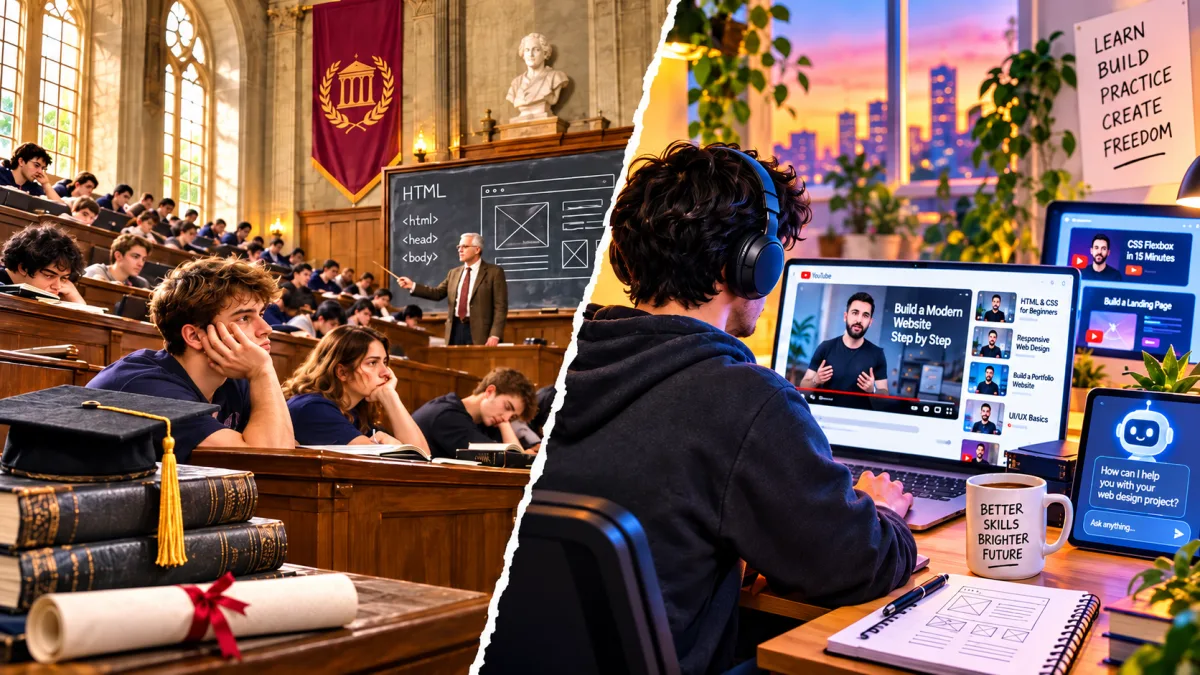
Fifteen years ago, formal education was the gateway to web design. Aspiring designers needed instructors to demystify HTML, CSS, Photoshop, typography, UX and the countless other skills that seemed inaccessible to self-taught learners. The landscape has transformed entirely. YouTube now hosts thousands of tutorials on Figma, CSS Grid, accessibility and virtually every other design discipline. Free courses abound. When confusion strikes, ChatGPT or Claude can explain concepts, review code, identify errors and clarify mistakes. The economics have shifted dramatically: YouTube University charges almost nothing.
Speed is the first casualty
Universities operate on institutional timelines. The web moves at internet speed. Approving and updating a single course can consume months or years. By contrast, a new design tool or AI capability typically has tutorial coverage within hours. The gap widens further with artificial intelligence. While YouTube delivers instruction, AI functions as something closer to a personal tutor—answering follow-up questions, simplifying explanations, debugging code and critiquing work. The 2026 HEPI Student Generative AI Survey documented that 95% of surveyed UK undergraduates were already using AI in some capacity. Universities are no longer deciding whether students should engage with these tools; students have already made that choice.
The value proposition problem
Consider two parallel paths: one student invests years in a degree while another spends the same period consuming YouTube content, leveraging AI as a tutor and actively building websites. Both eventually interview for identical positions. In web design, this scenario carries particular weight because portfolios are tangible and verifiable. The U.S. Bureau of Labor Statistics notes that web developers and digital designers may not require formal credentials if they can demonstrate competence through completed projects and practical experience. A compelling portfolio carries substantial weight in hiring decisions. The uncomfortable question becomes unavoidable: what justifies the cost of enrollment?
YouTube University has its own weakness
While YouTube can teach nearly anything, it cannot effectively guide what learners should study. A viewer might progress from a CSS tutorial to an AI course, spend hours watching a Spotify redesign, discover Webflow and somehow end up consuming content about free AI tools. No one mandates learning accessibility when flashy animations seem more rewarding. No instructor provides critical feedback. Learners can develop substantial skills while harboring significant knowledge gaps. AI shares this limitation—it will assist in building something fundamentally flawed if the user lacks the expertise to recognize the problem. Universities could leverage this exact vulnerability as their competitive advantage.
Redefining the university role
Charging thousands of dollars for classroom instruction that duplicates excellent free YouTube content makes little economic sense. Universities should instead concentrate on what online platforms cannot provide: experienced mentors, rigorous critique, collaborative learning and structured curricula. Programs should require students to justify design choices, validate websites with actual users and engage with accessibility, psychology, typography and UX fundamentals—the essential but often-skipped material in self-directed learning. Students should be encouraged to use AI. Rather than spending a week manually coding a basic website, AI could generate an initial version while students spend the week identifying flaws, improving speed, enhancing accessibility, increasing originality and building genuine utility. The emphasis should shift from production to thinking.
Early institutional responses
Some universities are already moving in this direction. The University of Victoria restructured its computer-science program to weave AI throughout rather than treating it as supplementary material. UBC is implementing similar changes, with new AI coursework that emphasizes tool selection and critical evaluation of AI-generated output. These initiatives point toward the correct strategy. Universities should not fear YouTube University; instead, they should concentrate on delivering what it fundamentally cannot.
The new competitive landscape
Web design degrees no longer compete solely against other degrees. They compete against the combination of YouTube, AI subscriptions and years of hands-on building—a formidable and increasingly capable alternative. Universities retain genuine advantages: structured learning paths, mentorship, critical evaluation, collaborative experiences and deeper knowledge that self-taught learners typically overlook. However, students should be paying for these specific benefits, not for information delivery that costs nothing online. The future likely belongs neither to traditional universities nor to YouTube University alone. The most successful institutions will integrate the strongest elements of both models. If a design school cannot offer something superior to YouTube combined with an AI subscription, students have legitimate grounds to question their investment.
Read more
Why Static Portfolios Are Failing Tech Professionals—and What Works Instead
The traditional portfolio has lost its power to land jobs and clients. Recruiters now want proof of real-world problem-solving, not polished case studies.

Lowe's Expands Media Network With Third-Party Measurement and AI Tools
The home improvement retailer is broadening its advertising platform across streaming, social and delivery services while introducing independent incrementality measurement and AI-powered discovery features.

Honeyjar brings AI-powered PR strategy to founders and communicators without expertise
A new startup founded by veteran communications professionals aims to democratize PR knowledge through AI, automating pitch research and media outreach while keeping humans in control of final decisions.