Uvi's $7.5M seed round targets the hidden cost drain of AI agents lacking business context
The startup has developed a context reasoning layer that lets AI agents tap into unified institutional memory instead of relearning company operations with each deployment, cutting per-response costs by up to 46 times.
Uvi, an agentic AI startup, announced a $7.5 million seed funding round aimed at solving a costly inefficiency plaguing enterprises that deploy autonomous AI agents. CT Innovations led the investment, with Cardumen, Mana VC and 91 Ventures participating.
The core problem Uvi addresses stems from how AI agents operate when first deployed: they arrive with no knowledge of the organization's business processes, operations or historical decisions. Each new agent must reconstruct this context from scratch, consuming computing resources and driving up costs significantly. This cycle repeats with every fresh deployment, creating a compounding expense for enterprises.
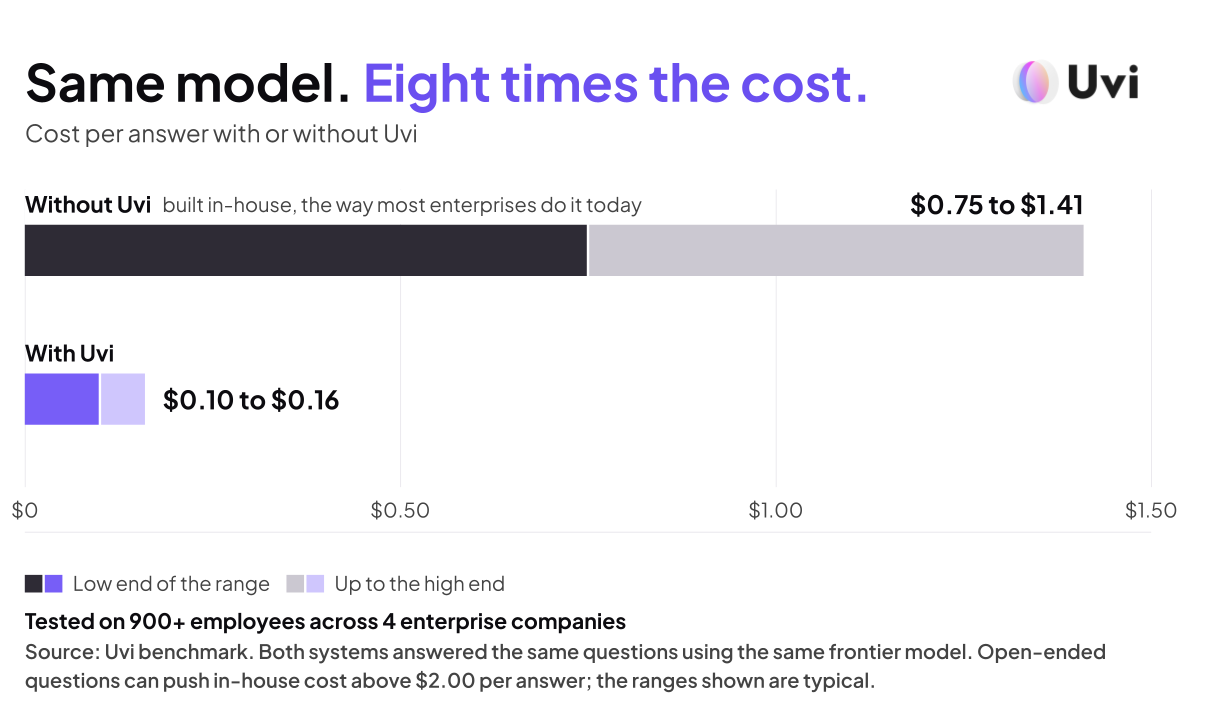
According to Uvi's internal benchmarks, internally built AI agents cost companies roughly eight times more than necessary due to this repeated context-gathering requirement. The inefficiency also affects speed and reliability. Uvi co-founder and Chief Executive Gilad Salinger noted that as AI adoption accelerates, the conversation has shifted from accuracy and security concerns to cost, token consumption and performance.
The reason is structural, not about intelligence. Big companies run dozens of different tools with completely different data shapes, and the ability to pull two slices of data in parallel, say one from Snowflake and another from GitHub, and then reason over that data does not exist for them. So even when an agent has already completed a task, it would fail the same task the next time, because it never retained how the work actually gets done.
Gilad Salinger, Uvi co-founder and CEO
Context is everything
Uvi's solution centers on what Salinger describes as a "context reasoning layer" that each organization owns and maintains. Rather than forcing every new agent to relearn operational procedures, all AI tools within a company's IT environment can access this shared institutional memory.
The platform integrates fragmented enterprise systems including Slack, Jira, Confluence and Salesforce alongside data from code repositories and internal meeting records. Uvi constructs a comprehensive map showing how this information connects, documenting the reasoning behind each decision, the decision itself and its organizational impact.
The context reasoning layer rests on a knowledge graph functioning as infrastructure beneath every deployed AI agent. Entity mapping allows the system to comprehend the organization's engineering stack, track dependencies and understand relationships between different assets. Uvi also examines historical context—such as decisions made in Slack that were later reversed in document comments—to reconstruct how agents should reason through problems. A custom semantic layer helps AI agents master company-specific terminology, enabling accurate interpretation of internal jargon.
Security is built into the design from the start. Recognizing that knowledge graphs frequently falter on user permissions, Uvi implemented access controls operating at both application and administration layers, supplemented by data tagging. Salinger explained the approach: "We tag data so that a person who leaves a tool, or leaves the company, cannot be surfaced by agents down the road. This is the part most RAG pipelines get wrong. They ingest once and forget who was allowed to see what. Our graph reconstructs relationships across platforms and carries the permissions with it, so there's no need for a separate security retrofit."
Uvi's benchmarks demonstrate substantial financial gains. Agents operating without the platform cost between $0.75 and $1.41 per response, sometimes exceeding $2. When routed through Uvi, costs drop to an average of 10 to 16 cents per answer. For open-ended questions where agents typically enter recursive search loops, Uvi agents cost 46 times less than their non-Uvi counterparts while delivering answers twice as fast.
The startup has already secured adoption from Monday.com Inc., Lemonade Inc. and Melio. At Monday.com, Uvi enables agents to grasp connections between Jira tickets, pull requests and feature flags. Without this contextual grasp, agents retrieve disconnected ticket lists that require manual sorting. By mapping ticket relationships, Uvi surfaces answers far more efficiently.
CT Innovations partner Gwen Cheni sees significant market opportunity. She noted that virtually every company she discusses AI agents with has struggled to build context at scale, with most still far from achieving it. "Uvi is the finished version of a project they have already paid for multiple times over," Cheni said.
Salinger contends that every AI agent will eventually require a context layer, as no alternative exists without sacrificing operational efficiency. He envisions a fundamental shift in enterprise AI architecture within three years: "In three years, the enterprise AI stack will not be organized around chat interfaces or document search. It will be organized around a persistent context layer that every agent, every model and every identity plugs into. Companies that have this content will ship new agents the way they ship with continuous integration/continuous development pipelines today, while those that don't will be forced to keep paying their models to relearn their business every morning."