Prismm tackles the messy business of inherited wealth for banks
A fintech startup founded by two banking veterans is building digital infrastructure to help financial institutions manage account transitions when customers die, keeping assets from flowing to competitors.
Prismm, a fintech company launched in 2020, addresses a critical gap in how banks manage customer accounts after death. The startup integrates beneficiary and estate planning capabilities directly into banking platforms, streamlining the process of transferring assets to heirs and keeping family wealth within the institution. The company is competing at TechCrunch Disrupt 2026's Startup Battlefield stage.
Sisters Martha Underwood and Shella Sylla founded Prismm after witnessing firsthand the chaos that unfolds when financial affairs are not properly organized. In 2017, their father was hospitalized following a fall while helping clear storm debris after Hurricane Irma in Miami. Their mother, who had delegated all financial management to her husband, could not locate critical documents or account information. Though their father recovered, the experience revealed how vulnerable families become when they lack access to financial records during emergencies.
The founders' vision crystallized years later when Underwood was working at a bank during the COVID-19 pandemic. She observed grieving families arriving at the institution after losing a loved one, struggling to locate accounts, manage outstanding bills, and support surviving spouses. This observation sparked a realization about the underlying problem. "That's when it hit us that this is an infrastructure problem, and as I started to dig deeper, we've created all of these platforms for wealth growth and tracking, but almost nothing for transition," Underwood explained. "It's still very much all manual. And that's when we said, 'We can digitize this process.' We were like, 'We can solve it because we see that there's other families that are going to have this issue,' and that's when we really doubled down."
Prismm's core functionality allows account holders to grant designated family members advance access to their accounts and supporting documents. Upon the account holder's death, authorized individuals can log in to view all assets and records in a centralized location and initiate eligible beneficiary transfers entirely online. Since identity verification, consent, and documentation are already captured in the system, the transfer can proceed remotely even when heirs are scattered across different states.
Underwood emphasized that existing solutions place too much responsibility on consumers at an already overwhelming time. "What's on the market is consumer-based," she said. "What we found is when you're asking the consumer to do something with everything else on their list, that's going to be the last thing they do, especially women. Women are the ones that are typically going to be handling these issues when there's a death. We're typically the caregivers, and so asking me to manage the documents for my mom and dad while I take care of my kids, my husband, everyone else, it just becomes too much. And so, this needs to be built as infrastructure, and there needs to be as little friction as possible to allow people to get to the information that they need to execute on a decision, and so that's why we integrate directly into bank cores."
Three products, two live
Prismm offers two operational products with a third under development. Prismm Designate enables banks to provide customers with a streamlined digital interface for updating beneficiary information, reducing friction for both account holders and financial institutions managing these records.
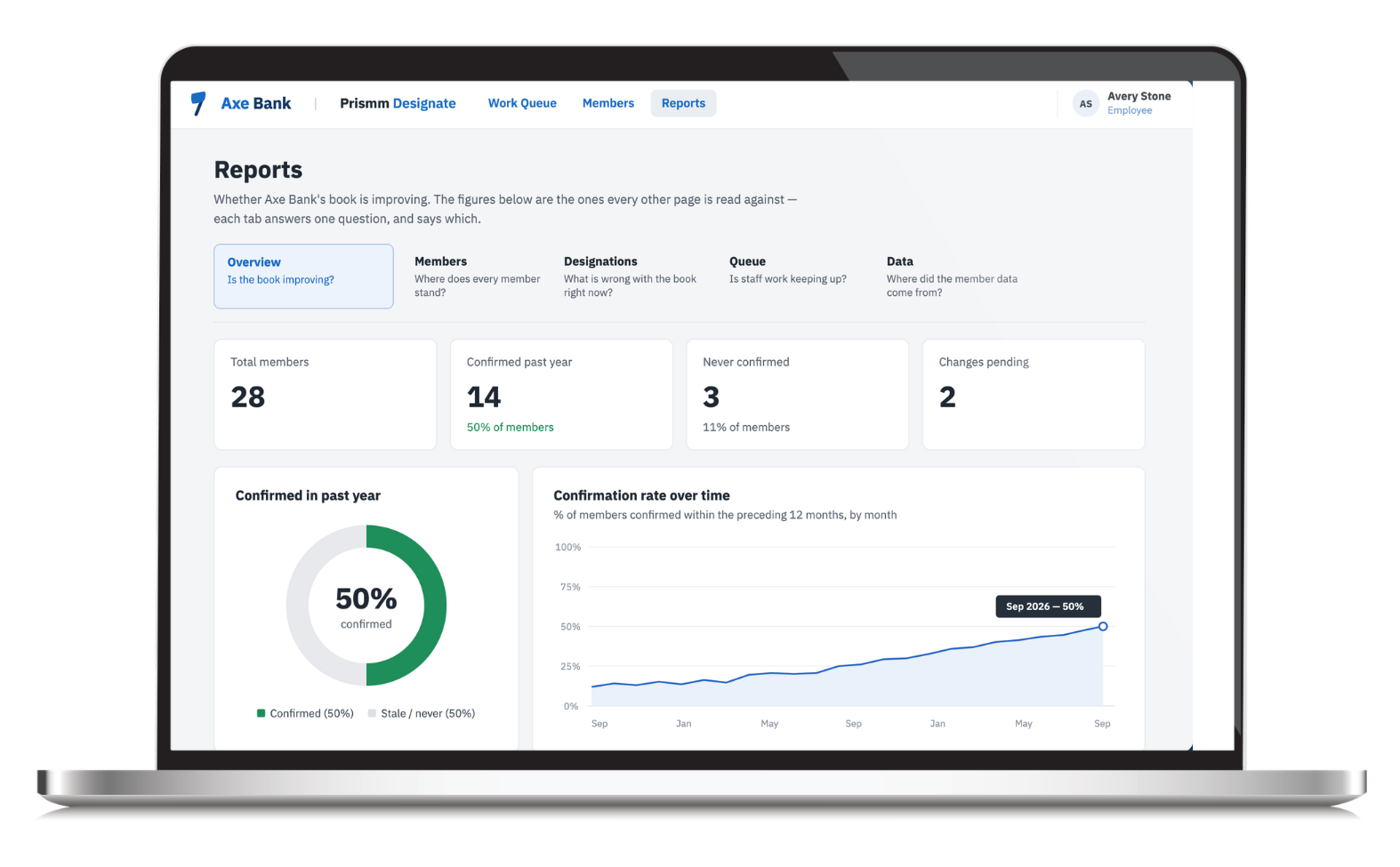
Prismm Anchor functions as a secure digital vault accessible through banking platforms. Account holders can consolidate information about their accounts, documents, property, and assets held across multiple institutions, with granular access controls for designated family members. The system operates within the bank's environment, eliminating the need for users to adopt a separate consumer application.
The forthcoming Prismm Continuity product will provide step-by-step guidance for staff and families navigating the asset transfer process. By embedding this workflow within the financial institution rather than burdening families with coordination, the product aims to reduce friction during the most challenging phase of inheritance.
The business case: stopping estate attrition
Underwood and Sylla position Prismm as foundational infrastructure that solves a costly problem for banks. Financial institutions hemorrhage billions annually through what the industry calls "estate attrition"—the phenomenon of heirs transferring inherited money to competing banks because the original institution lacks systems to manage account transitions smoothly. By simplifying the inheritance process and maintaining relationships with the next generation of depositors, banks can retain both assets and future customers.
"We will be the infrastructure that financial institutions use to move money to the next generation, because we don't only understand that you execute on the back end," Underwood said. "We understand that you need to be proactive and build relationships with the next generation of consumers on the front end."
Prismm is among dozens of startups competing in TechCrunch's Startup Battlefield competition this week in San Francisco. The winner will be announced on Thursday, October 15.
Read more
CedarDB's unified database approach gains traction as AI agents demand faster analytics on transactional data
The Munich-based database startup, which merges analytical and operational capabilities in a single system, is launching a cloud offering as enterprises seek to query transaction records with natural language prompts.
Mosqitter Transforms Mosquito Traps Into Disease-Tracking AI Network
A Pennsylvania startup is expanding its chemical-free mosquito-catching devices into an AI-powered surveillance system designed to identify species, monitor population trends, and alert public health authorities to emerging disease risks.
Uvi's $7.5M seed round targets the hidden cost drain of AI agents lacking business context
The startup has developed a context reasoning layer that lets AI agents tap into unified institutional memory instead of relearning company operations with each deployment, cutting per-response costs by up to 46 times.