Honeyjar brings AI-powered PR strategy to founders and communicators without expertise
A new startup founded by veteran communications professionals aims to democratize PR knowledge through AI, automating pitch research and media outreach while keeping humans in control of final decisions.

The communications industry has long struggled with inefficiency and gatekeeping, frustrating journalists, entrepreneurs, and PR practitioners alike. Honeyjar, competing in this week's TechCrunch Disrupt Startup Battlefield 200, proposes an AI-driven solution to distribute high-level PR expertise across organizations of all sizes, particularly those led by founders unfamiliar with communications strategy.
The company was founded by Michelle Masek, who serves as CEO, and Nadia Jamshidi, Chief Communications Officer. Both bring decades of experience in communications roles, ranging from in-house positions to agency work. Masek most recently held the position of senior vice president of marketing and communications at Obvious Ventures, the venture firm founded by Ev Williams.
Masek's motivation for creating Honeyjar emerged from her work at Obvious Ventures, where she managed communications strategy across 110 portfolio companies. She recognized a recurring problem: founders repeatedly sought guidance on fundamental communications questions. This led her to consider whether senior-level expertise could be scaled through artificial intelligence in a way that genuinely supported users in executing communications work with the same sophistication that experienced professionals bring to the task.
What Honeyjar does
The platform automates several core communications functions, including drafting announcements, identifying journalists most likely to cover a story, and surfacing relevant speaking engagements. However, Jamshidi emphasized that these capabilities represent only part of a larger vision. She explained: "Honeyjar can find reporters, build media lists, scan news and social, track coverage, and surface opportunities. Those capabilities are important, but they're just one piece of what we're building. The bigger idea is bringing the whole communications workflow together: signals, context, strategy, judgment, timing, and execution."
A broader audience than just startups
While founders represent an obvious user base, Masek identified a much larger market opportunity. She noted that "millions and millions of unassigned communicators responsible for the work of comms" exist across industries and organizational types. These individuals may lack formal communications titles but carry communications responsibilities nonetheless. Masek elaborated: "They don't have the title of comms, but they're marketers, investors, authors, creators, school superintendents, sports team leaders. It's incredibly horizontal, this need to nail strategic communications. It's always passed around, but the problems are very often not solved."
Not a replacement for PR professionals
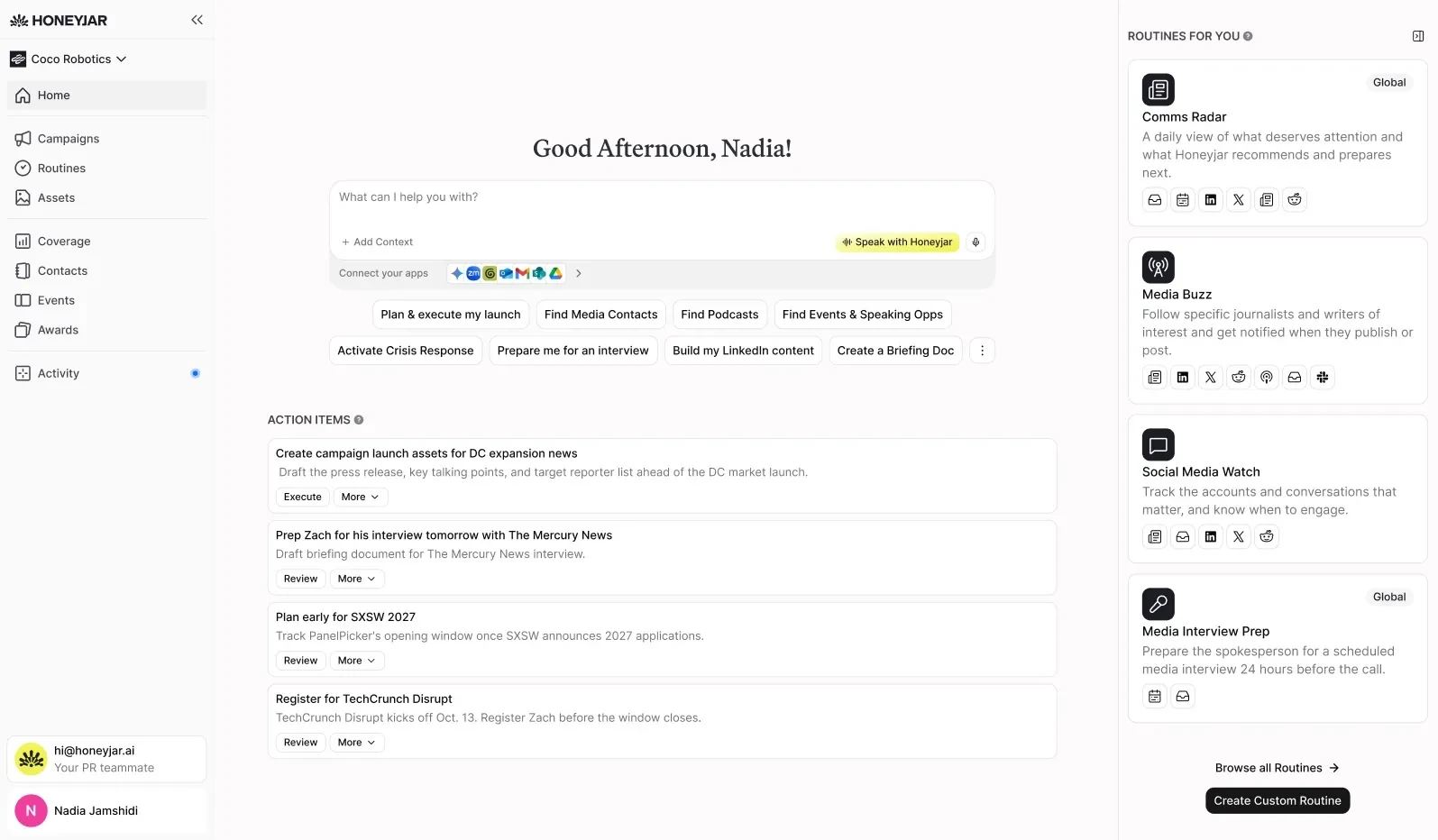
Masek and Jamshidi designed Honeyjar as a tool they themselves would want to use, not as a substitute for professional communicators. The founders believe the platform can enhance the work of both PR agencies and internal communications teams. For individual PR practitioners, Honeyjar offers the ability to take on additional client work without proportional increases in operational overhead.
Early traction and journalist concerns
When Honeyjar launched its waitlist, the company received 10,000 signups within 24 hours, according to Masek. Early beta testers include Nextdoor, robotics startup Coco Robotics, investor Bloomberg Beta, and agencies Mission North and Full Picture.
The prospect of AI-assisted PR tools raises legitimate concerns for journalists already overwhelmed by pitch volume, much of it already generated by AI systems. When asked about this risk, Masek stressed that while Honeyjar can compose pitch emails and social media content in a user's voice, the human operator must actively choose to send or publish each message. She stated: "We never want a world where the human is removed from the loop."
The role of judgment
Central to Honeyjar's approach is the concept of judgment—the ability to determine what actions to take, what to avoid, when to act, and how to adjust to circumstances. Masek and Jamshidi worked to embed their own professional judgment into the product's logic. Through an initiative called the Comms Lab, they are now training the system using the judgment of additional PR professionals.
Jamshidi defined the company's understanding of judgment: "For us, judgment is knowing what to do, what not to do, when to act, and how to adapt to the situation. That comes from understanding a company's goals and priorities, what's happening inside and outside the organization, and knowing what to say, to whom, where, and when."
In some instances, this judgment extends to advising users against pursuing coverage. Masek noted that Honeyjar might counsel a founder that they lack sufficient readiness for media attention. She articulated a vision where the tool helps improve the overall quality of pitches reaching journalists: "We hear from reporters all the time who want better pitches, who want to hear from experts directly. We actually see a future where there are more credible pitches in your inbox from sources who you actually want to hear from."
Read more

Why Static Portfolios Are Failing Tech Professionals—and What Works Instead
The traditional portfolio has lost its power to land jobs and clients. Recruiters now want proof of real-world problem-solving, not polished case studies.

Lowe's Expands Media Network With Third-Party Measurement and AI Tools
The home improvement retailer is broadening its advertising platform across streaming, social and delivery services while introducing independent incrementality measurement and AI-powered discovery features.

Vizio Expands Creator Channels and Premium Partnerships to Compete for Connected TV Ad Spending
Walmart's Vizio is broadening its free streaming service with over 40 creator-led channels and new premium content partnerships, positioning itself as a growing player in the connected TV advertising market.