Cisco Embeds AI Agents Across Webex, Adds Workplace and Customer Service Tools
At WebexOne in Austin, Cisco unveiled sweeping upgrades to its Webex platform that inject AI agents into team spaces, link office infrastructure to workplace management, and let customer-service teams work beyond individual interactions.
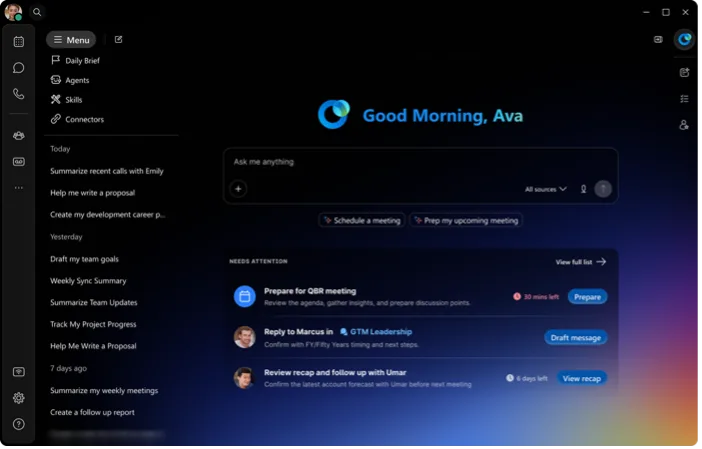
Cisco Systems Inc. unveiled an extensive refresh of its Webex collaboration suite, introducing artificial intelligence agents that operate within team conversations, integrating physical office systems with workplace administration, and enabling customer-support staff to maintain productivity after calls conclude. Revealed during WebexOne in Austin, Texas, these enhancements reinforce Cisco's push to merge human workers, AI agents and organizational data. The company frames this convergence of shared knowledge as essential infrastructure for applications capable of orchestrating work across multiple platforms and sustaining progress beyond formal meetings.
Agents are entering the workforce at an unprecedented pace, both to help you and operating by themselves. Connected intelligence goes from people to people but also people to AI and AI to AI.
Snorre Kjesbu, Cisco's senior vice president and general manager of collaboration
The rollout encompasses updates to Webex software, meeting-room equipment, and customer experience capabilities, with the majority of new offerings targeted for deployment in early 2027.
Webex Platform and Agent Integration
The refreshed Webex interface delivers a customized dashboard showing upcoming meetings, calls and key priorities by pulling data from calendars, messages and active tasks. Within spaces, meetings and calls, agents can participate alongside teams to facilitate scheduling, note-taking, language translation and task completion.
Cisco announced it will integrate Anthropic PBC's Claude into Webex via Claude Managed Agents, designed to handle analysis, content generation and coordinated workflows drawing from team conversation context. In parallel, a Model Context Protocol connection will funnel Webex data into OpenAI Group PBC's Dots agents, with Dots slated to operate as a personal agent within Webex itself.
People and agents working together is how collaboration is going to be done going forward.
Amit Barave, vice president and general manager for Cisco's Webex Suite and AI
Standalone personal agents can field calls when users are unavailable, evaluate caller needs and priority levels, then facilitate scheduling follow-ups or relay messages. An AI coach, initially rolling out in Webex's Vidcast video recorder, will critique recorded talks by assessing delivery speed, vocal quality and verbose language.
Knowledge Integration and Dialog Platform
Cisco is launching Dialog, a foundational software layer beneath the Webex AI Agent platform that merges customer records with enterprise systems, information repositories and governance rules. The goal is to eliminate fragmented service encounters by deploying agents that retain ongoing awareness of individual customers.
Dialog permits extended task execution, enabling agents to liaise with staff members, peer agents and enterprise infrastructure until a customer's issue reaches resolution. The system preserves context across communication channels and absorbs lessons from customer results and staff decisions within organizational guardrails. Cisco expects to open Dialog for beta testing in the first quarter of 2027.
We are moving away from a world where we build agents to where we train and onboard agents like digital co-workers.
Vinod Muthukrishnan, a Cisco executive who leads Webex customer experience operations
Rather than forcing organizations to script individual dialogue sequences, Dialog can initialize agents by drawing from existing interactions, rules and workflows. The platform accommodates both Cisco-native and external agents.
Cisco leadership emphasized that expanded agent scope demands stronger governance mechanisms. According to Muthukrishnan, "We are talking about securing, observing and governing an entire execution chain that starts with the conversation and goes well into the enterprise."
Cisco is broadening its AI Agent 360 control plane and management system with monitoring powered by its Splunk technology to link agent actions with operational metrics, covering escalation rates and business consequences. General availability arrives in December. Cisco AI Defense furnishes security protections, while fresh connections tie customer-service agents to offerings from Google LLC, Nvidia Corp. and Amazon Web Services Inc.
Cisco is also extending AI capabilities to organizations running on-premises communication infrastructure. Webex AI Agent is now generally available for Cisco's Unified Contact Center Enterprise, with voice functionality for Contact Center Express launching this month. A separate connection layer, arriving in early 2027, will permit organizations to run third-party AI models on local servers to satisfy data residency and regulatory mandates.
Physical Workspace and Hardware Upgrades
Cisco's Workplace Designer broadens its scope beyond individual conference rooms to encompass entire floors, structures and multi-building campuses. Users can load floor layouts and obtain guidance on room setup, network coverage and collaboration apparatus.
The Cloud Control unified operations management system will consolidate networking, collaboration and security administration. Facility data enables IT and operations teams to monitor space usage, troubleshoot service issues and evaluate whether current infrastructure meets organizational demands. Cisco's AI Canvas fuses workspace and device telemetry with network visibility to enable cross-system diagnostics.
RoomOS 27, coming in November, incorporates AI features and built-in Google Meet compatibility alongside current meeting platforms. A director agent manages camera, microphone and speaker behavior, leveraging Nvidia processing for intelligent background noise suppression. Smart Room Assurance assists teams in configuring devices and tracking room health.
Cisco is completing its integrated audio ecosystem with the new Cisco Ceiling Speaker Pro. Working alongside ceiling microphones and cameras, it pinpoints speaker locations and broadcasts their voices throughout the space. A single Ethernet link supplies power, audio and control signals, while self-configuration minimizes installation overhead. The speaker is expected to be available for purchase later this quarter.
With spatially aware voice lift, we know where the voice is coming from, and we intelligently distribute it where it's needed in the room. We're not just making the room louder. We're making the conversation more natural.
Espen Løberg, vice president and general manager of Cisco's collaboration devices business
Read more

Why Static Portfolios Are Failing Tech Professionals—and What Works Instead
The traditional portfolio has lost its power to land jobs and clients. Recruiters now want proof of real-world problem-solving, not polished case studies.

Lowe's Expands Media Network With Third-Party Measurement and AI Tools
The home improvement retailer is broadening its advertising platform across streaming, social and delivery services while introducing independent incrementality measurement and AI-powered discovery features.

Honeyjar brings AI-powered PR strategy to founders and communicators without expertise
A new startup founded by veteran communications professionals aims to democratize PR knowledge through AI, automating pitch research and media outreach while keeping humans in control of final decisions.