Beyond the Numbers: Why 10,000mAh Batteries Don't Tell the Whole Story
Chinese smartphone makers are pushing battery capacities to 10,000mAh and beyond, but raw capacity alone cannot predict real-world endurance. Silicon-carbon technology enables these gains, yet processor efficiency, software optimization, and display power consumption matter just as much.
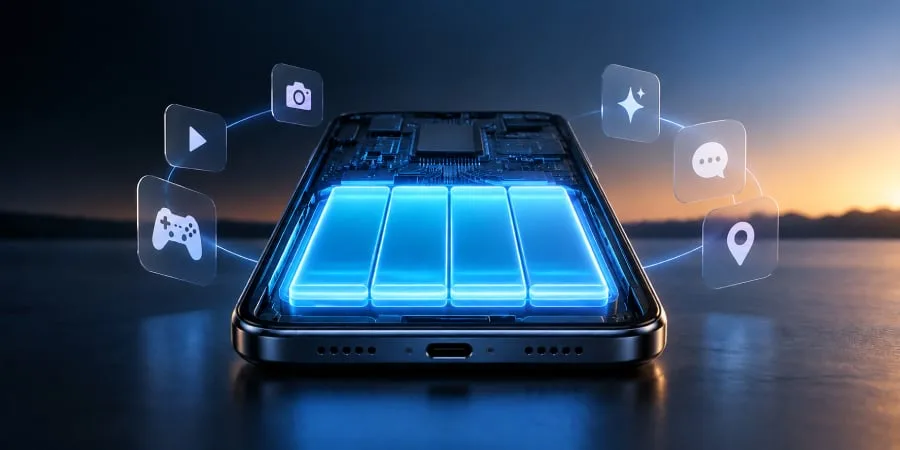
What once represented the pinnacle of battery technology—a 5,000mAh cell—now appears modest. In 2026, manufacturers, particularly those based in China, are shipping devices with substantially larger power reserves, with many reaching 7,000mAh or higher and a select few approaching the 10,000mAh threshold.
Silicon-carbon battery technology enables makers to pack additional capacity into phones without necessarily increasing thickness. Yet the megaampere-hour rating printed on a specification sheet reveals only part of the picture when it comes to actual usage time.
For those prioritizing battery longevity, capacity serves as a useful reference point. Real-world endurance, however, depends more heavily on independent testing results, charging velocity, system efficiency, and market-specific availability than on any single number.
Factors affecting battery life
A phone's energy reservoir only tells half the story. Multiple variables influence how rapidly that stored power depletes during use.
- Processor efficiency: Chips that deliver performance while minimizing energy draw extend runtime.
- Software optimization: Intelligent management of background processes and workload distribution reduces power consumption.
- Display: Screen brightness, pixel density, and refresh rate each contribute to overall power demand.
- Network connection: Poor signal strength forces the device to work harder, accelerating discharge.
- Heavy workloads: Intensive tasks like gaming and video capture drain batteries significantly faster.
- Battery health: Cells degrade over time, losing capacity and reducing available runtime.
10 smartphones ranked by advertised battery capacity
Advertised capacity does not directly translate to runtime. Chip design, screen efficiency, heat management, and firmware implementation can allow a device with a smaller battery to outlast one with a larger one.
The following ranking reflects manufacturers' stated battery sizes. This compilation emphasizes current mainstream devices rather than specialized rugged handsets, which often feature significantly larger batteries. Specifications and availability may differ across geographic markets.
Gaming endurance data from PhoneArena appears alongside each model to demonstrate performance under intensive conditions. These figures should not be interpreted as typical daily usage estimates; rather, they underscore why mAh alone cannot forecast real-world battery performance.
Redmi Note 17 Pro Max — 10,000mAh
This model holds the distinction of the largest advertised battery in the group. Xiaomi's Redmi division rates it at 10,000mAh, though PhoneArena documents 9,210mAh. The source of this variance remains unexplained, so prospective buyers should verify the exact specification for their regional variant. The device incorporates a silicon-carbon cell, delivers 100W wired charging, and achieved 19 hours and 28 minutes during PhoneArena's gaming test.
POCO X8 Pro Max — 8,500mAh
The POCO X8 Pro Max ranks second with an 8,500mAh silicon-carbon battery and matching 100W wired charging capability. Despite its substantial capacity, PhoneArena recorded only 9 hours and 55 minutes of gaming endurance.
OPPO Find X9 Pro — 7,500mAh
OPPO equips this flagship with a 7,500mAh silicon-carbon battery alongside 80W wired and 50W wireless charging. Gaming tests by PhoneArena reached 11 hours and 17 minutes, while Tech Advisor designated it as its "Best Overall" after recording more than 26 hours in its PCMark battery test.
REDMAGIC 11 Pro — 7,500mAh
Matching the OPPO at 7,500mAh, the REDMAGIC 11 Pro's gaming-centric design makes this capacity particularly relevant. PhoneArena measured 14 hours and 14 minutes of gaming performance.
OnePlus 15R — 7,400mAh
This variant surpasses its flagship sibling with a 7,400mAh battery. PhoneArena documented 14 hours and 40 minutes of gaming, positioning it marginally ahead of the standard OnePlus 15 in that specific test despite carrying a lower overall battery-life rating.
OnePlus 15 — 7,300mAh
The OnePlus 15 houses a 7,300mAh silicon-carbon battery, substantially exceeding the 5,000mAh baseline that once characterized premium devices. PhoneArena's gaming test yielded 14 hours and 16 minutes, with web browsing extending beyond 30 hours.
Honor Magic8 Pro — up to 7,100mAh
Battery specifications for this model vary by region. European units carry a 6,270mAh battery, while other markets receive 7,100mAh versions. PhoneArena's European test unit achieved 9 hours and 33 minutes of gaming, outperforming the POCO X8 Pro Max despite its smaller capacity.
Xiaomi 17 Ultra — 6,800mAh
The Xiaomi 17 Ultra pairs a 6,800mAh silicon-carbon battery with demanding processor and display hardware. PhoneArena recorded 7 hours and 10 minutes of gaming, though browsing tests reached 22 hours and 39 minutes.
Xiaomi 17 — 6,330mAh
The standard Xiaomi 17 drops to 6,330mAh, positioning it among the smaller batteries in this ranking. Gaming endurance measured 6 hours and 40 minutes, while browsing achieved 24 hours and 48 minutes—approximately two hours longer than the Ultra variant.
iPhone 17 Pro Max — 5,088mAh
PhoneArena lists the iPhone 17 Pro Max at 5,088mAh, making it the capacity outlier in this comparison. Nevertheless, the publication measured 11 hours and 34 minutes of gaming, demonstrating how engineering optimization allows a smaller battery to compete with larger Android counterparts.
What buyers should consider beyond capacity
Expanded battery reserves enable phones to support power-hungry capabilities—high-refresh displays, on-device machine learning, and intensive gaming—without constant recharging. Capacity, however, represents just one consideration in the purchasing equation.
Prospective buyers should weigh independent endurance assessments, charging speeds, market availability, device weight, software longevity commitments, and battery degradation patterns. A thoughtfully engineered device with a modest battery may deliver superior everyday performance compared to one that simply maximizes the mAh specification.
Read more
California Tightens Rules on Robotaxis as Incidents Mount
A new state law sets safety standards and accountability measures for autonomous vehicle operators, requiring local support staff and penalties for blocking emergency responders.

Wawa Elevates Long-Tenured Executive to CIO Role
The convenience store chain has named Bill O'Donnell, a 25-year company veteran, as its new chief information technology officer, putting him in charge of tech strategy, cybersecurity and digital operations.

ServiceNow Debuts Flow, a Conversational Service Desk Built for Speed Over Complexity
ServiceNow is rolling out Flow, a natural language service desk tool that automates employee requests through Slack and Microsoft Teams without requiring a full IT service management overhaul.