Apple's iPhone Duo Tackles the Foldable Crease With Design and Software
Apple's first foldable iPhone doesn't eliminate the crease down the middle of its 7.6-inch display, but the company has engineered multiple solutions to make it less noticeable during everyday use.
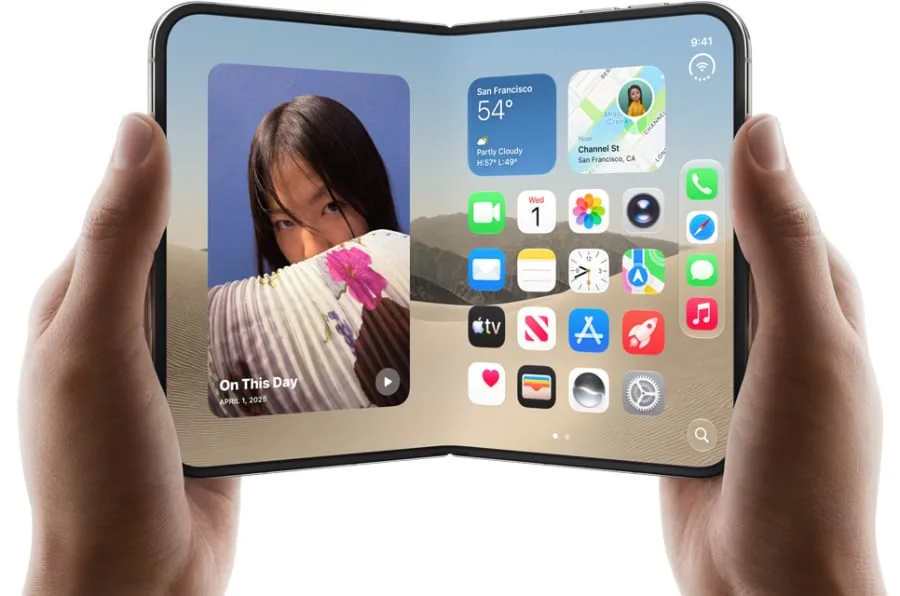
When Apple unveiled its inaugural foldable handset, the company chose not to hide a fundamental reality: a visible line runs through the center of the screen. Instead, the tech giant has layered engineering and software strategies to render that crease less prominent and tactile than competitors' offerings.
The iPhone Duo's inner display stretches 7.6 inches across, a familiar trade-off for anyone accustomed to folding phones. Yet Apple has deployed multiple tactics to diminish the crease's visibility and feel, ranging from a nano-texture surface treatment to a hinge engineered to stabilize the screen when fully extended.
Initial hands-on reviews indicate the strategy delivers results that exceed expectations, though the crease remains technically detectable. This distinction carries weight for consumers contemplating a minimum $1,999 investment in Apple's entry into a category where rivals have invested years perfecting their display technology.
Apple designed the iPhone Duo around the crease
Rather than claiming the crease has been eliminated, Apple positions the iPhone Duo's inner display as featuring a premium nano-texture finish that cuts glare and reflections while helping to "minimize crease visibility." According to Apple's announcement, the precision hinge provides structural support at the display's center when the device reaches its fully open state.
The matte finish represents only one component of the overall design strategy. The inner display incorporates multiple layers, encompassing high-strength glass, a titanium plate, proprietary adhesives, and a polymer cover layer. These elements work in concert to permit the display layers to shift as the phone bends, distributing stress across the screen.
These specifications complement TechRepublic's examination of Apple's 2026 product roadmap, which spotlighted the Duo's 7.6-inch inner screen, diminutive 5.4-inch outer display, and $1,999 entry price. The outcome appears to be a crease that technically persists yet may become inconspicuous during routine operation.
During The Verge's initial hands-on session, reviewers characterized the crease as nearly imperceptible under typical viewing conditions. MacRumors reached a comparable conclusion, observing that the crease remained apparent under certain lighting angles but that Apple's display treatment rendered it less conspicuous and harder to detect by touch.
This distinction carries significance. Foldable screens inherently bend, and the central question regarding the Duo may center not on the crease's existence but rather on whether users perceive it sufficiently to diminish their experience.
A better crease does not eliminate the trade-offs
Apple's solution warrants measured skepticism.
Current assessments derive from pristine demonstration units, not devices subjected to months of repeated opening, lint accumulation, accidental impacts, temperature fluctuations, and typical daily use. The iPhone Duo will not arrive in customers' hands until Oct. 23, leaving its long-term screen and hinge resilience untested by independent reviewers.
Apple contends the inner display withstands routine use and incorporates a custom polymer cover layer offering up to 40% greater stiffness compared to materials deployed elsewhere in the sector. Nevertheless, Apple's promotional materials omit specifics regarding the folding cycle ratings for either the hinge or display.
Furthermore, Apple enters a foldable marketplace where competitors continue advancing rapidly. Samsung has refined its Galaxy Z Fold series across multiple iterations, positioning the crease as merely one element within a broader competitive landscape encompassing thickness, weight, durability, imaging capabilities, and user interface design.
TechRepublic's reporting on Samsung's current foldable offerings demonstrates how developed this category has become, establishing an exceptionally demanding benchmark for a first-generation product.
The Duo must therefore prove its merit beyond the crease alone. At $1,999, it commands a substantial premium over Apple's conventional iPhones, asking buyers to embrace a first-generation Apple device in exchange for a screen capable of transitioning from a pocket-sized phone into something approximating a compact tablet.
Additional compromises exist. Apple's 48MP Dual Fusion camera system delivers up to 2x optical-quality zoom, whereas the iPhone 18 Pro models feature a dedicated telephoto lens providing superior optical-quality zoom capability.
Apple is also using software to make the fold less distracting
Apple possesses an edge that transcends physical hardware: command over the software ecosystem surrounding it.
Apple characterizes the Duo as running a reimagined iOS 27 tailored to capitalize on the folding screen's capabilities. User interfaces reconfigure as the device opens and closes, applications can operate concurrently, and information can relocate across the expanded display based on the device's orientation.
This software dimension introduces an additional facet to Apple's effort to render the fold less obtrusive. Beyond relying exclusively on display engineering, Apple can architect the interface so the crease remains less likely to align with critical controls or information.
This aligns with TechRepublic's comprehensive coverage of iOS 27, which has examined how Apple's newest software refinements reshape interactions across its entire device ecosystem.
The combination of hardware and software engineering may ultimately constitute Apple's more significant response to the fold. A vertical line becomes considerably more tolerable if the additional screen real estate substantially enhances multitasking, video playback, document viewing, and other routine activities.
What the iPhone Duo crease means for buyers
For potential purchasers, the crease itself likely should not serve as the primary deciding criterion. Early assessments suggest Apple has engineered it to remain subtle enough that numerous users may cease noticing it during typical use, particularly when viewing content head-on.
More pressing considerations involve whether the display maintains this subtlety following months of regular folding and whether the expanded inner screen delivers sufficient utility to warrant the Duo's $1,999 starting price. Consumers who regularly juggle multiple tasks, review documents, stream video, or operate multiple applications simultaneously may discover the larger display justifies the compromise. Those primarily seeking a traditional iPhone experience may encounter less incentive to absorb the additional expense and uncertainty inherent in a first-generation foldable.
The most prudent strategy remains straightforward: refrain from judging the iPhone Duo exclusively based on retail display photographs of its crease. Following the device's Oct. 23 customer launch, direct attention toward independent durability assessments, real-world crease perception, and whether the larger screen genuinely transforms user behavior.
Apple appears to have succeeded in rendering the crease less conspicuous. Whether the remainder of the Duo furnishes buyers sufficient cause to overlook it represents the more consequential question.
Read more

California Tightens Rules on Robotaxis as Incidents Mount
A new state law sets safety standards and accountability measures for autonomous vehicle operators, requiring local support staff and penalties for blocking emergency responders.

Wawa Elevates Long-Tenured Executive to CIO Role
The convenience store chain has named Bill O'Donnell, a 25-year company veteran, as its new chief information technology officer, putting him in charge of tech strategy, cybersecurity and digital operations.

ServiceNow Debuts Flow, a Conversational Service Desk Built for Speed Over Complexity
ServiceNow is rolling out Flow, a natural language service desk tool that automates employee requests through Slack and Microsoft Teams without requiring a full IT service management overhaul.