Apple's Health App Gets Smarter With AI-Powered Daily Guidance
Apple is transforming its Health app from a passive data collector into an intelligent wellness coach, using Apple Intelligence to convert complex biometric readings into actionable daily recommendations.
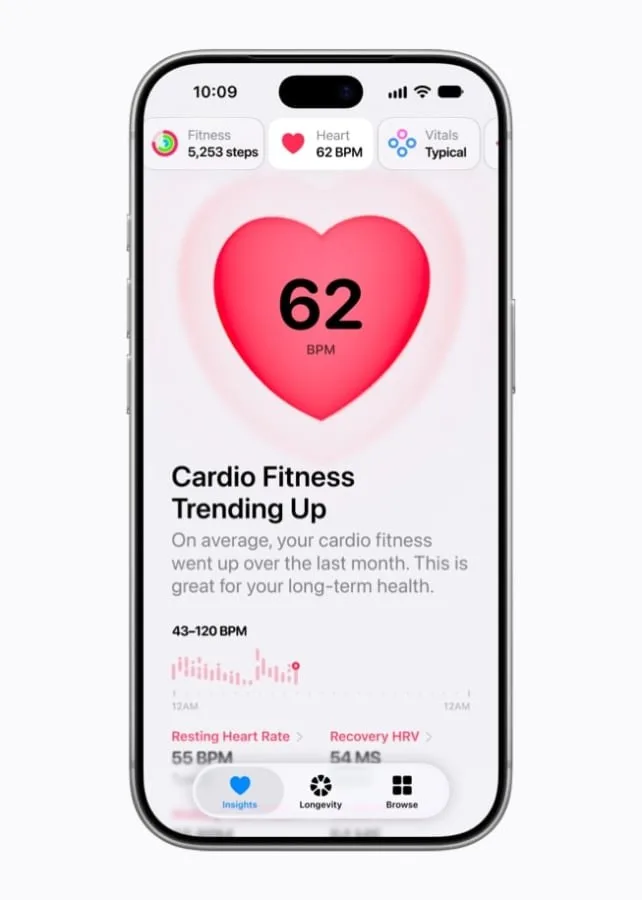
Rather than simply storing health metrics, Apple is reimagining how its Health app interprets that information for everyday users. The company unveiled this vision at its September 9 event, introducing the Apple Watch Series 12 and Apple Watch Ultra 4, each equipped with an enhanced Health Sensing System. Yet the real story lies not in the new hardware itself, but in the software revolution it enables: a redesigned Health app powered by Apple Intelligence, arriving on iOS 27 and iPadOS 27.
Historically, Apple Health functioned as little more than a digital repository for biometric information. The forthcoming update fundamentally changes this model by leveraging Apple Intelligence to synthesize health and activity data into tailored summaries and actionable insights.
The Series 12 and Ultra 4 introduce a daily readiness score, a metric that combines recent activity levels, sleep quality, and vital signs into a single 0-to-10 rating. This number pairs with straightforward guidance in plain language—Recover, Pace Yourself, Ready, or Go For It—to help users determine whether to focus on rest or push forward with more demanding activity.
A separate Longevity tab calculates what Apple calls "Health Age," an algorithm-derived figure that measures an individual's biometric profile—including VO2 max, resting heart rate, and heart rate variability—against their actual age.
By combining breakthrough sensing on Apple Watch with Apple Intelligence in the Health app, we're able to translate complex biometric data into clear guidance for users
Dr. Sumbul Desai, Apple's vice president of Health
Beyond activity tracking, Apple is broadening into preventive screening and clinical testing options. An on-device movement assessment uses the iPhone camera and Apple Watch to evaluate balance, strength, and mobility without uploading video data. Additionally, users can arrange a 50-biomarker blood test through Quest Diagnostics for $119 at approximately 2,000 locations across the United States, with findings like A1c and LDL cholesterol accessible via the Health app.
The prescriptive coaching pivot
Apple's overhaul signals a fundamental industry shift: moving away from merely reporting health metrics toward delivering individualized wellness guidance.
By distilling complex biometric patterns into simpler, more digestible recommendations, Apple directly competes with dedicated longevity platforms and wellness monitoring services. Converting multiple health signals into a single daily prompt could make health information more accessible to ordinary users who lack medical training.
However, reducing physical recovery to a single numerical score oversimplifies a complex biological reality. True readiness depends on numerous variables—medications, stress levels, work schedules—that consumer-grade sensors cannot fully measure. While simplified metrics may encourage healthier habits, they risk generating unwarranted concern if users interpret algorithmic estimates as medical verdicts. Users should view these scores as wellness indicators, not clinical diagnoses, especially when they diverge from actual symptoms, medication instructions, or guidance from medical professionals.
Availability and requirements
Access to these new capabilities depends on specific hardware prerequisites.
- The updated Health app launches later this year in U.S. English initially, with Apple Intelligence capabilities requiring an eligible iPhone or iPad.
- The daily readiness score is exclusive to the Health Sensing System on Apple Watch Series 12 (beginning at $399) and Ultra 4 (beginning at $799).
- Health Age functionality requires an Apple Watch, though Apple has not yet disclosed which older models qualify.
- The full watchOS 27 rollout begins Monday, September 14, and requires an Apple Watch Series 9, SE 3, Ultra 2, or newer, paired with an iPhone 11 or later running iOS 27.
Prospective users should clarify which capabilities demand a new Apple Watch purchase versus which will reach current devices through software updates. The genuine challenge ahead is whether Apple's streamlined scoring system genuinely helps people make wiser daily choices without encouraging overreliance on estimates that cannot capture every medical or personal circumstance.
Read more

California Tightens Rules on Robotaxis as Incidents Mount
A new state law sets safety standards and accountability measures for autonomous vehicle operators, requiring local support staff and penalties for blocking emergency responders.

Wawa Elevates Long-Tenured Executive to CIO Role
The convenience store chain has named Bill O'Donnell, a 25-year company veteran, as its new chief information technology officer, putting him in charge of tech strategy, cybersecurity and digital operations.

ServiceNow Debuts Flow, a Conversational Service Desk Built for Speed Over Complexity
ServiceNow is rolling out Flow, a natural language service desk tool that automates employee requests through Slack and Microsoft Teams without requiring a full IT service management overhaul.