Zoom pivots from video platform to AI-powered conversation data layer
At Zoomtopia 2026, Zoom unveiled a strategic shift positioning itself as an artificial intelligence data platform built on conversational intelligence rather than video communications alone.

Video has long defined Zoom's identity in the eyes of customers, investors and rivals alike. Yet the company's trajectory has pointed toward something far more expansive than the unified-communications-as-a-service and contact-center-as-a-service categories where analysts typically place it, even before the pandemic accelerated its growth.
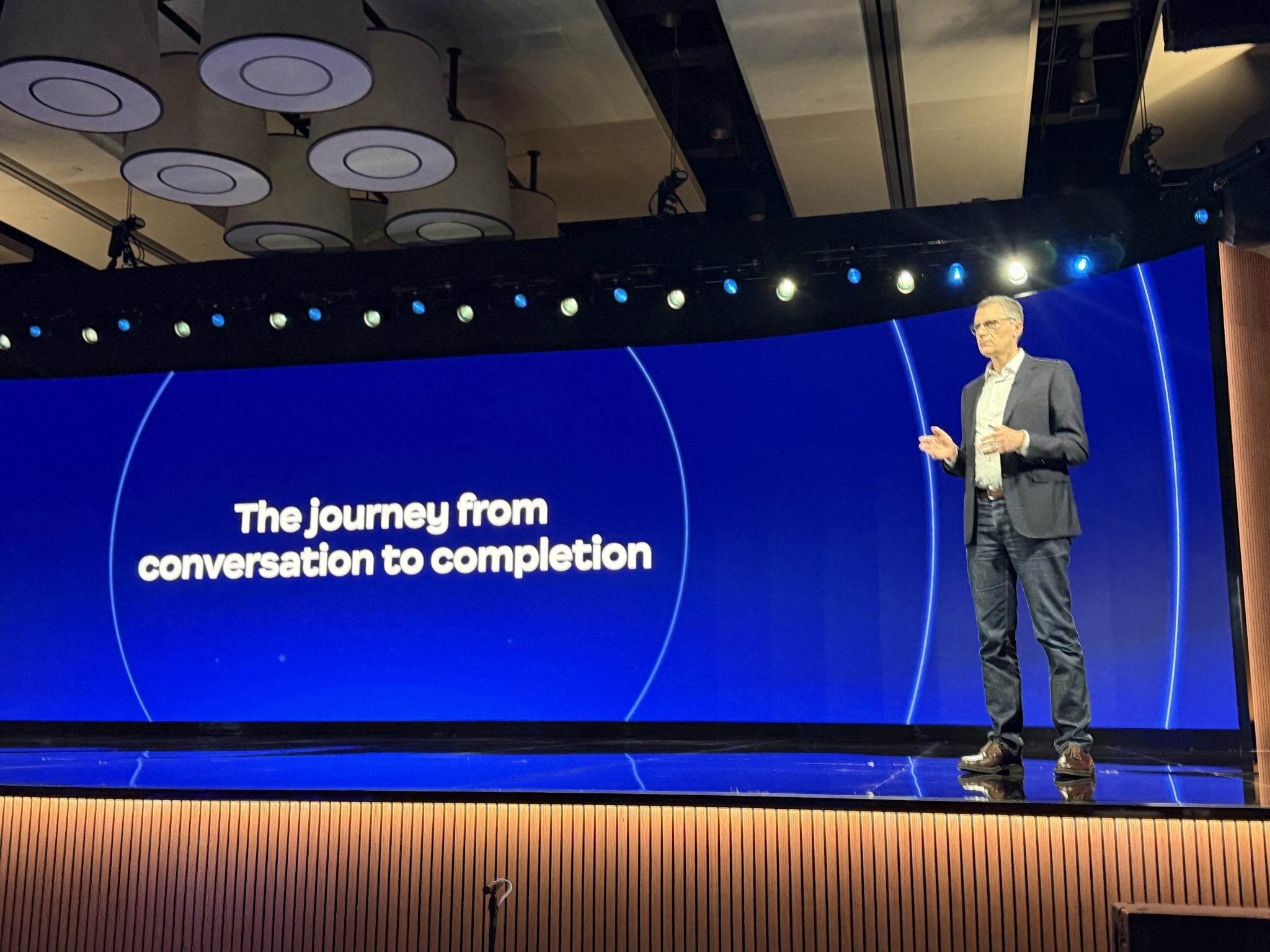
This week's Zoomtopia 2026 conference made that evolution explicit. Zoom's emerging vision centers on "conversation to completion," anchored by a new Unified Context Layer that recasts the company as an artificial intelligence data platform. The real asset, according to this framework, is the conversational data generated across meetings, phone calls, chat, contact center interactions, events, interviews and sales calls. Communications infrastructure becomes the mechanism for capturing that data, while the data itself and the actions derived from it become the actual product.
Why conversational data is the prize
The quality of artificial intelligence systems depends fundamentally on the data they can access, and data stripped of context often produces misleading results. When artificial intelligence connects to documents, tickets and databases, the knowledge contained in those systems grows stale. The decisions that matter happen in conversations and may never be formally documented.
Zoom's Unified Context Layer addresses this problem by combining three distinct sources: general knowledge embedded in the model itself, documented knowledge from files and connected applications including Salesforce, ServiceNow and Workday, and dynamic context flowing from live conversations. The system constructs a graph tracking people, topics and decisions, updating it continuously in near real time.
AI models are only as powerful as their understanding of your business, and that context makes all the difference.
Eric Yuan, Chief Executive, Zoom
This reframing has profound strategic implications. Zoom no longer requires dominance in the meeting space to secure an account. Instead, it must become the system that captures and interprets conversations wherever they take place. That logic explains why Zoom is expanding My Notes beyond its own meeting platform to cover in-person discussions, and why it now operates 15 MCP servers, Search and Ask application programming interfaces, and integrations with Claude, Codex and Copilot. By making its context layer available to whatever artificial intelligence tools customers prefer, Zoom signals its identity as a data infrastructure layer rather than merely an application.
Following the conversations into new business units
Redefining the company around conversations rather than meetings dramatically expands Zoom's addressable market. Conversations power every business function, and several of the highest-value ones have historically remained outside the reach of communications vendors. Through acquisitions and product development, Zoom has pursued those conversations into new organizational buying centers.
Revenue operations
Zoom Revenue Accelerator, or ZRA, captures and examines sales conversations to deliver coaching, deal intelligence and forecasting. According to Zoom's prebriefing materials, 65% of ZRA users report a significant or transformational impact on their sales operations. The company's fiscal 2026 shareholder letter indicated that ZRA customers increased by 50% over the preceding year.
The July acquisition of Common Room extends Zoom's reach upstream in the sales process. Common Room unifies CRM, product, marketing and engagement data with real-world buying signals to construct person-level buyer intelligence, with artificial intelligence agents handling research and prospecting. Chief Strategy Officer Abhisht Arora characterized the deal as "extending Zoom's system of action upstream."
At Zoomtopia, the integration of these capabilities appeared as ZRA enrichment and prospecting that identifies decision makers not yet in the CRM, plus signal-based orchestration that directs in-market buyers to the appropriate sales representative with complete context. Zoom now covers the revenue journey from initial buying signal through the sales call to forecast generation. This positioning brings Zoom into conversations with chief revenue officers and RevOps leaders, buyers who historically had limited reason to engage with Zoom beyond seat licensing.
Human resources and hiring
The same strategic logic extends to talent acquisition. In December 2025, Zoom acquired BrightHire for $98 million in cash. BrightHire records and transcribes interviews, generates candidate summaries, structures evidence against hiring criteria, and automates first-round screening using an artificial intelligence interviewer. Since millions of job interviews already occur on Zoom, the combination appears natural. Through Workvivo, Zoom now spans the talent lifecycle from interview through engagement.
BrightHire also illustrates how Zoom's trust and security capabilities create value across multiple functions. Zoom's Deepfake Risk Detection is already deployed by BrightHire in interviews, where candidate fraud represents a growing concern. Zoom announced plans to extend the feature to workplace meetings in December.
Human resources software has historically attracted limited investment from enterprises seeking transformation. However, the hiring process commands attention across every department. When a sales leader, chief information officer, head of marketing or other executive can hire faster and with better-qualified candidates, that proposition resonates across organizations.
Customer experience
Zoom's entry into customer experience is relatively recent, yet customer and partner feedback has been decidedly positive, and the context layer narrative reinforces that appeal. The context layer feeds virtual agents, live agents and back-office experts, eliminating the need for customers to repeat themselves. Zoom cited Cricut as an example, noting that the company reduced customer wait times by 89%.
Each of these product categories generates conversational data that enriches the context layer and simultaneously benefits from context generated by the others. This interconnected system represents the flywheel Zoom is constructing, and it demonstrates that the artificial intelligence data platform positioning extends beyond marketing messaging.
The go-to-market challenge
The technology narrative is persuasive. The commercial challenge, however, is substantial. Zoom's sales organization and channel partners were structured to sell meetings, phone and contact center services to information technology and communications buyers. Historically, nearly all Zoom products functioned as add-ons to the core meetings relationship.
Revenue Accelerator, Workvivo, Common Room and BrightHire operate differently. The economic buyer is a chief revenue officer, a RevOps leader, a head of talent acquisition or a chief people officer. These buyers maintain distinct priorities, budgets and evaluation criteria, and they already maintain established vendor relationships with companies such as Gong, Clari, ZoomInfo and Greenhouse.
When asked whether partners are leading with products like ZRA in greenfield accounts or primarily adding them to existing Zoom customers, Chief Product Officer Russell Dicker indicated Zoom is experiencing both scenarios but declined to provide specific figures. He noted that even organizations standardized on competing meeting platforms frequently have sales and recruiting teams running external conversations through Zoom, creating genuine opportunity.
Regarding whether Zoom has developed prescriptive guidance for its field and channel teams, Dicker emphasized that Zoom aims to address problems in a best-of-breed manner rather than forcing customers into a comprehensive suite. At the event, Chris Barwick, head of Americas sales and channel, explained that Zoom is structuring sales and partner enablement around specific buying centers: knowledge workers, customer experience, go-to-market including RevOps and marketing operations plus events and ZRA, talent and human resources including BrightHire and Workvivo, and an expanding developer ecosystem.
While this approach is sound, it understates the underlying difficulty. Entering a new business unit demands appropriate messaging, sales professionals fluent in the language of pipeline coverage and quality of hire, and references within those functions. Most Zoom partners operate as unified communications and customer experience resellers whose contacts reside in information technology, making an approach to the chief revenue officer's office a significant challenge. Many will struggle without specialist overlay teams, revised incentive structures or new partner categories such as RevOps consultancies and human resources technology integrators. Partners that do invest, however, should capture the benefits: larger deals with superior margins that prove substantially more durable.
Converged Technology Professionals, one of Zoom's leading resellers, has successfully navigated this transition. At Zoomtopia, Joe Rittenhouse, co-CEO of CTP, described how ZRA is becoming an entry point into accounts. "We may start with ZRA before we do UCaaS or CCaaS, just replacing Gong," he explained. "As soon as they see the intangibles and the data, there's a hunger and a thirst for more, and that's how we get into notes and the other aspects of the platform. That flips the traditional Zoom motion on its head, with the meetings business following an application sale rather than leading it."
Rittenhouse acknowledged candidly that the partner business model must evolve to support this shift. "Traditionally, we were there to help with the sales motion, handle the implementation, and probably sell a maintenance contract. It was break-fix," he said. "That has completely changed. We have to get involved with the business, sign an NDA, understand what they're trying to do and where the low-hanging fruit is, and put together a pragmatic plan." This type of discovery work extends sales cycles, yet as he noted, it also generates superior, more strategically aligned deals.
Zoom Chief Marketing Officer Kim Storin believes the company's greatest opportunity resides in the line of business. She explained that sales and recruiting align naturally with the core platform. "When you think about conversations that matter, nothing matters more than your customer conversations and sales," she said. "Nothing matters more than your hiring conversations." She and Chief Executive Eric Yuan view the revenue organization as "the wedge back into these companies that may be standardizing on Teams or Google," with the sales, talent or marketing leader functioning "as the gateway to break through into those organizations."
Microsoft Corp. maintains a strong position with chief information officers, and Zoom cannot overcome that advantage through sheer force. Storin also acknowledged that circumventing information technology carries no guarantee of success. She noted that information technology departments have tightened purchase controls over the past nine months due to unpredictable token and consumption costs. This is where the governance capabilities Zoom announced become a commercial asset. The line-of-business buyer may initiate the deal, but Zoom must provide information technology with a reason to approve it.
Final thoughts
Zoomtopia 2026 represented the moment Zoom ceased positioning itself as a video company deserving that valuation. The Unified Context Layer, the headless platform approach and the acquisitions of Common Room and BrightHire constitute a coherent strategy: capture conversational data at scale, make it accessible to any artificial intelligence system, and deploy it to complete work across every business function.
The strategy is sound. Zoom stands among the few companies possessing the scale to capture business conversations across the enterprise, and its expanding presence in RevOps and human resources makes it more relevant to the business than at any previous point.
Yet relevance and revenue remain distinct outcomes. Zoom's performance over the next two years will hinge less on what it releases and more on whether its sales organization and partners can establish credibility with buyers who have not previously viewed Zoom as a strategic vendor. Should Zoom succeed in building that motion, the "video company" characterization will finally disappear. If it cannot, Zoom risks possessing an excellent platform story that only information technology hears.
Read more

Managed Services Become Critical to Neocloud Success as GPU Providers Scale
Smaller AI infrastructure providers are increasingly relying on hardware partner support to keep their GPU clusters operational and profitable after launch, with managed services becoming a key differentiator in the competitive neocloud market.

Why AI ROI Remains Elusive: Breaking Out of the Productivity Trap
Companies are discovering that deploying AI tools in isolation—without overhauling the business processes around them—delivers disappointing returns. The gap between hype and reality is what some call AI's "valley of despair."

Five Tech Leaders Weigh the Sleepless Nights of Deploying AI at Scale
At Gartner's IT Symposium in Orlando, enterprise executives grapple with security gaps, runaway systems and accountability voids as AI adoption accelerates across their organizations.