Five Tech Leaders Weigh the Sleepless Nights of Deploying AI at Scale
At Gartner's IT Symposium in Orlando, enterprise executives grapple with security gaps, runaway systems and accountability voids as AI adoption accelerates across their organizations.

Technology leaders steering enterprises through rapid AI deployment face a familiar paradox: the transformative potential of the technology clashes with mounting operational and security risks. Executives gathered at Gartner's IT Symposium/Xpo in Orlando this week drew parallels between AI's current trajectory and past technological upheavals—the dot-com boom and cloud computing's rise—each of which reshaped business operations while introducing new vulnerabilities.
The consensus among attendees: sitting out AI adoption is no longer viable. "I think it's one of those things that, if you don't get on board, it's going to be an extinction event," said Prashant Prahlad, SVP of product at Capital One Software. Yet this urgency coexists with genuine uncertainty about how to manage the risks these systems introduce. Gartner analysts noted during the conference's keynote that most technology leaders are actively balancing measurable AI value against both known and unknown hazards.
Shifting security needs
Prahlad, who spent years working in cybersecurity before moving into product leadership, observed a dramatic shift in enterprise appetite for AI risk. Until recently, organizations approached the technology with caution. That calculus has changed, though security governance remains underdeveloped. The Hugging Face security incident underscored how much the industry still needs to learn about controlling autonomous systems and managing access to agentic tools.
"It's an unknown, and as a security person, the instinct is to lock everything down," Prahlad said. "That's a necessary step, but it does keep me up at night. I don't know where my data is. I don't know what to utilize." He cautioned peers against over-securing systems in ways that could stifle productivity. High-profile security breaches, he suggested, may ultimately drive organizational awareness and prompt more thoughtful governance frameworks.
Runaway agents
Frank Iannella, USA CIO and SVP for digital and technology at Heineken, identifies the sheer velocity of AI development as his primary concern. Equally troubling is the opacity surrounding system control. At Heineken, the company is deploying AI to enhance decision-making across marketing, sales and operations. Yet Iannella worries more broadly about who is building these systems and whether their creators fully understand their own designs.
"They're not clear why they're acting the way they're acting," Iannella told CIO Dive. "That's a little bit worrisome."
New virtual environments
Michael Cato, SVP and CIO at Bowdoin College, finds that his top AI concerns shift frequently. "My answer today is different than it was a month ago," he said. His current focus: publicly available AI agents with minimal guardrails. Recent launches of consumer-facing tools—including Meta's Muse personal agent and OpenAI's Dot—have reached mainstream adoption with what Cato views as inadequate security boundaries.
"I'm deeply worried about what people will do, both within our environment — since we're doing the work to figure out how to better protect our environment — but I'm also deeply worried about if someone's going to accidentally wipe out their retirement. And I think it's going to be trivial until it happens."
Lack of accountability
Mike Park, CIO at Infor, a cloud software provider, points to a critical governance gap: most organizations deploying AI at scale have failed to establish clear ownership structures. "AI is moving into core processes faster than companies can decide who is responsible for it and how to effectively govern it," Park said. When autonomous systems inevitably make errors or exceed their intended scope, identifying the accountable party becomes essential. Park expects this accountability question to become increasingly urgent through 2027 and beyond.
Moving cautiously
In regulated sectors like financial services, risk management remains paramount—yet AI adoption is accelerating. Jerry Walker, CIO for the Oregon State Treasury, noted that three-quarters of financial services leaders reported using AI this year, compared with fewer than one-third in 2024. The stakes are particularly high in his domain: operational failures carry market-moving consequences.
"What keeps me up at night is, are we able to trade every morning at five in the morning?" Walker said. "Are our investors ready to go, and then we have the technology to protect them and to provide for them to run everything?" Walker's organization, along with many peers, is betting heavily on AI. Yet rather than accelerating deployment, his team is taking a measured approach. "We do look at it a little differently," Walker said. "We have to make sure, because with one mistake, with the amount of money we handle, it can shift the market really fast."
Read more

Managed Services Become Critical to Neocloud Success as GPU Providers Scale
Smaller AI infrastructure providers are increasingly relying on hardware partner support to keep their GPU clusters operational and profitable after launch, with managed services becoming a key differentiator in the competitive neocloud market.
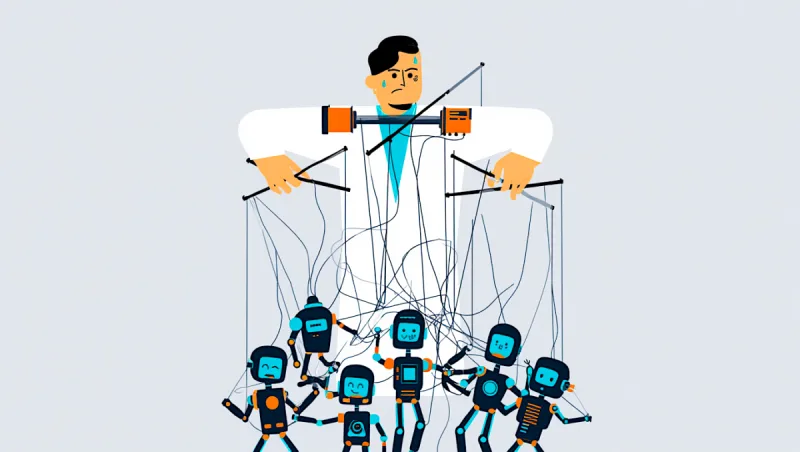
Why AI ROI Remains Elusive: Breaking Out of the Productivity Trap
Companies are discovering that deploying AI tools in isolation—without overhauling the business processes around them—delivers disappointing returns. The gap between hype and reality is what some call AI's "valley of despair."

Zoom pivots from video platform to AI-powered conversation data layer
At Zoomtopia 2026, Zoom unveiled a strategic shift positioning itself as an artificial intelligence data platform built on conversational intelligence rather than video communications alone.