SAP Strengthens Joule AI Agents With Governance Framework and Tabular Models
At its TechEd developer conference, SAP unveiled enhancements to its Joule assistant and Business AI Platform, introducing governance controls for autonomous agents and new foundation models designed for structured data.

SAP SE revealed a suite of artificial intelligence advancements during its annual TechEd conference for developers, focused on strengthening its Joule assistant offerings and Business AI Platform alongside the introduction of tabular data foundation models.
Joule Work's latest capabilities aim to make AI agents more capable while enabling them to work with open standards. Through the Model Context Protocol and Agent 2 Agent, Joule—SAP's agentic AI assistant—can collect information, make determinations and carry out complex business operations spanning the organization. The system also integrates external data sources and services into these workflows.
A critical consideration for enterprise AI deployment involves managing agent behavior. According to Ted Way, vice president and chief product officer of SAP business AI product engineering, "Open protocols need governed doors." Just as human employees require access controls and permission levels, AI agents must operate within defined boundaries and oversight mechanisms.
Way described SAP's vision for allowing customer-built agents to work alongside SAP's business agents across enterprise systems. Opening these connections, however, demands a secure control mechanism where businesses can track and regulate all activity. SAP is introducing an orchestration layer that permits assistants and agents to access Joule Agents through a governed gateway.
A fresh capability enables agents to activate n8n workflows, a significant integration available through Joule Studio. N8n operates as a node-based workflow automation system connecting disparate applications through deterministic automation. Unlike generative AI, n8n relies on event-based and trigger-based reasoning without the possibility of hallucination or randomness—it executes predetermined rules consistently from beginning to end.
This characteristic makes n8n particularly suited for highly controlled or mission-critical operations requiring absolute precision. "It needs to do these five steps in this order exactly like this every single time," Way noted, positioning n8n as the appropriate tool for such scenarios.
SAP's strategy merges the flexibility of natural-language agent instructions with rigid, predetermined sequences. An agent can assess whether a particular workflow is necessary, while operations demanding strict compliance can maintain their exact procedural requirements.
Cloud Data Infrastructure for Enterprise Autonomy
SAP expanded the SAP Business Data Cloud Ontology Manager within SAP Data Cloud to deliver an AI-optimized authoring interface. This tool equips agents with knowledge of how different applications interconnect by establishing connections between organizational data points, enabling agents to reason with greater accuracy and make better decisions across the enterprise.
SAP's recently announced acquisition of Reltio, unveiled at SAP Connect, introduces multidomain data management capabilities to the platform. This addition consolidates customer, supplier and product information across SAP systems and external platforms into reliable data assets for both applications and agents.
The offering works alongside SAP's current Knowledge Graph, which supplies extensive business context sourced from SAP information.
The company also expanded its lakehouse functionality through Dremio, which SAP acquired. The enhancement introduces native compatibility with Apache Iceberg and Apache Polaris alongside a rapid, distributed query engine. This engine permits comprehensive data access without requiring data movement or duplication.
Tabular Models for Structured Business Data
Way observed that "Not every enterprise problem is a language problem," noting that while AI development has emphasized natural language processing, much corporate information exists in tabular formats.
To address this gap, SAP introduced SAP-RPT-2.0, its latest tabular AI model. This model extends previous capabilities in classification and regression to include anomaly and outlier detection, delivering AI-driven insights through embeddings. The multitable functionality decreases the need for manual feature engineering while accelerating and improving analysis of structured information.
SAP also debuted the SAP-RPT-TS model, designed to assist customers in forecasting values for time-indexed metrics. The model integrates with SAP Business Planning, enabling less specialized users to implement the system without developing custom machine learning solutions.
In collaboration with Hewlett Packard Enterprise Co., SAP is deploying SAP-RPT on the International Space Station. The deployment aims to forecast potential problems before they become critical failures, recover missing sensor readings from past information, and produce understandable status reports for both astronauts and mission control teams—all without requiring data transmission to Earth for processing.
Read more
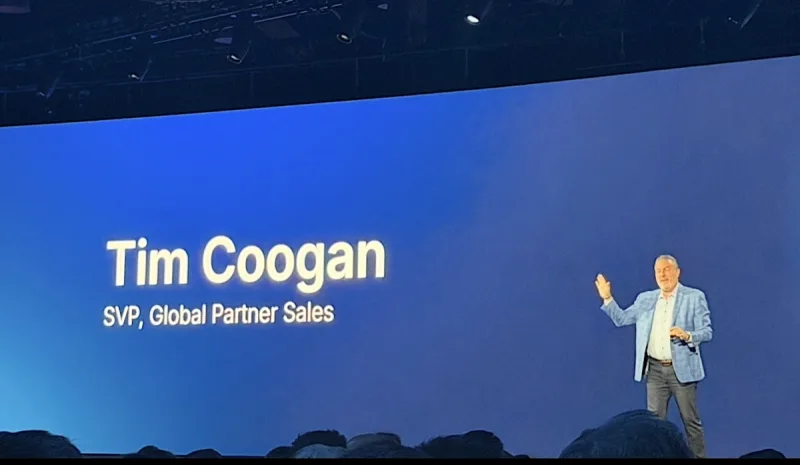
Cisco's Partner Summit Signals Shift From Sales to AI-Driven Services
Cisco is restructuring how its channel partners earn money, moving away from transaction-based models toward intelligence-led services and AI-powered tools that reward influence across the entire ecosystem.

Three critical lessons from Workiva's Amplify event on AI governance in enterprise workflows
As AI agents move from advisory roles to executing regulated tasks in finance, compliance and sustainability, enterprises face new challenges in defining autonomy limits, redesigning workflows and assessing readiness process by process.

AI's dual role in cybersecurity: faster defenses and faster exploits
Frontier AI models are reshaping the security landscape, enabling organizations to detect vulnerabilities at unprecedented speed while simultaneously arming attackers with powerful new tools. The PHP exploit surge shows how quickly the advantage can shift.