Cisco's Partner Summit Signals Shift From Sales to AI-Driven Services
Cisco is restructuring how its channel partners earn money, moving away from transaction-based models toward intelligence-led services and AI-powered tools that reward influence across the entire ecosystem.
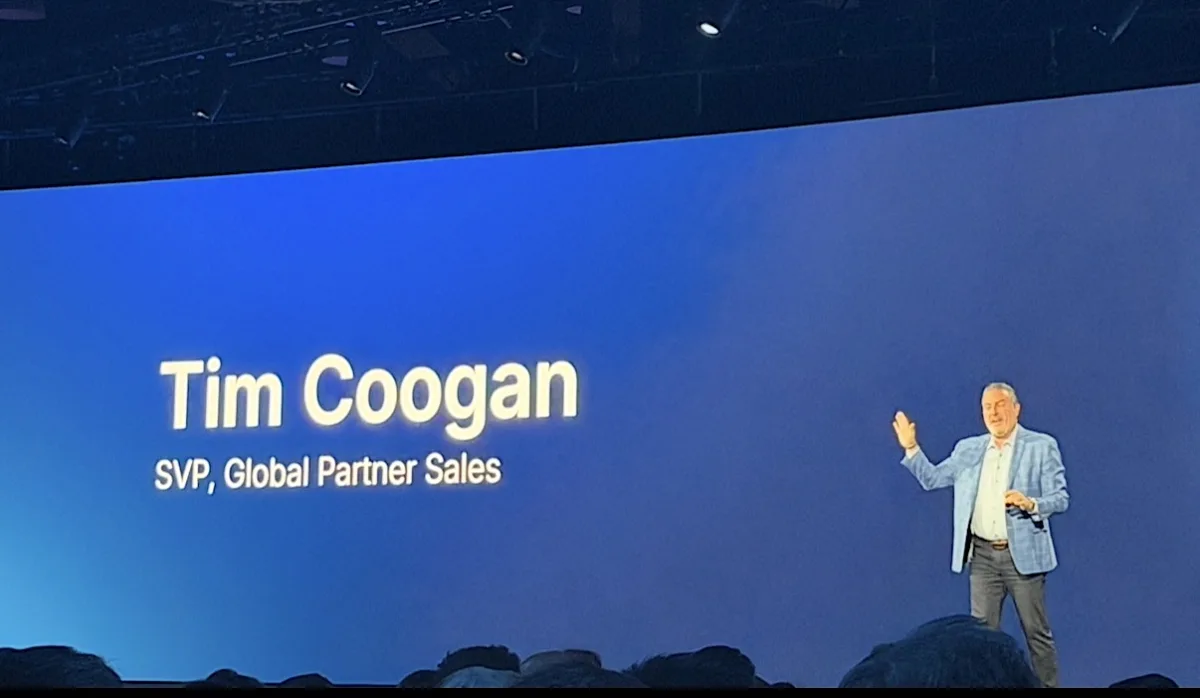
Over three decades, Cisco Partner Summit has centered on how resellers move Cisco Systems Inc. products. The 2026 gathering in Vancouver took a different direction: exploring how partners generate revenue when deal closure no longer drives the economics. Momentum surrounded the event, with Cisco's stock climbing more than 50% in the preceding 12 months. Tim Coogan, senior vice president of global partner sales, informed the 2,000 assembled partners that channel bookings represented roughly 90% of Cisco's fiscal 2026 total, with global channel growth reaching just over 17%. Chief Executive Chuck Robbins described fiscal 2026 as "the absolute best year that Cisco's ever had." Yet strong performance can obscure fundamental shifts, and Vancouver's announcements reveal a substantial reimagining of value distribution across Cisco's partner network.
Influence now counts, not just transactions
Perhaps the most consequential yet understated shift emerged through Ecosystem Deal Registration, which grants advisers, consultants and developers formal recognition for contributing to Cisco wins, regardless of whether they execute the transaction. This category of partners has historically received less prominence than traditional resellers, yet they have become indispensable in the artificial intelligence landscape.
Currently, this recognition manifests as marketing assistance and visibility alongside Cisco sales teams. Beginning in spring, preferred advisers and developers will qualify for referral incentives. Cisco is launching dedicated Partner Value Indexes for advisors and developers, with a consolidated distributor index arriving in 2027.
Coogan underscored the significance of this evolution. "Our traditional programs were transaction-based," he stated during his keynote remarks. "This is a unique way to bring the entire ecosystem of partners together into a single solution for the benefit of our customers." Research cited by Cisco, drawing on Omdia findings, reveals that customers engage with six to seven partners and encounter 28 distinct moments of influence before purchasing. A compensation structure rewarding only the partner holding the final contract overlooks the majority of factors shaping purchasing decisions. Channel conflict represents a genuine risk, and resellers will demand evidence that incentivizing influence expands opportunity rather than fragmenting it.
Robbins acknowledged difficulties surrounding the Cisco 360 deployment and demonstrated the organization's readiness to implement fixes. "We're not perfect. We'll screw it up, but we'll fix it," he remarked. Partners should continue holding leadership accountable to this commitment.
Cisco IQ turns services into the business
A single announcement carries potential to reshape partner economics: Cisco IQ Partner Branded Support Standard. Partners can now deliver Cisco IQ under their own identity, leveraging their own personnel, with role-based access to customer infrastructure inventories, application programming interfaces, IT service management integrations, and a Model Context Protocol server.
"For too long, partners entered customer conversations without the same view as Cisco. That changes today," stated Liz Centoni, executive vice president and chief customer experience officer. "It's their name, their customer relationship and their services practice. Cisco IQ is the engine. Partners are the business."
Centoni offered several persuasive examples. More than 16,000 customers and nearly 20 million devices now operate on Cisco IQ. Generali compressed the assessment time for a single security advisory across 16,000 devices from four days to 10 minutes. Georgetown University converted two months of manual renewal work into a 20-minute process.
During her presentation, Centoni illustrated the financial opportunity with a concrete scenario. A partner refreshing 75 switches generates approximately $625,000 in bookings. That same partner beginning with Cisco IQ, discovering unmonitored devices, selling hardening services, designing the refresh, and managing operations across all 175 switches can reach roughly $1.3 million over five years, including incentives. That represents 2.1 times the value. "Basic gives you the map. Standard and Signature give you the GPS," she explained.
Cisco is supporting this transition with a $2,500 adoption incentive per onboarded customer, a 6% deal registration on Standard and Signature support, and a $1 million Builders Challenge for partners developing managed services on Cisco IQ. The company is essentially moving partners from project-based revenue to recurring revenue, where valuation multiples command higher prices. Partners treating Cisco IQ merely as a support add-on will miss the fundamental opportunity.
Mythos made modernization an emergency
Historically, conversations about last-day-of-support felt like vendor pressure for equipment purchases. Robbins acknowledged this perception. "When we used to stand up and talk about what we call LDOS (last day of support), people would go, 'OK, that's just the vendor trying to sell more equipment,' and you would have been partially right," he said. "Now the urgency of getting that equipment out of the infrastructure, equipment that can't be patched and for which there are no spares, is a real emergency."
Coogan presented figures demonstrating this urgency. In 2018, more than two years elapsed between vulnerability discovery and exploitation. Last year, the window compressed to approximately three weeks. This year, it has narrowed to eight hours or less. Only 3% of partners identified AI security as a growth opportunity last year. This year, 33% did.
Cisco's response encompasses expanded Live Protect coverage, what the company calls the industry's first quantum-resilient Wi-Fi 7 access point, and Privileged Infrastructure Access, developed with Teleport, enabling engineers and AI agents to obtain short-lived, identity-bound access to routers and switches. Robbins characterized the architecture this way: "If agents are operating across your infrastructure, the only common denominator they're going to touch on a daily basis is the network."
Robbins noted that only 8% of the installed base has transitioned to Cisco's new enterprise portfolio. Yet customers feel "overwhelmed." Winning partners will present phased strategies outlining priorities and justifications. This demands advisory capability, not quoting proficiency.
Margin follows the platform
Mark Patterson, executive vice president and chief financial officer, has attended Partner Summit for more than 20 years but took the stage for the first time this year. His session proved among the day's most valuable because it addressed what drives partners most: profitability. Regarding price increases, he stated, "Raising prices is the absolute last resort for us." He noted that the Nov. 7 increase targets memory-intensive products rather than being distributed broadly.
His most critical observation concerned profitability. "The big takeaway is that margin follows the platform," Patterson said. "You might lead with compute, but then you add networking, security, Splunk and observability. That's where you'll drive much of the margin."
The incentive structure reflects this perspective. The program introduces an additional 2% cross-sell bonus for expanding into new Cisco architectures, including Splunk. It raises the reward for annual contract value growth by 50%, doubles adoption incentives, and delivers 12% deal registration for Supermicro systems sold as part of full-stack AI infrastructure. Coogan made an uncommon admission regarding Splunk. "We moved slower on Splunk than we wanted to, than we should have, and that changes this year and it changes now," he said.
Patterson also emphasized Cisco Capital as an underutilized resource, noting that "the margins are paid entirely up front," which enables partners to structure larger deals for customers carrying substantial technical debt. The underlying message: thin-margin compute serves as the entry point, not the profit center. With 91% of surveyed partners reporting that customers worry about AI expenses, those capable of designing cost-efficient on-premises inference will capture associated revenue.
Partners must become builders
The final insight addresses value creation responsibility. Cisco is placing its own AI tooling directly into partners' hands. Model Foundry, a new service within Cisco Cloud Control, provides partners early access to Cisco's purpose-built models, including Deep Network for network troubleshooting. Partners can execute these models through an OpenAI-compatible application programming interface and customize them using customer data. Cloud Control Studio enables partners to construct agents for customers. New Model Context Protocol servers for networking platforms eliminate custom integration requirements, and ThousandEyes synthetic testing is now embedded in eligible Wi-Fi 6E and Wi-Fi 7 access points without additional expense.
Cisco is also deploying AI to address its own channel inefficiencies. The Partner Experience Platform is undergoing reconstruction to merge opportunity, quote, and payout into a unified workflow. An early agent-to-agent pilot with a distributor reduces bill-of-materials creation time by roughly 80%.
Coogan spoke about partners with deference. "Our partners don't owe us anything, and they don't work for us," he said. "We earn the right to work with them every day." This perspective matters at Cisco, particularly when asking partners to develop skills many have yet to acquire. Partners noted that the AI knowledge gap is narrowing, but the hands-on deployment gap continues widening.
What this means for partners
The 2026 Partner Summit reflects the Cisco channel's transition from a resale model to an intelligence-led services model. Partners should consider these recommendations:
Move customers from Basic support
Basic support furnishes customers with inventory visibility. Standard and Signature unlock capabilities generating partner value: vulnerability prioritization, proactive risk intelligence, peer benchmarking, and quantum-readiness assessments. Centoni observed that Cisco has "far too many critical customers who have basic that should be on standard and signature" and noted that customers on higher tiers achieve net promoter scores 15 points higher, translating to improved retention and stronger renewals. With a $2,500 adoption incentive per onboarded customer and 6% deal registration on Standard and Signature, economics reward partners acting now. Begin by auditing your installed base, pinpointing critical accounts remaining on Basic, and scheduling a live Cisco IQ demonstration to build the case.
Lead with resilience, not refresh
Customers recognize their equipment ages. What they need is clarity about priorities. Employ Cisco IQ and Cisco's Resilient Infrastructure playbooks to construct a phased, risk-ranked strategy. Initially, address devices lacking support. Subsequently, strengthen those remaining in service. Finally, upgrade gear past its last day of support or that cannot be patched. The new Quantum Safe and software End of Vulnerability Support assessments supply additional evidence for scoping work. This approach transforms a hardware discussion into a professional services engagement. When customers cite budget constraints, it also provides a framework to defer refresh into the following year's budget. Customers purchase priorities, not part numbers.
Team up intentionally
Most customers already partner with six to seven vendors, and Ecosystem Deal Registration provides Cisco a formal mechanism to compensate advisors, consultants, and developers shaping deals without transacting them. Transacting partners should view this as a pipeline opportunity rather than competition. Identify advisors influencing your largest accounts, independent software vendors building on Meraki and Cisco Cloud Control, and Splunk specialists filling practice gaps. Splunk represents new territory for many Cisco partners, and Coogan provided guidance. When another partner possesses expertise your team requires, collaborate. Partners formalizing these relationships early will experience larger, faster deals before rivals adapt.
Invest in builders
Coming differentiation will not stem from deeper discounting. It will derive from who transforms Cisco's data and models into services unavailable elsewhere. Model Foundry, Cloud Control Studio, the Cisco IQ Model Context Protocol Server, and new Model Context Protocol servers for networking platforms furnish building blocks for custom agents, automated troubleshooting, and managed services operating on customer telemetry. Partners told Cisco the AI knowledge gap is narrowing, but hands-on deployment experience scarcity has become the larger barrier. Enroll engineers in Black Belt training and dCloud labs. The $1 million Builders Challenge also motivates establishing a small team on a new managed service. Partners capable of fine-tuning models and deploying agents will differentiate from those merely reselling.
Final thoughts
For buyers, the partner you engage should arrive with a live perspective of your environment and a strategy, not a quote. If they don't, seek another partner—one that has transformed its own operations to support your modernization. Robbins concluded that Cisco and its partners shaped the internet era and can lead the AI era together. The mechanisms and incentives exist. Execution must now match the pace of emerging threats.
Read more

SAP Strengthens Joule AI Agents With Governance Framework and Tabular Models
At its TechEd developer conference, SAP unveiled enhancements to its Joule assistant and Business AI Platform, introducing governance controls for autonomous agents and new foundation models designed for structured data.

Three critical lessons from Workiva's Amplify event on AI governance in enterprise workflows
As AI agents move from advisory roles to executing regulated tasks in finance, compliance and sustainability, enterprises face new challenges in defining autonomy limits, redesigning workflows and assessing readiness process by process.

AI's dual role in cybersecurity: faster defenses and faster exploits
Frontier AI models are reshaping the security landscape, enabling organizations to detect vulnerabilities at unprecedented speed while simultaneously arming attackers with powerful new tools. The PHP exploit surge shows how quickly the advantage can shift.