Apollo's analysis reveals AI gains concentrated among tech giants, leaving broader market flat
An investment firm's study shows that while the Magnificent Seven have reaped substantial returns from artificial intelligence investments, the rest of corporate America has yet to translate AI spending into measurable financial improvements.

Notwithstanding widespread enthusiasm and billions in capital deployment across artificial intelligence initiatives, companies outside the technology sector have not yet realized meaningful financial returns, according to research from Apollo Global Management Inc., one of the world's largest investment firms.
In an analysis released Saturday, Apollo Global Management Inc. examined what it calls the "S&P 493"—the S&P 500 excluding technology powerhouses Alphabet Inc., Amazon.com Inc., Apple Inc., Meta Platforms Inc., Microsoft Corp., Nvidia Corp. and Tesla Inc.—and found that these firms have not yet reaped rewards from their AI investments.
Torsten Slok, an analyst at Apollo, observed that although the Magnificent Seven have generated tangible profits from AI, other companies show stagnant profit margins and flat revenue per worker, with no measurable productivity improvements. According to Slok, "Mainstream corporate America is pulling back and starting to view token spending not as a source of growth but as a cost center that weighs on margins."
Slok's assessment rested on examination of three critical performance indicators: revenue per worker, profit margins and productivity growth. While these metrics have surged dramatically for the seven technology leaders, the broader market shows no comparable movement.
The metrics tell the story
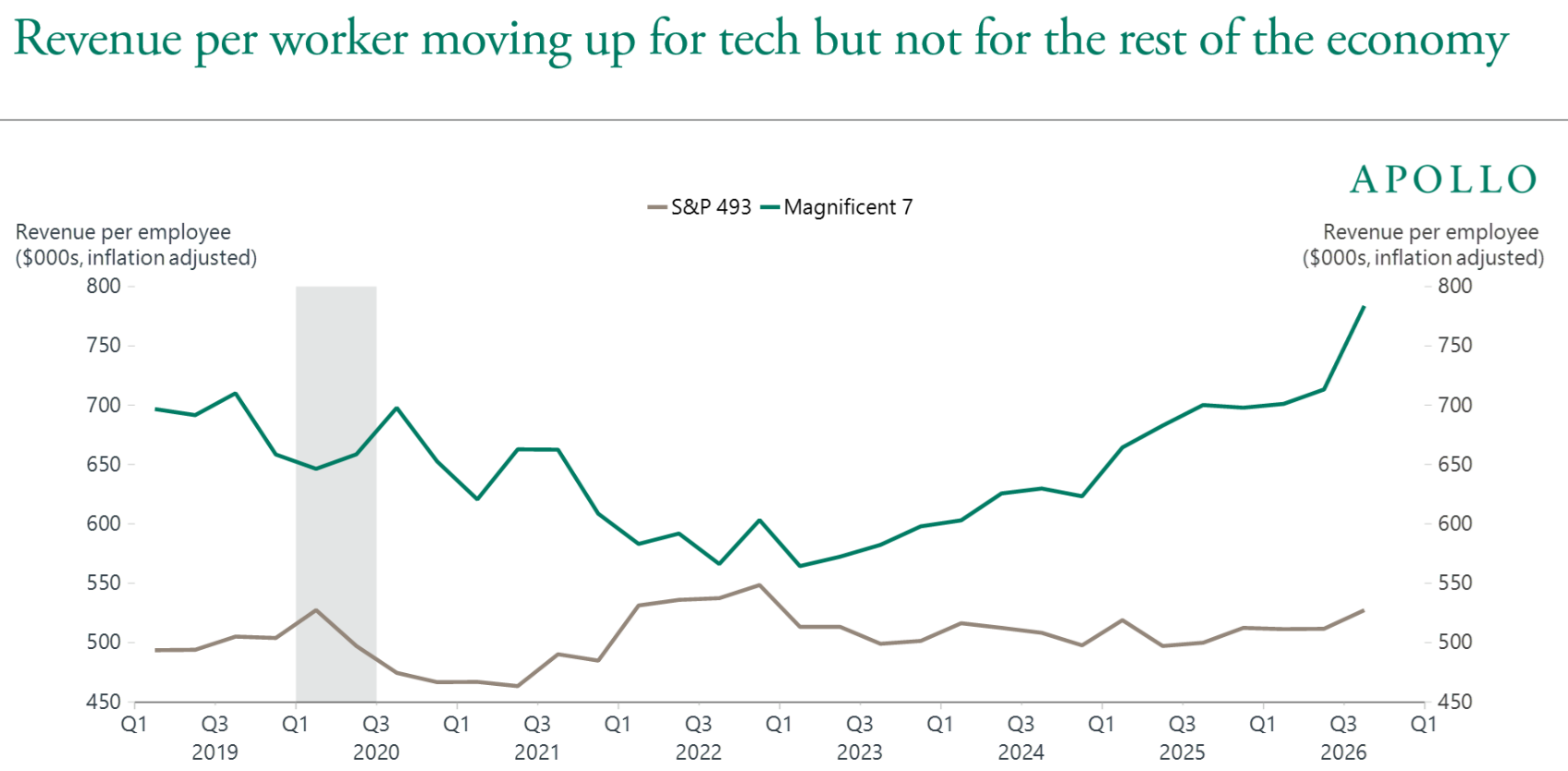
At the technology firms, revenue per employee climbed from roughly $550,000 in 2022 to nearly $800,000 in the current year, according to Apollo's findings. In contrast, the S&P 493 has experienced virtually no change, remaining around $550,000 since 2019.
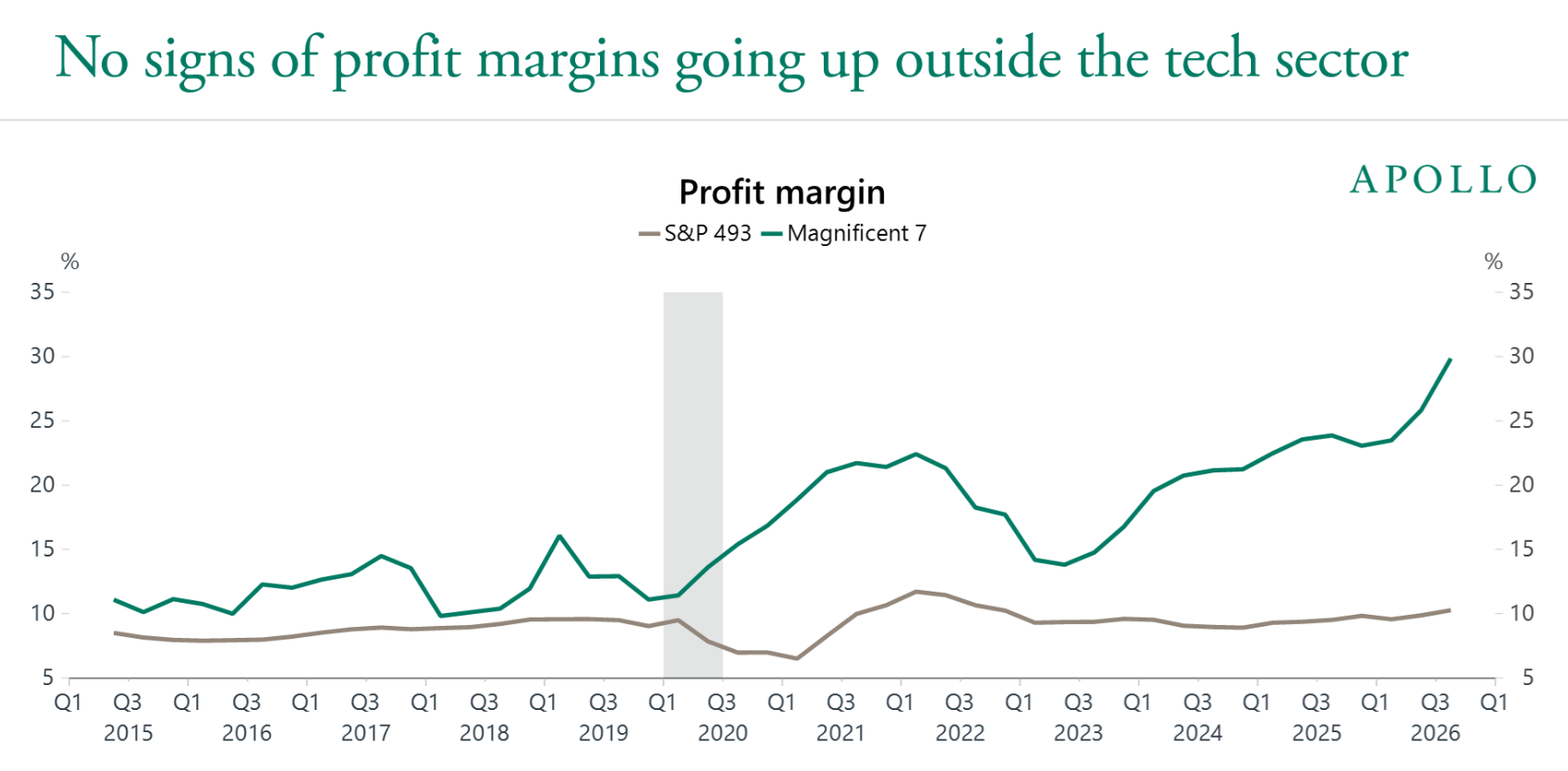
Profit margins paint an analogous picture. The technology firms have seen margins expand significantly beginning in the third quarter of 2023, whereas the remainder of the market has remained essentially unchanged.
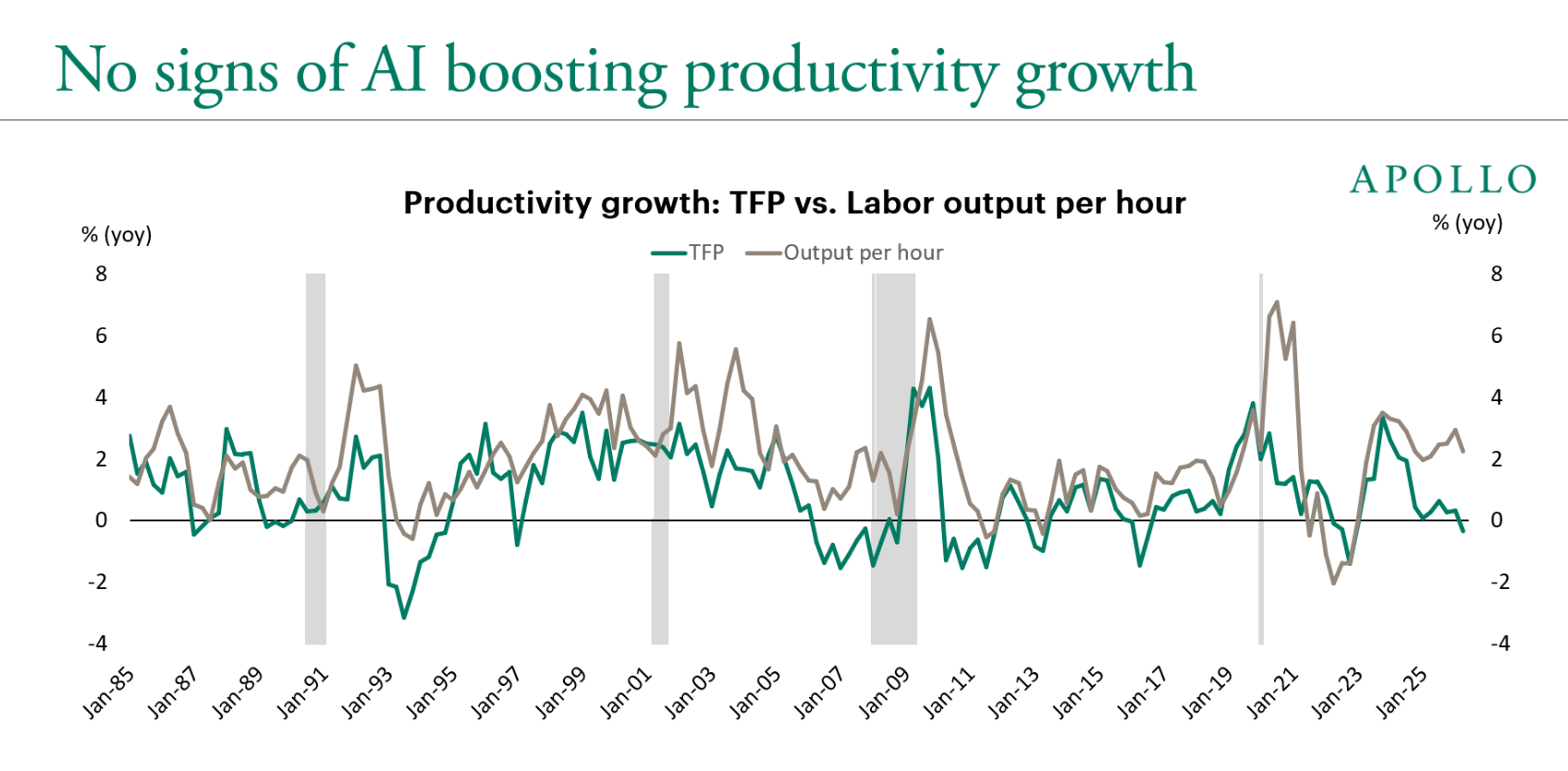
Productivity growth data presents a more complex picture but similarly demonstrates that AI has delivered minimal impact in enabling companies to accomplish more with existing resources, contrary to the optimistic projections of many AI advocates.
The findings challenge assertions from those predicting that AI will usher in an "age of abundance," where workers dedicate less time to employment and more to personal pursuits. While certain venture capital-funded startups are bucking the trend by expanding AI token expenditures, established corporations are increasingly reluctant to do so, Slok noted.
"Mainstream corporate America does not need the latest model and is unwilling to pay for it," Slok stated. "As long as agentic AI and token spending are confined to a small part of the economy, the macroeconomic effects of AI will be very limited."
The challenge of judgment
Some observers might attribute the lag among non-technology firms to a simple innovation gap, but Slok rejected this explanation, arguing that merely allocating resources to AI does not guarantee positive outcomes. "The question looking ahead is whether, even as models become commoditized, mainstream corporate America can turn increasingly cheap intelligence into higher revenue growth and higher profit margins," he wrote. "That may be harder than it sounds."
The fundamental obstacle, according to Slok, stems from the nature of business decision-making, which fundamentally depends on judgment. While AI excels at computation, analysis and content generation, judgment demands extensive contextual understanding, and responses frequently depend on which individual or system provides the answer. Before AI can be reliably deployed in business contexts, it must resolve substantial hurdles, Slok explained, encompassing comprehension of organizational culture, responsibility frameworks, moral considerations, equity principles and confidence—all of which bear on brand perception and influence financial performance.
"The bottom line is that the AI story will be decided in the S&P 493, not the Magnificent Seven, and so far there is no evidence that revenue growth or margins are improving outside of the tech sector," Slok concluded.
Read more

The Government Rebranded AI as 'Super Intelligence.' Your Tech Stack Didn't Change.
A White House executive order swaps terminology across federal agencies, but the underlying technology remains identical. For CIOs, the real risk lies in procurement and governance, not semantics.

Why enterprises are turning Wi-Fi into indoor location intelligence
Satellite GPS stops at the roofline, leaving indoor spaces unmapped and AI systems without real-time context. Most organizations already own the network infrastructure needed to solve this problem.

Identity Security Must Adapt as AI Agents Operate Across Enterprise Systems
Okta's Oktane event revealed that securing AI agents requires shared architecture, cross-vendor cooperation and runtime controls that extend identity management beyond initial login.