Xsight Labs Secures $300M to Scale AI-Ready Networking Chips
The Israeli startup has closed a major funding round valuing it at $2.8 billion, with plans to expand its power-efficient Ethernet switches and data processing units across cloud and AI infrastructure.

Xsight Labs Ltd., an Israeli developer of programmable networking semiconductors, announced the completion of a $300 million financing round that values the company at $2.8 billion. The capital will support efforts to deepen market penetration for its lineup of programmable Ethernet switches and 800-gigabit data processing units targeting cloud and artificial intelligence deployments.
Fidelity Management & Research Co. led the round, with backing from Aliya Capital Partners, Atreides Management, Artisan Partners, Battery Ventures, Diagonal Capital, Intel Capital, Key1 Capital, Maverick Capital, Sienna, T. Rowe Price, Union Group and Valor Equity Partners.
The investor consortium is betting on a straightforward thesis: the AI data center networking sector will expand to a $150 billion market by 2028, and Xsight's focus on power efficiency and programmable architecture positions it to capture meaningful market share during this expansion.
Core Products and Technical Differentiation
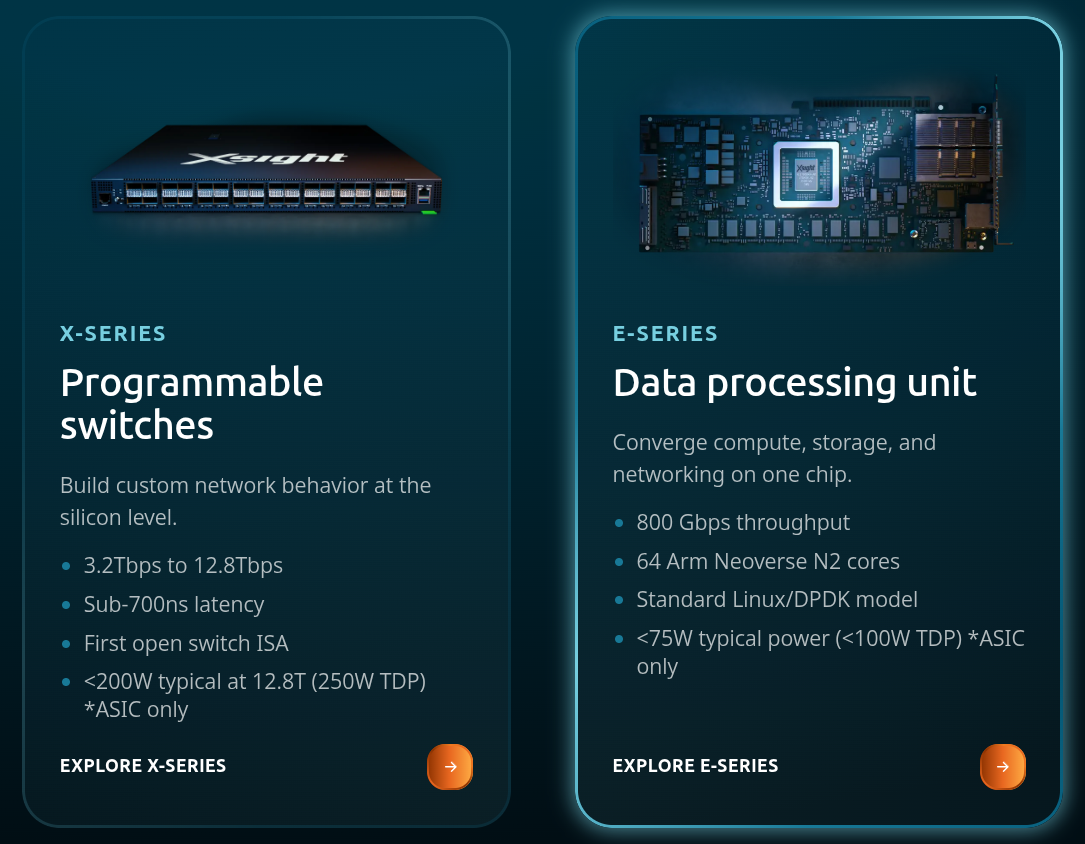
Founded in 2017 and headquartered in Tel Aviv, Xsight manufactures two primary networking components for data center environments: the E1 data processing unit and the X2 Ethernet switch, both engineered for AI-specific connectivity requirements. The company distinguishes itself through power efficiency—its 12.8 terabit-per-second switch operates at under 200 watts—and through software programmability that enables customer-driven customization rather than fixed-function designs.
The E1 integrates two 400G ports with 64 Arm-based Neoverse N2 cores manufactured on a 5-nanometer process, alongside 32 megabytes of shared cache. The chip includes PCIe Gen5 connectivity and line-rate encryption engines. Its distinguishing feature places all 64 cores directly on the data pathway, enabling routing, telemetry and packet inspection to occur on every packet rather than being delegated to a smaller exception-handling engine. This architecture delivers four times the performance per watt compared to previous-generation designs and has achieved SONiC-DASH Hero 800G validation, sustaining over 14 million connections per second without packet loss.
The X2 switch delivers 12.8 terabytes of full-duplex bandwidth at under 200 watts, with first-bit-to-first-bit latency below 700 nanoseconds and 128 lanes of 100G PAM4 SerDes. Its reprogrammable data plane permits real-time reconfiguration for different network applications. According to Xsight, the X2 consumes 40 percent less power than competing 12.8 Tbps switches.
In AI data center environments, where accelerator chips consume the majority of the power budget and cooling resources, network fabric power consumption represents pure overhead. Xsight emphasizes that the E1's performance-per-watt advantage directly addresses this constraint.
Market Traction and Competitive Positioning
SpaceX Corp. represents Xsight's most prominent customer to date. The company disclosed last year that the X2 was selected as the core high-speed networking component for Elon Musk's Starlink V3 satellites, which will handle over 1 Tbps of fronthaul traffic and approximately 160 gigabytes-per-second of uplink capacity. Beyond raw performance, the selection reflected the switch's capability to function in radioactive environments and extreme thermal conditions.
The E1 and X2 have been deployed by multiple data center operators worldwide in edge and network infrastructure roles, with several Tier-1 hyperscalers currently evaluating the products. "This valuation is a testament to the team's relentless execution and reflects the market need for a high-performance alternative to closed, legacy architectures," stated co-founder and Chief Executive Yossi Meyouhas.
Xsight intends to expand engineering teams across facilities in Israel, the U.S., Europe and Asia while increasing manufacturing and supply chain capacity to serve tier-1 customers. The company is developing next-generation versions of both products with support for standards established by the Ultra Ethernet Consortium.
Ethernet connectivity is narrowing the performance gap with proprietary interconnects that currently dominate AI chip cluster links. The Ultra Ethernet Consortium released its 1.0 specification last year, defining remote-memory-access transport with multipath routing and congestion control optimized for AI training and inference workloads. Xsight notes that the X2 ranks among the first switches to meet this new standard.
Established competitors including Cisco Systems Inc., Broadcom Inc and Marvell Technology Inc. control substantial portions of the data center networking market. The critical question remains whether Xsight's lower power consumption and competitive cost per token processing can overcome these incumbents' entrenched customer relationships and comprehensive product ecosystems.
Read more
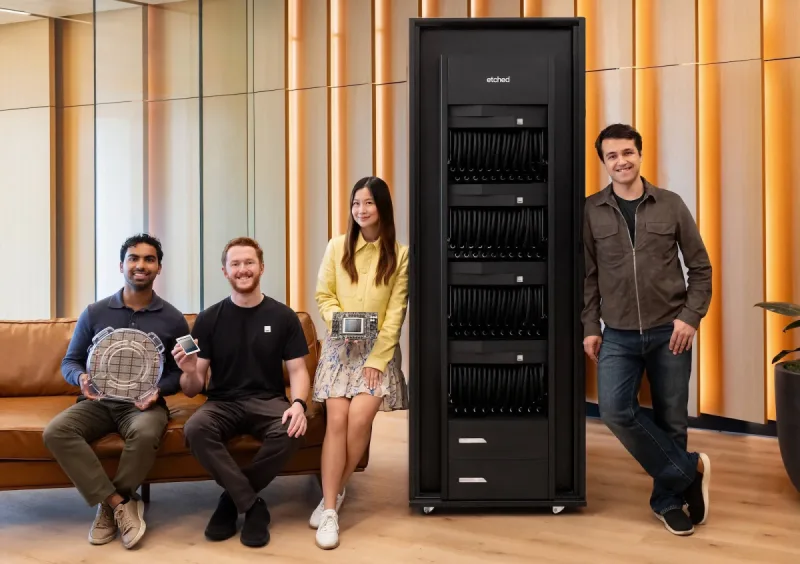
Etched's Valuation Doubles in Months as VCs Bid $40B–$50B for AI Chip Maker
The startup that raised $700 million at a $21 billion valuation just weeks ago is now fielding investment offers valuing it at double or more, as investors race to back its challenge to Nvidia's dominance in AI hardware.

Menlo's Factory bet signals confidence amid founder clash with Khosla
Menlo Ventures has invested in AI coding startup Factory as part of its latest funding round at a $5 billion valuation, a move that carries weight beyond typical round extensions given the company's recent public dispute with prominent investor Vinod Khosla.

Venture funding hits $679 billion in first nine months of 2026 as AI startups dominate
Global venture investment reached $159 billion in Q3 2026, with a record 27 companies closing billion-dollar rounds as artificial intelligence companies continue to attract the vast majority of capital.