Tiny Health Closes $33M Series B to Scale Microbiome Testing Beyond Infants
The Austin-based startup, founded after its CEO noticed differences in her children's early microbial exposure, is expanding its gut-testing platform into enterprise partnerships and predictive health research.
Cheryl Sew Hoy's observation of her daughter's eczema, allergies and food sensitivities—contrasted with her son's absence of these conditions—sparked a question about the role of early microbial exposure. Her daughter had been delivered via C-section; her son was born vaginally. The divergence led her to explore microbiome research and, ultimately, to start a company.
"I learned that you can course-correct if you focus on the early life of the baby. If they're missing certain beneficial bacteria, it can really cause a lot of issues for the infant," Sew Hoy recalls. "I was reading all this literature and asked my doctors about it, and none of my doctors knew what I was talking about."

One week after her son's birth in 2020, Sew Hoy incorporated Tiny Health in Austin. The company announced a $33 million Series B funding round led by B Capital. The round brings total funding to $46 million, following a $4.5 million seed round in 2021 and an $8.5 million Series A in late 2023. Returning investors Spero Ventures, The Venture City and Overwater Ventures participated alongside new backers Black Opal Ventures and Alumni Ventures. B Capital's Nick Whitehead will take a board seat.
Tiny Health's at-home microbiome tests are seeing accelerating demand. The startup's overall revenue has more than doubled year-over-year, according to Sew Hoy. Its B2B division, Powered by Tiny, which distributes tests through healthcare providers and other companies, grew fourfold in the past year. Sew Hoy declined to share specific revenue or valuation figures, though she noted the valuation is "much higher" than the Series A.
From infant testing to broader health screening
Tiny Health spent two years building its platform before launching an at-home baby gut test in 2022. Healthcare was unfamiliar terrain for Sew Hoy, whose previous venture, digital coupon platform Reclip.It, was acquired by Walmart Labs in 2013. Before securing seed funding, she invested $50,000 of her own capital into an initial study and spent roughly a year collecting stool samples and developing the platform.
The infant test served as a clear market entry point. Sew Hoy saw parents of children with conditions like eczema seeking explanations for their causes, while clinicians lacked practical tools to apply emerging microbiome science. Though Tiny Health also offered pregnancy, vaginal microbiome and adult tests, it initially concentrated on infant testing. Adult testing has since become its largest segment, Sew Hoy said.
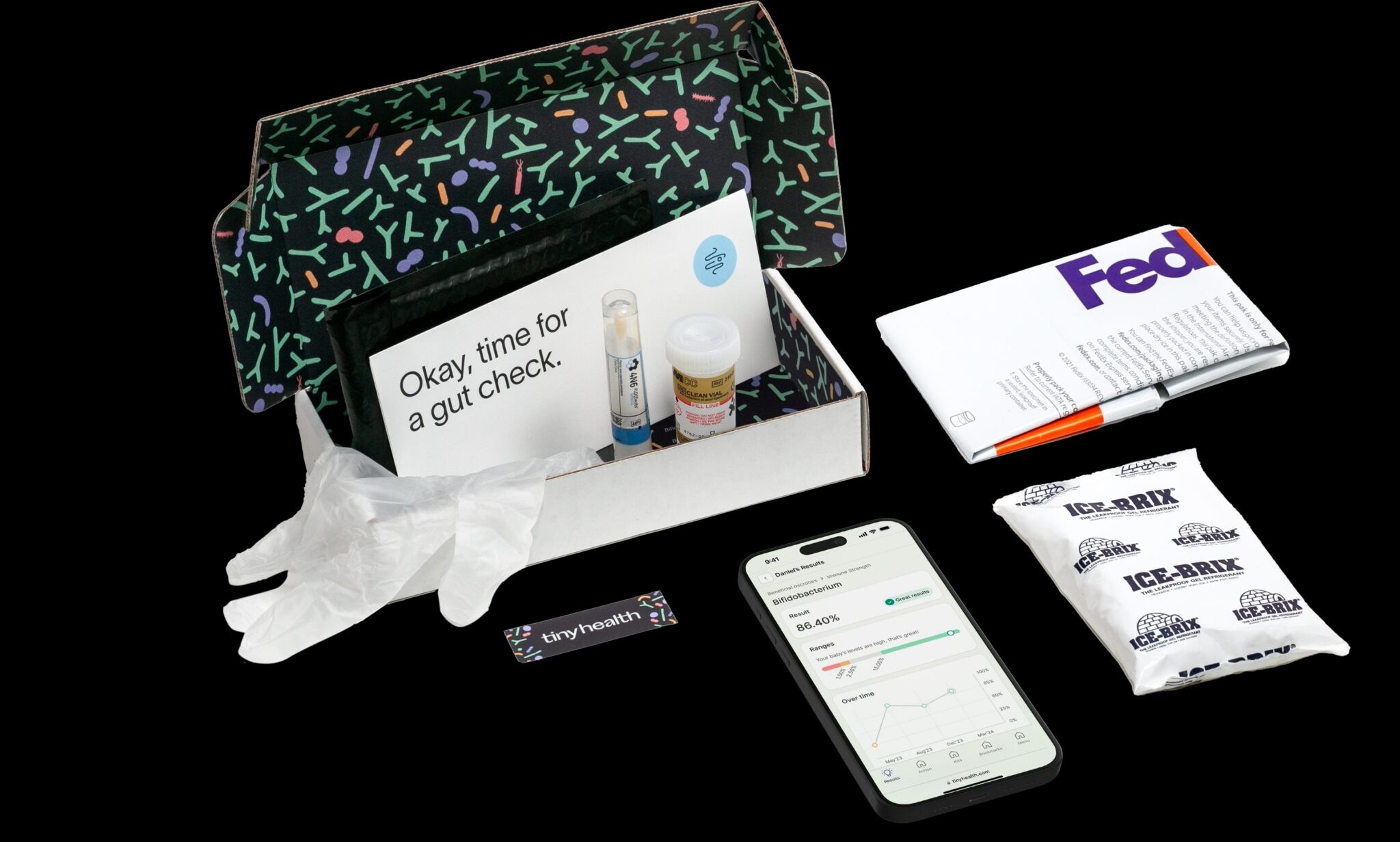
The process is straightforward: customers collect a small stool sample using a swab, mail it in, and receive a report detailing detected microbes along with explanations and recommended next steps. Tiny Health also offers Tiny Plus, a subscription that includes a baseline test and a follow-up retest.
Sew Hoy points to shotgun metagenomic sequencing as a key competitive advantage. This method analyzes microbial DNA more comprehensively than tests targeting a limited set of microbes. Chief science officer Kimberley Sukhum, who joined in 2021, oversees scientific operations. Co-founder Donald Koo, who came aboard two years after Sew Hoy started the company, leads technology efforts. Chief medical officer Dr. Elisa Song, an integrative pediatrician who previously consulted for the company, rounds out the leadership.
Reports examine what detected microbes may be doing and suggest actions such as dietary modifications, with links to supporting research.
"We are a wellness test," Sew Hoy said. "We're not a diagnostic … It's very actionable, very evidence-backed."
Insurance does not cover the tests, which can identify microbes in a sample but cannot determine what caused a person's symptoms.
Other companies are pursuing different digestive health strategies. Austin-based Throne Science manufactures a device that attaches to a toilet to track stool patterns and hydration. Tiny Health analyzes microbial DNA from collected samples. Throne recently raised $10 million in a Series A round led by Will Ventures.
B2B expansion outpacing direct-to-consumer
Powered by Tiny, the company's fastest-growing business segment, distributes testing through healthcare providers and companies integrating it into their own offerings. Partners include Superpower, Fullscript and Mayo Clinic's Executive Health and Longevity Programs. The company also works with supplement manufacturers and academic partners conducting clinical studies requiring microbiome measurement.
Customers began sharing their direct-to-consumer results with physicians, according to Sew Hoy. Some clinicians subsequently reached out to Tiny Health seeking help interpreting the reports. The startup now serves more than 6,000 practitioners and provides training on integrating its tests into patient care.
The enterprise business supplies testing to health and wellness companies through technology integrations. As noted, this B2B arm expanded fourfold last year. Scaling both segments, along with clinician training, will be priorities for the new capital.
Nick Whitehead, senior principal at B Capital, told Crunchbase News that his firm sees an opportunity to make microbiome research more actionable for consumers as preventive health interest grows.
We're in the middle of a real shift in how people engage with their own health. Consumers are paying out of pocket for wearables, blood panels, and full-body scans because they want to understand what's happening inside their bodies before something goes wrong. The gut microbiome is one of the most important and least understood pieces of that picture … Tiny Health turns that science into something people can actually act on, and we believe the company that does this well will define the category.
Nick Whitehead, B Capital
Whitehead also highlighted Tiny Health's reputation among clinicians his firm consulted during due diligence.
Tiny Health was consistently the test they rated highest.
Nick Whitehead, B Capital
The company's longitudinal data from families tested since infancy is another draw, Whitehead noted.
Building predictive health tools from sample data
Tiny Health has accumulated nearly 200,000 microbiome samples over time, according to Sew Hoy. The startup is developing a tool called TinyAI that will leverage this data and research vetted by its scientific team to help users interpret their results. The company also uses health information provided by customers, with identifying details stripped, to support this effort.
Looking ahead, Tiny Health aims to identify patterns that could reveal health risks before conditions manifest. Research has linked gut microbiome imbalances to more than 100 diseases.
We want to be able to predict disease before it happens and intervene before it happens.
Cheryl Sew Hoy
A critical open question remains whether microbiome-guided interventions can actually improve health outcomes. Tiny Health reports publishing four scientific papers, including one involving infants, and plans to fund additional research on adults.
The company currently has approximately 40 employees and plans to hire 30 more. New capital will fund expansion of its healthcare provider and corporate partnerships, as well as research into whether microbiome changes can improve health outcomes. The company will allocate $5 million to a program giving researchers and clinical partners access to its testing platform and data.
Read more
Spotify Founder's Health Screening Startup Neko Brings Preventative Medicine to the U.S.
The body-scanning company co-founded by David Ek has arrived in New York with a 300,000-person waitlist and backing from nearly $1 billion in funding.

FieldAI Seeks $700M at $10B Valuation as Robot AI Demand Accelerates
The robotics AI startup is in advanced fundraising talks that would quintuple its valuation from last year, according to sources familiar with the matter.
Tech hiring slows even as employers post record open positions
A surge in IT job listings to three-year highs masks a contraction in actual hiring, with technology sector roles declining and unemployment ticking upward.